A quiet fifteenth-century trading post on the west bank of the Chao Phraya River, under the rule of Ayutthaya, would eventually grow to dominate the entire kingdom of Siam.
On the twenty-first day of April in the year 1782, a massive wooden pillar was driven into the waterlogged soil of Rattanakosin Island, a small peninsula formed by a sharp bend in the Chao Phraya River. To the astrologers and priests who gathered at the muddy water’s edge, this city pillar, the Lak Mueang, was more than a marker; it was the anchor for a new cosmos. To the south and west, the river curled like a protective moat; to the east, a vast marshy plain known as the Sea of Mud stretched toward the horizon. Here, King Phutthayotfa Chulalok, later remembered as Rama I, decreed that the capital of Siam would rise. He was a monarch who had just taken the throne after the deposition of King Taksin, a brilliant but increasingly unstable warrior who had ruled from Thonburi on the river’s opposite bank. Rama I looked across the wide, silt-heavy waters of the Chao Phraya and saw that Thonburi, pinned against the western bank, was vulnerable to Burmese invasion. By shifting his seat to the eastern shore, he placed a formidable aquatic barrier between his crown and his enemies, initiating an era that would transform a defensive outpost of stilted houses into one of the world's most overwhelming urban phenomenons.
The spot was not entirely wild. For centuries, a small agricultural village and customs outpost had stood there, known colloquially as Bangkok—a name likely evoking either a "village on an island" (Bang Ko) or a grove of wild plums (Bang Makok). Yet the official name bestowed upon the new seat of the Rattanakosin Kingdom was an exercise in celestial ambition. It began with Krung Thep Maha Nakhon—the City of Angels—and unspooled into a breathless, ninety-word litany of Pali and Sanskrit descriptors celebrating the city as the home of gods incarnate, built by the divine architect Vishvakarman at the behest of Indra. It remains the longest place name in recorded human history, a vocalization of statecraft meant to signal that although the old capital of Ayutthaya had been utterly destroyed by the Burmese in 1767, its spirit had been reincarnated on this muddy bend of the Chao Phraya.
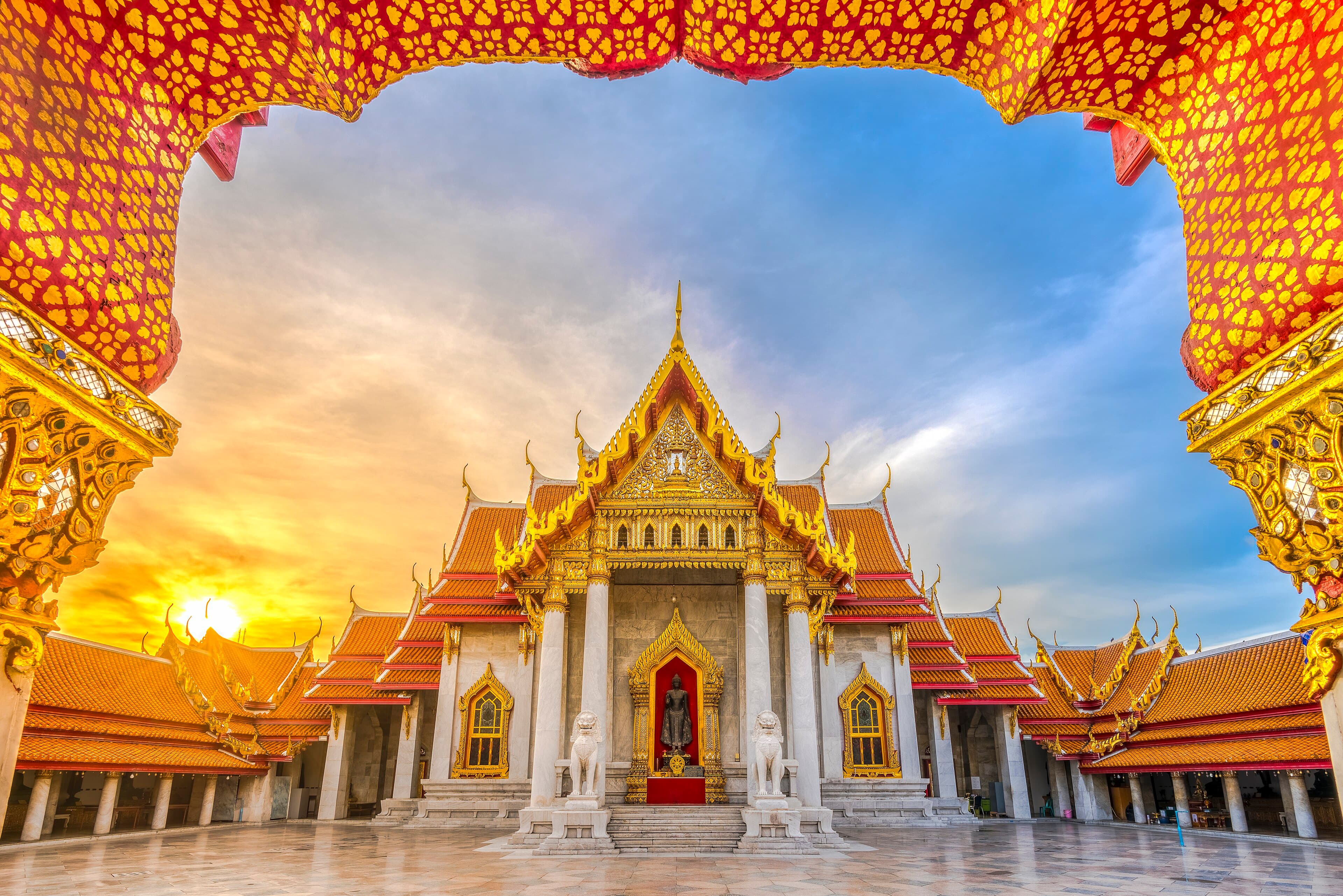
For its first century, Krung Thep was a metropolis of water. Its residents did not walk; they rowed. The city was built not of brick and mortar, but of bamboo, thatch, and teak, anchored to floating pontoons or elevated on slender piles above the tidal mud. Thousands of houseboats lined the riverbanks, rising and falling with the monsoonal breath of the Gulf of Siam. The thoroughfares were an intricate maze of canals—klongs—that served as sewers, transport routes, and marketplaces all at once. At the center of this watery labyrinth rose the Grand Palace, a glittering white-walled compound of gilded spires and multi-tiered roofs clad in green and orange glazed tiles. Within this sanctuary, the King ruled as an absolute monarch, while around him, a highly diverse population of Siamese, Chinese traders, Mon, and representatives of nearly every culture between India and Japan carved out lives on the water. The Chinese, in particular, became the engine of the city’s commerce, handling the heavy trade in rice and teak that flowed down the river to the empires of the East and, eventually, the West.
By the late nineteenth century, the pressures of Western imperialism began to lap at the shores of Siam. Unlike its neighbors in Burma and Indochina, Siam preserved its independence, but doing so required a radical, self-imposed transformation, with Bangkok as its laboratory. Under King Mongkut and his successor, King Chulalongkorn, the city was systematically redesigned to present a face of "civilization" to visiting Western diplomats and merchants. The riparian lifestyle was gradually dismantled. Laborers filled in old canals to pave wide, tree-lined boulevards designed for carriages and, later, the electric tramways that began humming through the streets in the early twentieth century. Well-built brick houses replaced floating shops. The climate itself seemed to react to this massive physical restructuring; as the dense vegetation was cleared and the wetlands drained, the city’s humid air grew noticeably hotter. By the early 1900s, visitors remarked on a city in transition, where the ancient, gilded gables of Wat Arun and Wat Pho stood side-by-side with modern telegraph lines, railway stations, a European-style police force, and Western consulates operating under their own extraterritorial laws.
The twentieth century brought an end to absolute royal rule and thrust Bangkok into the turbulent arena of modern politics. The revolution of 1932, which established a constitutional monarchy, turned the capital's streets into a stage for a long cycle of military coups, student uprisings, and constitutional experiments. During World War II, the city allied with Japan and endured Allied bombing, but the post-war era brought an unprecedented, chaotic boom. Fueled by American aid and investment during the Cold War, and later by Japanese capital during the manufacturing boom of the 1980s, Bangkok expanded with little regard for urban planning. The city's population, which stood at roughly 450,000 in the early twentieth century, swelled to three million by the 1960s, eventually ballooning into a megacity of over eleven million people by the early twenty-first century.
This meteoric rise turned Bangkok into an extreme primate city—a sprawling urban giant that completely dwarfs every other town in Thailand in population, economic output, and political influence. The watery world of the nineteenth century was paved over entirely, replaced by a hyper-dense jungle of concrete flyovers, towering skyscrapers, and an extensive expressway network that proved permanently inadequate for the millions of private cars choking the streets. The city became globally notorious for its crippling traffic jams and the smog that hung over its canyons of glass. Yet, true to its history of adaptation, Bangkok met these crises by building upward and downward, weaving modern elevated skytrains and underground rail lines through its ancient skyline.
Today, Bangkok is a place of profound dualities, where the sacred and the profane, the historical and the hyper-modern, exist in a state of permanent, high-velocity friction. It is a regional hub of finance, healthcare, and pop culture, where multinational headquarters look down upon street-food stalls operating on the cracked pavements below. Tourists from every corner of the globe flock to the city, drawn by a sensory overload that ranges from the quiet, incense-laden air of Buddhist temples to the neon-drenched nightlife districts of Khaosan Road and Patpong—the latter a legacy of the city's days as a rest-and-recreation destination for American soldiers during the Vietnam War.
As the waters of the Chao Phraya continue to slip past the foundations of the Grand Palace toward the sea, the city remains anchored by the same Lak Mueang driven into the mud in 1782. Bangkok has repeatedly demolished and rebuilt itself, shifting from a defensive riverine fortress to a cosmopolitan trading port, and finally to a towering modern megacity. It stands as a monument to Siam's remarkable ability to absorb the pressures of the wider world, translate foreign influences into its own distinct vernacular, and remain, against all odds, entirely itself.
+ 12 further connections to entries not yet ingested