In the late fifteenth century, amid the fertile plains of the Punjab, a spiritual path emerged that defined itself not by conversion or the possession of exclusive truth, but by the lifelong pursuit of learning.
The Punjab of the late fifteenth century was a land defined by its borders, a fractured green plain where the expanding horizons of Islamic Sufism met the ancient, structured landscape of Hindu devotion. In 1469, in the village of Talwandi near Lahore, a child named Nanak was born into the Khatri caste. He arrived in a world already vibrating with the quiet rebellions of wandering mystics—the poet Kabir, who mocked the hypocrisy of both temple and mosque, and the saint Ramanand, who had begun to dismantle the walls of caste among his disciples. But where others saw a conflict of rival dogmas, Nanak experienced a singular, dissolving clarity. Following a period of deep meditation, he emerged with a simple, revolutionary pronouncement that bypassed the theological battle lines of his era: "There is no Hindu, there is no Mussalman."
This was not a call for syncretism or a casual blending of faiths, but a radical assertion that God transcended the human vocabulary of division. Nanak spoke of Ik Onkar, the One Supreme Reality, a singular, formless, and all-pervading spirit (Nirankar) that was simultaneously within everything and entirely beyond time (Akal). To Nanak, the ultimate purpose of human existence was not to secure passage to a distant heaven or to escape to a quietist nirvana, but to achieve jivanmukti—liberation and spiritual enlightenment within one's own lifetime. The primary barrier to this union was haumai, the blind ego, which bound the soul to maya, the temporary illusion of the material world. This illusion was not the physical world itself, but the false values humans mapped onto it, driven by the panj chor, the "five thieves" of lust, anger, greed, attachment, and pride. The remedy Nanak offered was deceptively simple: nam simran, the continuous, meditative remembrance of the divine name, and a life of active, ethical engagement. "Truth is the highest virtue," he famously observed, "but higher still is truthful living."
This philosophy rejected the spiritual efficacy of asceticism, empty ritual, and caste segregation. Rather than retreating to the mountains to find God, Nanak insisted that the spiritual life must be lived within the secular household. He walked thousands of miles across southern Asia, preaching that every human being, regardless of birth, possessed the eternal right to seek divine knowledge. To ground this radical equality in daily practice, his successors instituted the langar, a community kitchen where prince and peasant, Brahmin and untouchable, were required to sit side by side in rows on the ground and eat the same food.
+ 6 further connections to entries not yet ingested
The movement Nanak initiated was defined by the concept of the Guru—not merely a human teacher, but the very voice of the spirit guiding humanity from darkness to light. Before his death in 1539, Nanak chose his disciple Lahina as his successor, renaming him Angad, meaning "my own limb." According to Sikh tradition, when Angad was chosen, Nanak’s spiritual light was transferred to him, beginning a lineage of ten human Gurus who were seen as containing the same singular, divine spirit in different bodies. Guru Angad standardized the Gurmukhi script, rescueing local dialects from the preserve of elite priestly languages and committing the early teachings to a script that anyone could learn to read.
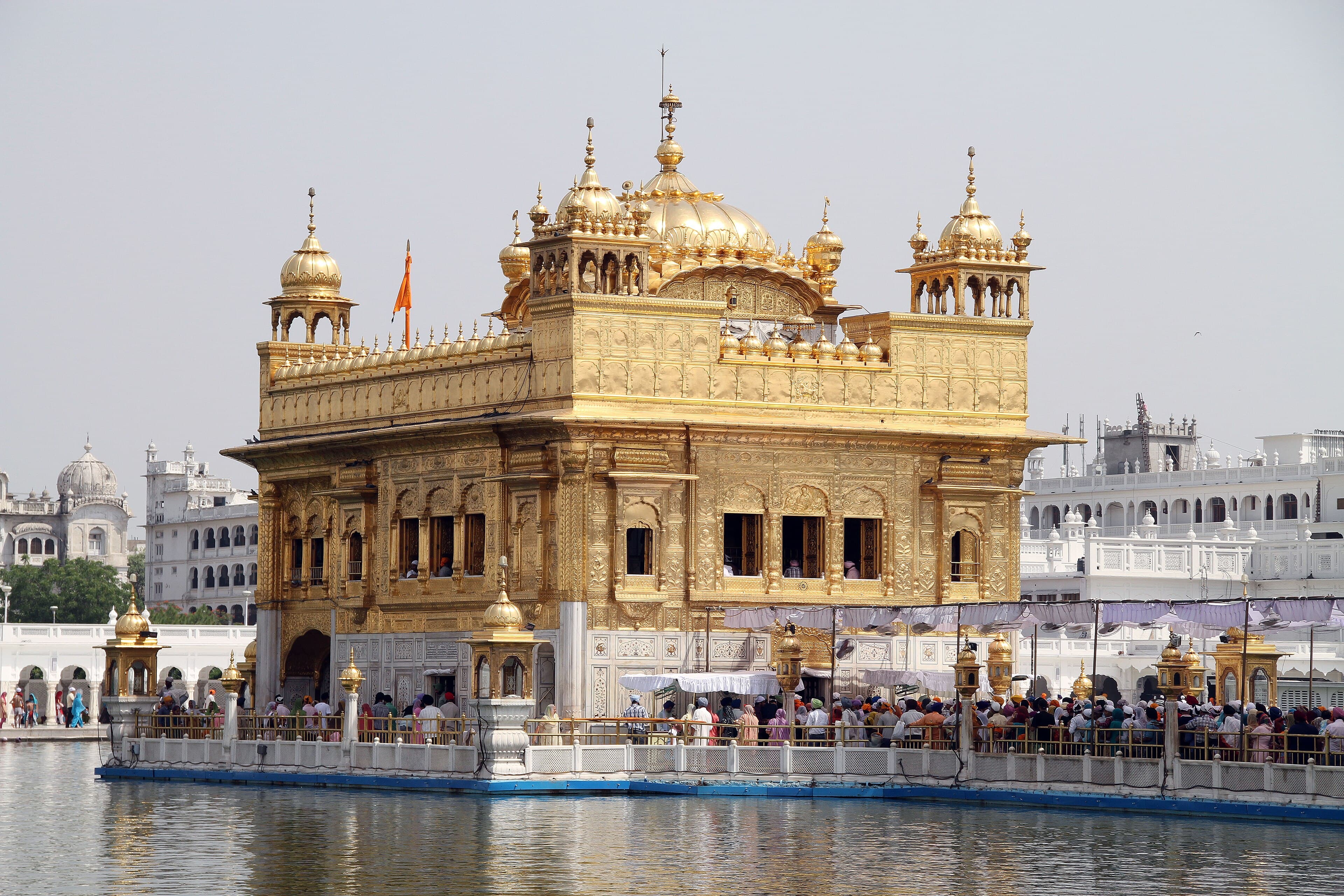
As the community of Sikhs—a word meaning "disciples" or "learners"—grew, successive Gurus systematically built the infrastructure of a new society. The third Guru, Amar Das, championed the dignity of women, speaking out against the practice of suttee (the immurement or burning of widows) and demanding that women participate fully in the spiritual life of the community. The fourth, Guru Ram Das, excavated a sacred clay pool that would become the spiritual heart of the faith, founding the city of Amritsar around it. His successor, Guru Arjan, completed the construction of the Harmandir Sahib (the Golden Temple) in the center of this pool, designing it with four doors facing every direction to signify that all people, from any corner of the earth, were welcome. Arjan also compiled the Adi Granth, assembling the hymns of the Sikh Gurus alongside the verses of Hindu and Muslim saints like Kabir and Baba Farid, cementing a scripture that mirrored the universalist vision of the faith.
However, the rapid growth of this distinct, self-governing community in the strategic borderlands of the Punjab eventually drew the suspicious gaze of the Mughal Empire. The era of philosophical quietism was forced to confront the harsh realities of imperial power. In 1606, Emperor Jahangir ordered the arrest and execution of Guru Arjan, who was tortured to death after refusing to convert to Islam. This martyrdom marked a pivotal turn in the history of the faith. Arjan’s son, the sixth Guru, Hargobind, girded himself with two swords: Miri, representing temporal, political authority, and Piri, representing spiritual leadership. This was the birth of the sant-sipahi, the saint-soldier. It was an assertion that the spiritual heart must be defended by physical courage, and that the struggle for justice in the material world was an inseparable part of devotion to the timeless God.
The pressure intensified under the reign of Emperor Aurangzeb. In 1675, the ninth Guru, Tegh Bahadur, was publicly executed in Delhi for defending the religious freedom of Kashmiri Hindus who had sought his protection against forced conversion. The duty of preserving the community fell to his young son, Gobind Rai, who would become the tenth and final human Guru, Gobind Singh.
In 1699, during the spring festival of Vaisakhi, Guru Gobind Singh gathered his followers and created the Khalsa—a disciplined fellowship of the pure, dedicated to defending the oppressed and resisting tyranny. He initiated the first five members, the Panj Pyare (the Five Beloved Ones), who came from different castes and regions of India, and then, in a striking display of humility, asked them to initiate him in turn. To eradicate the social hierarchy embedded in family names, all men who joined the Khalsa were given the name Singh (lion) and all women Kaur (princess). Initiated Sikhs were commanded to wear the five articles of faith, known as the Five Ks, which included kesh (uncut hair, kept under a turban as a symbol of acceptance of God's will) and a kirpan (a ceremonial sword, representing the duty to protect the weak).
Before his death in 1708, Guru Gobind Singh declared that the line of living, human Gurus was at an end. He vested the eternal spiritual authority of the faith in the sacred scripture, thenceforth known as the Guru Granth Sahib, and the temporal authority in the Khalsa Panth, the collective community.
Today, Sikhism stands as one of the world’s major independent religions, its twenty-five to thirty million adherents still guided by the living presence they find within their scripture. In a world that often demands conformity or conversion, the Sikh tradition remains distinct in its rejection of any monopoly on absolute truth, refusing to actively proselytize while opening its temples to all. It persists as a philosophy that bridges the gap between the transcendental and the everyday, insisting that the search for the divine is blank and meaningless unless it is accompanied by the struggle for a just, compassionate, and egalitarian world.