Place · 12th c. CE · Indian Ocean Trade
Angkor Wat
- Also known as
- Anghorvata
- Angko Vat
- Angkor
- Angkor Vat
- Angkor Vat
- Angkor Vat
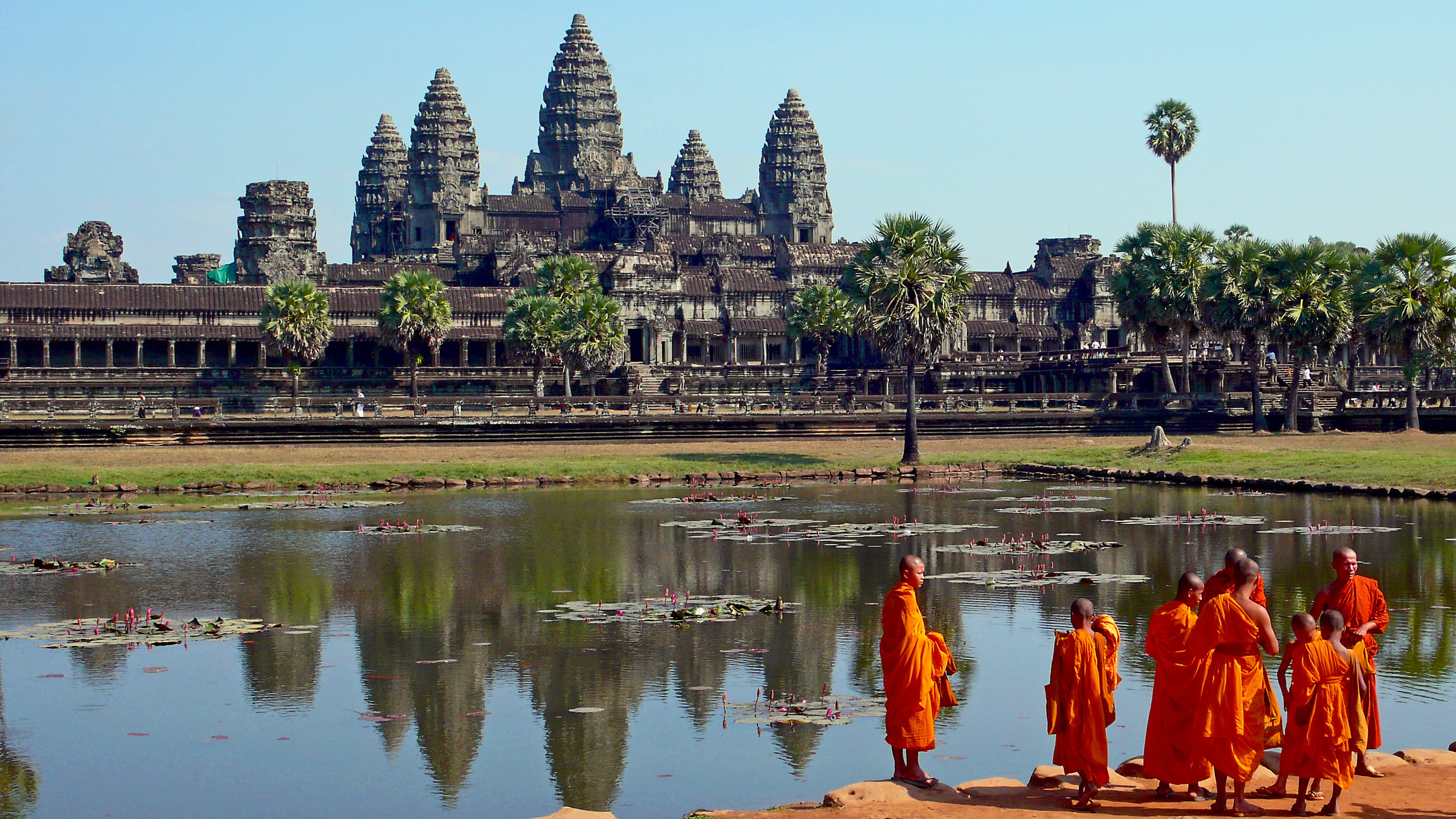
To approach the great monument of Angkor Wat is to confront a cosmic map rendered in sandstone and water.
In the early twelfth century, on a vast alluvial plain near the northern shores of the Tonle Sap lake, a city of stone began to rise from the Cambodian jungle. It was not built merely to house a court or to defend a frontier, but to anchor the cosmos. Commissioned around 1122 CE by King Suryavarman II, the monarch who unified the Khmer Empire, the temple-city of Angkor Wat was conceived on a scale that challenged the limits of human engineering and imagination. Its original name was likely Vrah Viṣṇuloka, "the sacred dwelling of Vishnu"—or perhaps Parama Viṣṇuloka, a posthumous reference to Suryavarman himself as "the king who has gone to the supreme world of Vishnu." This was a space where the boundary between the divine sovereign and the preserver of the universe was deliberately dissolved. Unlike the vast majority of Angkorian temples, which face east to greet the rising sun, Angkor Wat was oriented toward the west. Because the west is traditionally associated with the setting sun and the afterlife, scholars have long concluded that the grand monument was intended from its inception to serve as Suryavarman’s grand mausoleum, a stone threshold through which his spirit would transition into eternity.
To understand Angkor Wat is to understand Mount Meru, the sacred five-peaked mountain of Hindu and Buddhist cosmology that stands at the center of the universe. The Khmer architects did not merely represent this cosmology; they translated it literally into stone and water. The entire complex, stretching across more than one hundred and sixty hectares, is encircled by a broad moat over one hundred and ninety meters wide, representing the cosmic oceans that border the edge of the world. Within this watery perimeter lies a massive outer wall, enclosing three progressively elevated galleried terraces that lead the eye upward to a central quincunx of five soaring, lotus-bud towers. This layout combined two classic forms of Khmer architecture: the temple-mountain, which symbolized the cosmic peaks, and the galleried temple, which offered shaded walkways for ritual circumambulation. Though once imagined as an empty sanctuary tended only by a handful of priests, modern archaeological analyses suggest that the interior of this sacred enclosure was a bustling urban ecosystem, housing a permanent resident population of between three thousand and forty-three hundred people who lived, worked, and prayed within the shadow of the central towers.
Every square inch of this stone mountain was treated as a canvas for the sacred. The walls of the galleries are wrapped in extensive, intricately carved bas-reliefs and populated by thousands of devatas—celestial female deities who appear to glide across the sandstone surfaces. These carvings, though masterfully detailed, remain frozen in a state of suspended creation; when Suryavarman II died around 1150 CE, construction abruptly ceased, leaving several sections of the bas-relief decorations forever unfinished. The king’s grand design was soon tested by the volatile geopolitics of mainland Southeast Asia. In 1177 CE, roughly twenty-seven years after Suryavarman’s death, the Chams—the traditional maritime rivals of the Khmer—sacked the capital of Yaśodharapura. The empire was shattered, but only briefly. The charismatic Khmer ruler Jayavarman VII restored order, establishing a fortified new capital just to the north at Angkor Thom, with the Buddhist Bayon temple as its centerpiece. Influenced by his devout Mahayana Buddhist wife, Indradevi, Jayavarman converted the state religion. Over the decades that followed, Angkor Wat underwent a slow, profound metamorphosis. It was gradually converted from a Vaishnava Hindu temple into a Theravada Buddhist sanctuary. Many of its original Hindu sculptures were carefully replaced or modified, and by the late thirteenth century, the transition was complete.
Yet, as the political gravity of Cambodia shifted southward in the centuries that followed, leading to the fall of the capital to the Ayutthaya Empire in 1431 CE, Angkor Wat defied the fate of the surrounding metropolis. While the grand wooden palaces and sprawling neighborhoods of the ancient capital decayed and were reclaimed by the forest, the great stone temple was never completely abandoned. It remained an active, breathing center of Theravada Buddhist worship. To protect their sacred sanctuary against the encroaching threats of the Ayutthaya, the remaining inhabitants modified the complex, transforming it into a defensive fortification by blocking gateways and cutting defensive holes into the outer walls. Throughout this period of regional realignment, the temple’s grand ponds were regularly cleared and maintained. By the seventeenth century, its reputation as a site of immense spiritual power had reached far beyond the borders of Cambodia. Japanese Buddhist pilgrims made the arduous journey across the seas, establishing small settlements alongside the local Khmer population. Among them was the pilgrim Ukondayu Kazufusa, who left an inscription recording his celebration of the Khmer New Year at Angkor Wat in the spring of 1632 CE.
For Western eyes, the encounter with this colossal survivor of the medieval world was nothing short of bewildering. In 1586, the Portuguese Capuchin friar António da Madalena became one of the first Europeans to walk its galleries. He was so struck by its architectural harmony that he confessed to the historian Diogo do Couto that it was "not possible to describe it with a pen, particularly since it is like no other building in the world." Nearly three centuries later, in 1860, the French naturalist Henri Mouhot, guided by the French missionary Father Charles-Émile Bouillevaux, "rediscovered" the temple amidst the dense northern forests. Mouhot’s romantic, posthumously published travelogues painted the ruins as a rival to the Temple of Solomon, built by "some ancient Michelangelo." Captivated by this artistic legacy, France established a protectorate over Cambodia in 1863, eventually invading Siam to reclaim the northwestern provinces of Siem Reap, Battambang, and Sisophon, which had been under Siamese rule since 1795. Early colonial excavations yielded a haunting paradox: while the stone temples stood in majestic defiance of time, there were no ordinary dwellings, cooking utensils, weapons, or items of clothing to be found. The mortal city of wood and thatch had dissolved back into the earth, leaving only the immortal city of the gods.
The twentieth century brought both restoration and ruin. In 1908, the École française d'Extrême-Orient established the Conservation d'Angkor to clear the strangling jungle growth and stabilize the sagging masonry. This painstaking work was shattered in the 1970s by the arrival of the Cambodian Civil War and the brutal regime of the Khmer Rouge. Although the physical damage to Angkor Wat was mercifully limited compared to other Khmer ruins, the human cost was absolute; the conservation projects were abandoned, and the Conservation d'Angkor was disbanded in 1975. Khmer Rouge forces camped within the ancient galleries, burning what remained of the temple's historic wooden elements for firewood, while skirmishes with Vietnamese forces left bullet holes peppered across some of the priceless bas-reliefs. The end of the war in the late 1980s brought a different kind of devastation: art thieves systematically pillaged the site, lopping off heads of statues and carving out reliefs to supply the international black market.
The resurrection of Angkor Wat became an international endeavor. Between 1986 and 1992, when western nations refused to recognize the Cambodian government, the Archaeological Survey of India stepped in to conduct vital, if later criticized, stabilization work using chemical washes and cement. In 1992, UNESCO declared Angkor a World Heritage Site, initially placing it on the "Danger" list until global preservation efforts could be coordinated. Today, Angkor Wat stands not as a dead relic of a lost empire, but as the living heart of a nation. It is a symbol of resilience so profound that its iconic five-tower silhouette is emblazoned upon the national flag of Cambodia. Visited by millions of travelers and pilgrims each year, the monument remains exactly what its architects intended nine centuries ago: a bridge between the transient world of humanity and the eternal order of the cosmos.
Connected to
- religionBuddhism
- in countryKhmer Empire802 CE
+ 12 further connections to entries not yet ingested