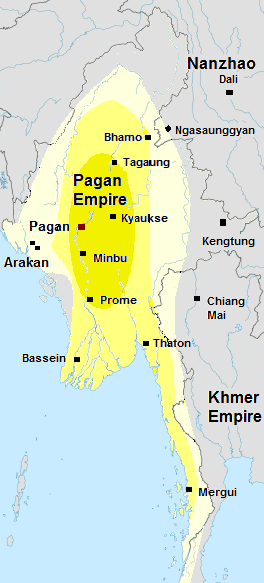
Out of a modest ninth-century settlement along the Irrawaddy River grew a power that would permanently redraw the cultural map of Southeast Asia.
On the arid, sun-bleached plains of the Irrawaddy River’s great bend, in what is today central Myanmar, stand more than two thousand Buddhist temples, stupas, and monasteries. Today, their brickwork is terracotta and ochre under the tropical sun, but eight centuries ago, they were coated in white plaster and capped with gold, shining like a constellation dropped onto the dry earth. This was Pagan—historically known to its neighbors and in classical Pali texts as Arimaddanapura, the "Foe-Crushing City," and Tampadīpa, the "Copper Land." Between the ninth and late thirteenth centuries, this city-state transformed from a dusty settlement of migrant clans into one of the two dominant empires of mainland Southeast Asia, standing shoulder-to-shoulder with the great Khmer Empire to its east. Its rise established the Burmese language, the Bamar identity, and the Theravada Buddhist faith that still shape the region today.
To nineteenth-century court historians, the origins of this empire were ancient, divine, and inextricably linked to India. The Glass Palace Chronicle (Hmannan Yazawin), compiled in 1819, traced Pagan’s royal lineage back to 850 BCE, claiming its founder was Abhiraja of the Sakya clan—the very clan of the Buddha. Defeated in battle by a neighboring Indian kingdom, Abhiraja supposedly fled his homeland to found a dynasty in northern Myanmar. The chronicle claims that the Buddha himself visited the site of Pagan during his lifetime, declaring that a great kingdom would arise there 651 years after his death. Around 107 CE, according to this sacred history, King Thamoddarit established the city, and by 849 CE, a king named Pyinbya fortified its walls.
Modern archaeological and historical reconstruction offers a different, though no less dramatic, story. It was not Indian princes who founded Pagan, but rather the Mranma—the predecessors of the modern Bamar ethnicity. Originally hailing from the high, cold lands of Qinghai and Gansu, the Mranma migrated through the Yunnan-based Nanzhao kingdom. Between the 750s and 830s CE, the militaristic Nanzhao launched repeated, devastating raids against the Pyu city-states, the ancient, literate, and deeply Indianized civilizations that had managed the waters of the Irrawaddy basin for nearly a millennium. In the wake of these attacks, the Pyu urban centers crumbled. Through the mid-to-late ninth century, waves of Burman warriors and their families filtered into the weakened Pyu realm, settling at the strategic confluence of the Irrawaddy and Chindwin rivers. They adopted the naming systems of the Nanzhao kings—where the last name of the father became the first name of the son—but they also absorbed the sophisticated irrigation techniques and deeply entrenched Buddhist culture of the Pyu. This cultural fusion gave birth to the Burmese people.
+ 2 further connections to entries not yet ingested
For more than a century, Pagan remained a modest, localized principality, competing with other riverine city-states. Inscriptional evidence of its early rulers is scarce; prior to the mid-eleventh century, only kings like Nyaung-u Sawrahan and Kunhsaw Kyaunghpyu are verified by contemporary stone carvings. The physical footprint of the state was small, stretching roughly three hundred kilometers north to south and just over a hundred kilometers east to west. Radiocarbon dating suggests that the city’s defensive brick walls were not raised until approximately 980 CE. Pagan was growing, however, and in 1004 CE, its envoys made their first appearance at the Song imperial capital of Bianjing, announced to the Chinese court as representatives of a distinct sovereign power.
The true transformation of this regional principality into a unifying empire began in 1044 CE with the accession of King Anawrahta. Over his three-decade reign, Anawrahta launched a series of military campaigns that consolidated the Irrawaddy valley and its periphery for the first time in history. By the 1050s and 1060s, Pagan’s authority reached south into the upper Malay Peninsula, east to the Salween River, north to the modern borderlands of China, and west into northern Arakan and the Chin Hills. As the state expanded, so too did its cultural hegemony. By the late twelfth century, the Burmese language and Bamar culture had eclipsed the older Pyu, Mon, and Pali administrative norms. Yet this was not a monoculture. The religious landscape was a layered, syncretic tapestry: while Theravada Buddhism slowly spread down to the village level, popular devotion remained deeply intertwined with Vajrayana, Mahayana, Brahmanic, and ancient animist spirit-worship across all strata of society.
The physical expression of this religious devotion became Pagan’s defining feature and, ultimately, its economic undoing. To gain spiritual merit, guarantee favorable rebirths, and display their earthly power, kings, queens, courtiers, and wealthy merchants engaged in a centuries-long building frenzy. Over ten thousand Buddhist temples, stupas, and monasteries were erected in the capital region. These structures were not merely monuments; they were economic entities. To ensure their perpetual upkeep, wealthy patrons donated vast tracts of arable land, along with the labor of agricultural serfs, to the religious authorities. Critically, these religious donations were deeded to the monastic order (sangha) as tax-free in perpetuity.
By the mid-thirteenth century, this system of piety had created a severe structural crisis. Generations of tax-free land donations had concentrated a massive share of the kingdom’s agricultural wealth in the hands of the monastic estates. By the 1280s, the crown found itself starved of the revenues and land grants it desperately needed to command the loyalty of its courtiers, provincial governors, and military servicemen. The state's administrative cohesion began to fray from within, setting off a vicious circle of domestic rebellions and vulnerability to external threats. The Mons, the Shans, and the Arakanese began to assert their independence or raid the weakened borders of the Irrawaddy valley.
The final blow came from the north. The Mongol Empire, having conquered China and established the Yuan dynasty, turned its gaze southward. Between 1277 and 1301, repeated Mongol invasions shattered the military capabilities of the Pagan kingdom. By 1287, the central government collapsed entirely, ending more than four centuries of unified rule. The fall of the empire did not, however, erase its legacy. Though 250 years of political fragmentation followed, lasting well into the sixteenth century, the cultural and political map of the region had been permanently redrawn. The small settlement of ninth-century migrants had successfully forged a unified Burmese identity, established a literary and artistic tradition that would survive centuries of warfare, and anchored Theravada Buddhism as the spiritual heart of mainland Southeast Asia.