Place · 8th c. CE · Indian Ocean Trade
Borobudur
- Also known as
- Barabudhur
- Barabudur
- Barabudur
- Barabudur
- Barabudur
- Barabuḍur
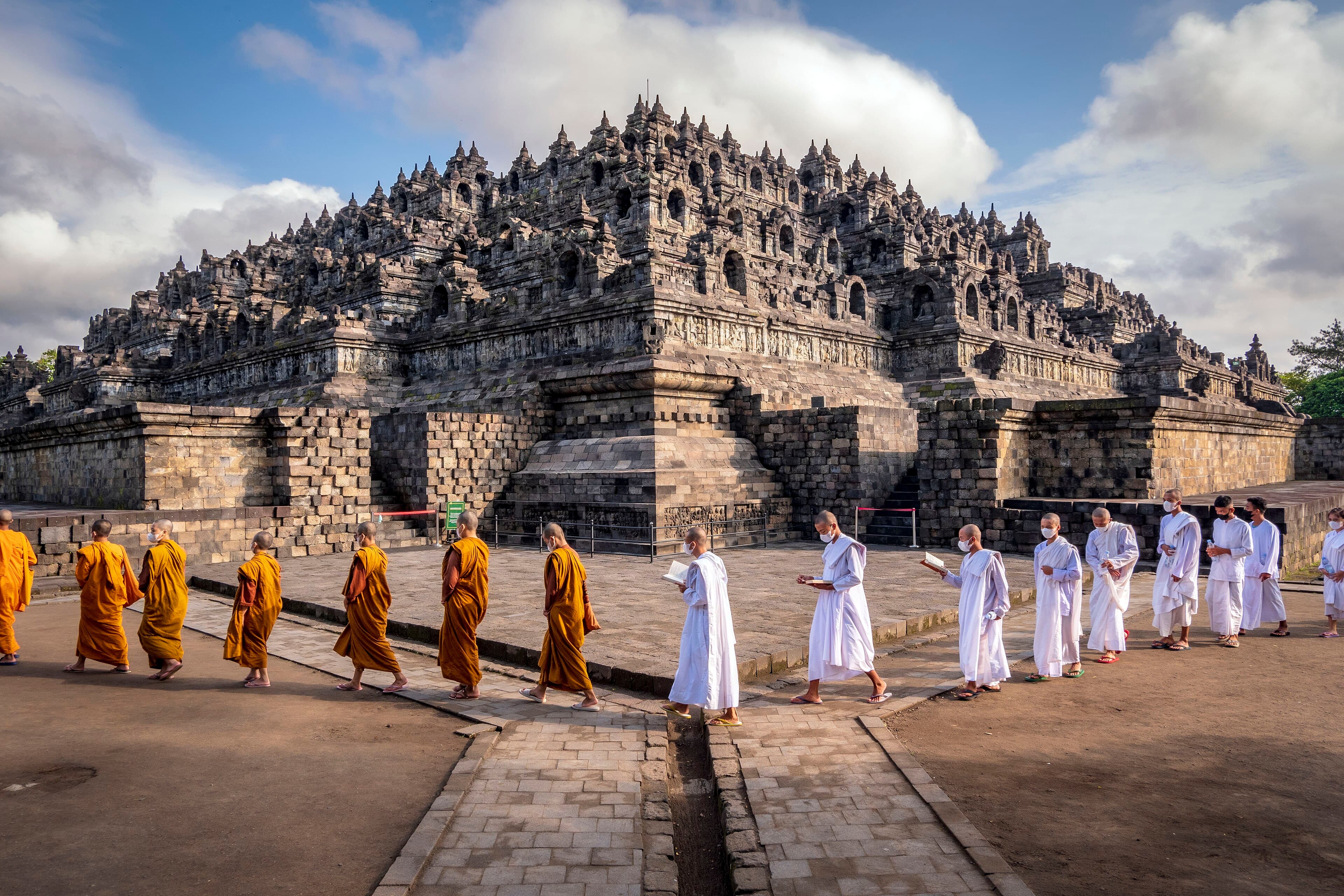
Rising from the volcanic plains of Central Java, Indonesia, is a colossal mountain of gray stone that serves as both a map of the cosmos and a physical path to enlightenment.
High above the fertile Kedu Plain of Central Java, where the twin volcanoes of Sundoro-Sumbing and Merbabu-Merapi stand sentinel over the landscape, sits a massive stone mountain made by human hands. Built around 800 CE from millions of blocks of gray, interlocking andesite, Borobudur is the largest Buddhist temple in the world. It is shaped like a stepped pyramid, yet it functions less like a building and more like a physical map of the human mind on its journey toward the infinite. It is a monument designed to be walked, climbed, and decoded.
To encounter Borobudur is to enter a physical, three-dimensional mandala. The temple consists of nine stacked platforms—six square lower tiers topped by three circular terraces—culminating in a colossal central dome. To the pilgrim, the structure represents the Buddhist universe, divided into three progressive realms of existence. The first is Kamadhatu, the world of desire, which lies hidden at the monument’s very base. Above this rise the square galleries of Rupadhatu, the world of forms, where pilgrims walk between high stone walls carved with astonishingly detailed narrative reliefs. Finally, the pilgrim emerges onto the open, windswept circular terraces of Arupadhatu, the world of formlessness. Here, the narrow, stone-walled corridors vanish, replaced by an expansive view of the Javanese horizon. On these upper terraces sit seventy-two openwork, bell-shaped stupas, their diamond and square lattices partially revealing stone Buddhas seated inside, staring out across the valley.
The creation of this colossus was an extraordinary feat of engineering and statecraft, achieved during the height of the Sailendra Dynasty. Under their patronage, Javanese architects blended classical Indian Buddhist cosmology with indigenous Indonesian traditions of mountain-shaped shrines and ancestor worship. Though modern eyes might expect such a grand Buddhist project to have arisen from religious rivalry, the archaeological record suggests an era of remarkable, peaceful coexistence. Not far from Borobudur, the Hindu Sanjaya Dynasty constructed their own masterworks, including the Prambanan temple compound. Javanese kings frequently patronized the holy sites of their neighbors; indeed, Rakai Panangkaran, a Hindu ruler, granted the land for a Buddhist temple at Kalasan, while Sailendra hands likely assisted in the construction of Hindu shrines.
For decades, scholars debated the exact environment in which Borobudur was built. In 1931, the Dutch painter W.O.J. Nieuwenkamp proposed a poetic hypothesis: that Borobudur had been designed to resemble a giant lotus flower floating on a vast lake that once filled the Kedu Plain. While later geological studies and pollen analyses conducted in the 1970s and 1980s disproved the existence of a lake during the temple's construction, the image of Borobudur as a lotus rising from the earth remains a powerful metaphor for the spiritual awakening it was built to inspire.
The temple’s name itself carries echoes of its ancient purpose. It may derive from Biara Beduhur, a local Javanese corruption of the Sanskrit Vihara Buddha Uhr, meaning "the monastery of Buddha on a high place." Ninth-century stone inscriptions discovered in the region hint at its original royal name. The Tri Tepusan inscription of 842 CE mentions a tax-free sanctuary named Bhūmisambhāra, established to honor the royal ancestors of the Sailendras. Scholars have suggested that the temple's full ancient name may have been Bhūmi Sambhāra Bhudhāra—Sanskrit for "the mountain of combined virtues after the ten stages of Bodhisattvahood."
This mountain of virtue was not merely meant to be admired from afar; it was designed to be experienced through the soles of one's feet. A pilgrim would enter the eastern gateway and begin a circumambulation, keeping the temple wall always to their right. Walking clockwise, they would slowly ascend the stairways, guided through more than three kilometers of corridors flanked by 1,460 narrative relief panels and 1,212 decorative carvings. This is one of the most extensive collections of Buddhist reliefs in the world. The carvings function as a visual library, illustrating the life of the historical Buddha, his previous incarnations, and the journeys of other seekers searching for ultimate wisdom. Originally, 504 serene Buddha statues kept watch over these corridors, their hands held in various mudras, or symbolic gestures, to teach those who walked past.
Yet, for all the labor and devotion poured into its volcanic stone, Borobudur’s era of active glory was relatively brief. By the fourteenth century, the bustling pilgrimage paths had grown quiet. The decline of Hindu-Buddhist kingdoms in Java, coupled with the mass migration of the royal court to East Java following a series of volcanic eruptions under King Mpu Sindok in the tenth century, left the temple increasingly isolated. As the Javanese population gradually converted to Islam in the fifteenth century, the great monument was reclaimed by the wild. Layers of volcanic ash from nearby Mount Merapi settled over the terraces, and the roots of the Javanese jungle took hold, wrapping the stone Buddhas in a dense, green shroud.
Though abandoned as a place of active worship, Borobudur was never truly forgotten by the people who lived in its shadow. Instead, it entered the realm of local folklore and superstition, becoming a place associated with dark forces, bad luck, and political doom. Eighteenth-century Javanese chronicles, such as the Babad Tanah Jawi and the Babad Mataram, recorded the monument's ominous reputation. In 1709, a rebel leader who staged a coup against the King of Mataram was captured near the ruins and subsequently sentenced to death. In 1757, the crown prince of Yogyakarta broke a strict taboo by visiting the site out of pity for "the knight captured in a cage"—a reference to a Buddha statue trapped inside a perforated stupa. Upon returning to his palace, the prince fell suddenly ill and died the following day.
The temple’s long slumber ended in 1814. During the brief British administration of Java, the governor-general, Sir Thomas Stamford Raffles, a man possessed of an insatiable curiosity for Javanese history and antiquities, heard rumors of a colossal monument buried deep in the jungle near the village of Bumisegoro. Raffles dispatched a Dutch engineer, Hermann Cornelius, to investigate. It was a monumental task. For two months, Cornelius and a crew of two hundred workers chopped down ancient trees, burned away thick tropical undergrowth, and shoveled away metric tons of volcanic earth. Slowly, the gray stone terraces emerged from the hillside. Though Cornelius did not clear the entire complex for fear of collapsing the unstable galleries, his drawings and reports, published by Raffles, stunned the global archaeological community.
Subsequent excavations, particularly by the local Dutch resident Christiaan Lodewijk Hartmann in the 1830s, eventually cleared the remaining earth from the site. Yet, the clearing of Borobudur was only the beginning of a long struggle to understand and preserve it. Today, Borobudur stands alongside Bagan in Myanmar and Angkor Wat in Cambodia as one of the twin peaks of Southeast Asian classical civilization. It is a monument that bridges the ancient and the modern: while it attracts millions of secular tourists as Indonesia's most-visited historical site, it has also reclaimed its spiritual purpose. Every year during Vesak Day, the air around the ancient terraces is once again filled with the scent of incense and the low chant of Buddhist monks, their orange robes contrasting against the gray volcanic stone, walking the same ancient, spiral path toward enlightenment that Javanese pilgrims walked over a thousand years ago.
Connected to
- religionBuddhism
+ 10 further connections to entries not yet ingested