Place · Southern Indian Empires
Hampi
- Also known as
- Bhaskara-kshetra
- Conjunto Monumental de Hampi
- Conjunto Monumental de Hampi
- ensemble monumental de Hampi
- Group of Monuments at Hampi
- Hampe
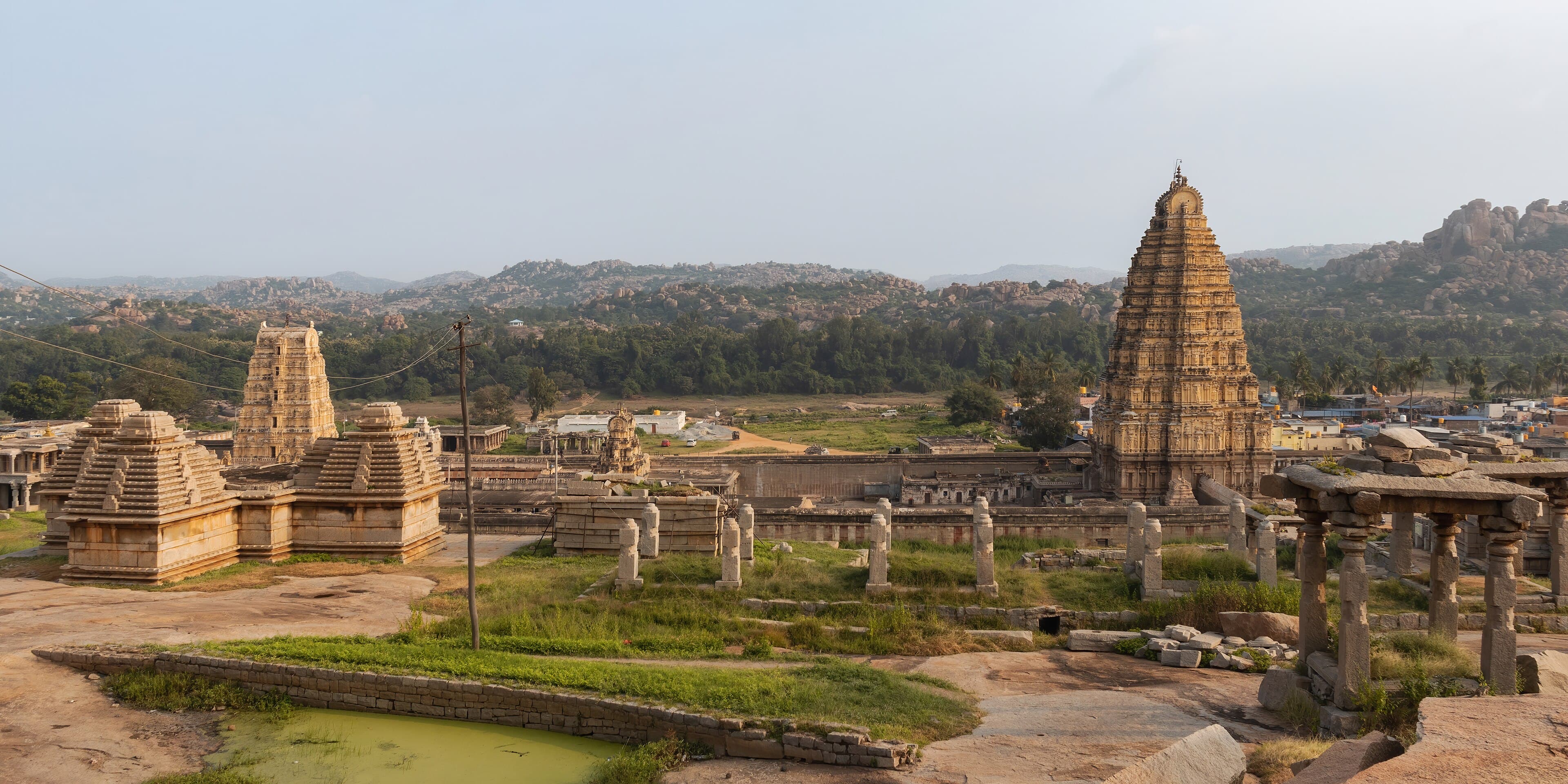
By 1500, the fortified metropolis of Vijayanagara, spread along the banks of the Tungabhadra River, was likely the richest city in India and the second largest in the world behind Beijing.
High upon the dry, wind-scoured Deccan Plateau of southern Karnataka, the landscape dissolves into a surreal wilderness of granite. Huge, sun-baked boulders, some the size of houses, lie piled upon one another in precarious, gravity-defying heaps, looking as though they were flung across the earth by a petulant deity. Through this chaotic geology winds the Tungabhadra River, its waters cutting deep channels through the gray and ochre stone. This is a country of myth. Long before it was ever a capital, this riverbank was known as Pampa-kshetra, the sacred ground where the goddess Parvati—known locally as Pampa—embarked on her grueling, ascetic penance on Hemakuta Hill to tame and win the wild, inward-looking Shiva. To the authors of the Ramayana, these boulder hills were Kishkindha, the kingdom of the monkey-warriors where Rama met Hanuman and plotted the rescue of his kidnapped wife, Sita. The earth here has always felt old, charged with a strange, tectonic energy, long before human hands began to carve the granite into the spectacular, doomed metropolis of Vijayanagara.
For over two centuries, this harsh terrain served as the citadel of the last great Hindu empire of southern India. Founded in 1336 CE amid the wreckage of older dynasties shattered by the northern invasions of the Delhi Sultanate, the city of Vijayanagara—the "City of Victory"—grew with astonishing speed. Its founders, the brothers Harihara and Bukka, under the spiritual guidance of the sage Vidyaranya, recognized that the chaotic granite hills and the rushing Tungabhadra formed a natural fortress. From this secure base, they built an empire that stretched across the south, acting as a powerful bulwark against the expansionist Muslim sultanates of the northern Deccan. By 1500 CE, Vijayanagara had grown into a colossus. It was the second-largest city in the medieval world, eclipsed only by Beijing, and arguably the wealthiest metropolis on the Indian subcontinent. It was a cosmopolitan magnet that attracted Persian horse-traders, Portuguese merchants from Goa, and travelers from across the known world, all lured by rumors of a city where diamonds were sold in open markets like common grain.
The travelers who made the arduous journey inland left accounts that read like fever dreams. They described a fortified city of vast proportions, sprawling over more than sixteen square miles of hills and valleys. It was a metropolis of dual characters: a sacred center of soaring temples and monasteries clustering along the river, and a royal center of palaces, audience halls, and military structures buried deeper within the hills. The architecture was an exuberant synthesis. While predominantly drawing from the classical South Indian stone-carving traditions of the Chalukyas and Hoysalas, the builders of Vijayanagara were also remarkably cosmopolitan. In structures like the elegant, two-storied Lotus Mahal, the public baths, and the monumental, arched elephant stables, they seamlessly blended traditional Hindu forms with the dome-and-arch style of Islamic architecture, creating a distinctive, pluralistic aesthetic. The city was home to vibrant neighborhoods of Hindu, Jain, and Muslim communities living side-by-side, their temples, shrines, and mosques integrated into a sophisticated urban infrastructure of stone aqueducts, massive reservoirs, and paved roads.
Connected to
- place of death of · birthplace ofKrishnadevaraya1471 CE
- founded by · in countryVijayanagara Empire1336 CE
+ 8 further connections to entries not yet ingested