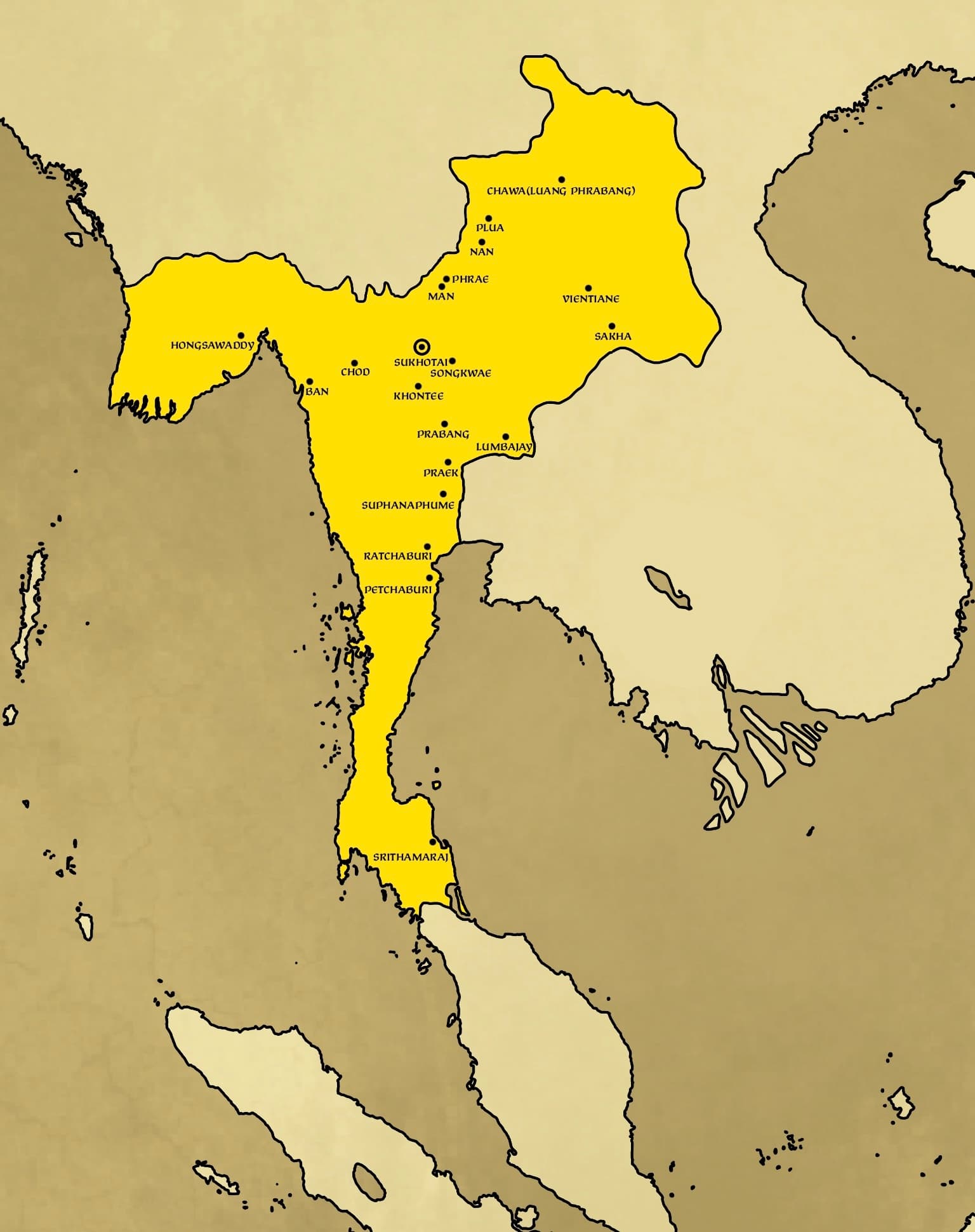
Long before it became the cradle of a regional empire, the settlement surrounding the ancient city of Sukhothai operated as a Seventh-Century commercial hub within the Dvaravati Lavo.
To look at the ruins of Sukhothai today, as they sit among the quiet ponds and manicured lawns of north-central Thailand, is to view a landscape of deliberate tranquility. Tall, slender brick stupas rise like budding lotus flowers, and massive stone Buddhas gaze downward with smooth, oval faces, their long, tapered fingers reaching toward the earth in gestures of reassurance. This aesthetic—characterized by a fluid elegance that seemed to liberate heavy bronze and stone from gravity—was long celebrated as the physical manifestation of a golden age. In the traditional telling of Thai history, this was the dawn of happiness, the literal translation of the Sanskrit-derived Sukhodaya. It was cast as the pristine, foundational moment when the Thai people shook off the heavy yoke of the Khmer Empire of Angkor, established their first independent kingdom under a benevolent, father-like king, and embraced the pure light of Theravada Buddhism.
Yet history is rarely so immaculate. Beneath the serene surfaces of Sukhothai’s monuments lies a far more complex and fractured story of a frontier zone where worlds collided. Before it was a kingdom, the region surrounding the ancient city was a volatile crucible of migrating peoples, shifting trade routes, and overlapping mandalas—the fluid, concentric circles of power that defined early Southeast Asian geopolitics. For centuries, this territory in the upper Yom and Nan river basins was a contested borderland. In the seventh and eighth centuries, the settlement emerged as a commercial outpost within the Dvaravati sphere of influence, closely tied to the Mon-dominated polity of Lavo. It was a landscape of constant transit, where Mon, Khmer, and early Tai peoples traded forest goods, iron, and salt. Power here was a shadow-play: authority shifted from the Lavo lords to the enigmatic northern state of Si Thep, only to be disrupted by incursions from northern highland kingdoms like the legendary Chiang Saen. By the mid-twelfth century, a lineage of early Siamese monarchs had begun to carve out permanent strongholds in this riverine frontier, navigating the complex web of vassalage to the great imperial power of Angkor, which briefly asserted suzerainty over the region in the late twelfth and early thirteenth centuries.
The year 1238 CE is conventionally marked as the moment the tether to Angkor was finally severed. In the decades leading up to this rupture, the region had been governed by a Khmer commander, but local Tai chieftains had grown increasingly powerful, bolstered by a steady southward migration of Tai-speaking peoples from the northern highlands and southern China. This demographic shift brought armed clans and ambitious lords into the lowlands, ready to challenge the old imperial order. The liberation of Sukhothai was a joint enterprise of two local chieftains: Pho Khun Pha Mueang, the lord of Rad, and Pho Khun Bang Klang Hao. Together, they marched on Sukhothai, defeated the Khmer garrison, and seized the city. In a gesture of political pragmatism, Pha Mueang, who held a title bestowed upon him by the Angkorian king, declined the throne himself. Instead, he crowned his ally, Bang Klang Hao, who assumed the regnal name Sri Indraditya (Si Inthrathit). This coronation marked the transition of Sukhothai from a fragmented network of trading outposts into a centralized, sovereign kingdom.
3 links to entries not yet ingested in the Library.
The infant state reached the zenith of its territorial influence and cultural self-definition under Sri Indraditya’s youngest son, Ram Khamhaeng, who ascended the throne in 1279. If the kingdom's founding was an act of military defiance, Ram Khamhaeng's reign was an exercise in brilliant statecraft. He transformed a modest regional principality into a vast mandala that stretched, however loosely, across Mainland Southeast Asia. Rather than relying solely on military coercion, Ram Khamhaeng bound his vassals through a network of personal loyalties, marriage alliances, and trade concessions. He opened diplomatic relations with the Yuan dynasty of Mongol China, personally traveling to the imperial court or sending embassies to secure Sukhothai’s position against rival Tai polities. This Chinese connection brought more than diplomatic security; it brought technology. Under Chinese tutelage, Sukhothai’s artisans mastered high-fired glazing techniques, creating a thriving export industry in celadon ceramics known as Sangkhalok ware. Great kilns at Sukhothai and its sister city, Si Satchanalai, produced thousands of elegant plates, jars, and water vessels that were traded across the maritime networks of Southeast Asia, turning the landlocked kingdom into a major player in international commerce.
It was also during this late thirteenth-century golden age that the cultural template of the kingdom was forged. Ram Khamhaeng is traditionally credited with two monumental achievements: the adaptation of existing Khmer and Mon scripts into the initial Thai alphabet, and the formal institutionalization of Theravada Buddhism as the state religion. He invited highly revered Sri Lankan monks from the maritime kingdoms of the south to establish their orthodoxy at Sukhothai. This was a deliberate departure from the state-supporting Hinduism and Mahayana Buddhism of Angkor. In place of the remote, god-king (devaraja) model of the Khmer, the rulers of Sukhothai cultivated the image of the dharmaraja—a king who ruled by the light of Buddhist law, accessible to his subjects and personally responsible for their moral and physical well-being. A famous, though highly debated, stone inscription attributed to Ram Khamhaeng’s reign paints a picture of a pastoral utopia: "In the water there are fish, in the fields there is rice... The king has hung a bell at the gate of the palace; if any subject has a grievance, he goes and rings the bell, and the king comes out to hear his case."
But the light of the "dawn of happiness" began to flicker almost as soon as Ram Khamhaeng passed away in 1298. The highly personalized network of loyalties that had bound distant cities to the capital disintegrated under his successors. Vassal states in the south and west quietly drifted away or asserted their independence. By the mid-fourteenth century, during the reign of Maha Thammaracha I (Li Thai), Sukhothai was no longer the dominant power of the plains. Li Thai, a deeply devout scholar-king who composed the Traibhumikatha—a massive Buddhist treatise on the cosmology of the three worlds—pivoted the kingdom's energy inward. He focused on building grand monasteries, raising colossal bronze Buddhas, and establishing spiritual authority to compensate for his dwindling military might.
This retreat into piety occurred at a dangerous moment. To the south, in the swampy, fertile plains of the lower Chao Phraya basin, a dynamic and aggressive new Thai power had emerged in 1350: the Kingdom of Ayutthaya. Possessing direct access to maritime trade and a highly centralized administration, Ayutthaya was built for conquest. In 1349, even as Li Thai sought to consolidate his realm through religious works, Ayutthayan forces invaded. Sukhothai was forced to submit, reduced from an empire to a tributary state. For nearly a century, the kings of Sukhothai ruled as vassals, their territory carved up and their political independence systematically eroded. The end came quietly in 1438. Following the death of King Borommapan (Maha Thammaracha IV), Ayutthaya formally dissolved the kingdom, annexing its territory into its administrative provinces.
The physical kingdom was gone, absorbed into the grander empire of Ayutthaya, but Sukhothai did not truly disappear. In the logic of Southeast Asian history, conquered dynasties often conquer their captors from within. The proud nobility of Sukhothai remained a powerful faction within the Ayutthayan court, their marriages with the southern royalty eventually producing the Sukhothai dynasty, which would rule Ayutthaya during some of its most critical periods in the sixteenth century. More than that, the artistic and spiritual innovations of Sukhothai—the fluid, elegant Buddha images, the script, and the ideal of the righteous Buddhist monarch—became the enduring cultural DNA of the Thai nation. The ruins of Sukhothai Thani, reclaimed from the jungle and preserved as a monument to human creativity, stand not as the tomb of a forgotten state, but as the quiet reservoir from which the modern nation-state still draws its sense of self.