Event · 650 CE – 1377 CE · Southeast Asian Empires
Srivijaya
- Also known as
- Empayar Srivijaya
- Imperio de Srivijaya
- Imperio Srivijaya
- Karajaan Sriwijaya
- Karajan Sriwijaya
- Kedatuan Sriwijaya
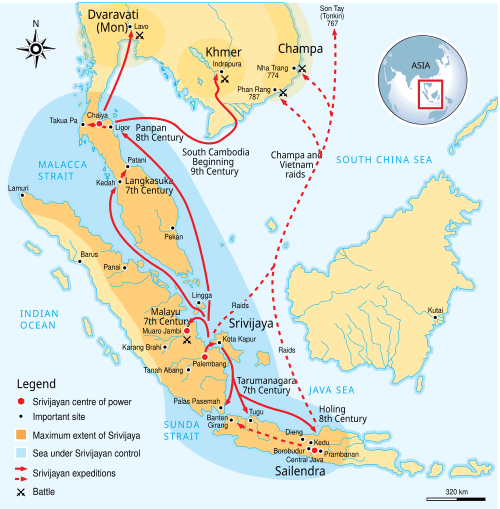
To control the flow of wealth between East and West, a power does not need to conquer vast continents; it only needs to command the water.
In the winter of 671 CE, a Chinese Buddhist monk named Yijing stepped off a Persian merchant vessel onto the shores of Sumatra, entering a world that seemed to float on the water. For six months, he lived in a bustling riverine settlement, translating sacred Sanskrit texts and observing a highly organized society of thousands of monks. He wrote of a great city where the king’s court and grand religious monuments stood on solid ground, while the common people lived in thatch-roofed houses built on bamboo rafts, rising and falling with the daily tides of the Musi River. This watery metropolis was the beating heart of Srivijaya—a Sanskrit name translating to "shining victory" or "glorious triumph." Yet, despite its centuries of dominance over the strategic bottlenecks of maritime Asia, this great thalassocracy vanished so completely from the physical and historical landscape that by the early twentieth century, its very existence had been forgotten.
The resurrection of Srivijaya is one of modern archaeology’s most startling detective stories. For hundreds of years, local memories of the empire faded into myth, and the physical traces of its capital were buried under the muddy, flood-prone delta of Palembang in southern Sumatra. When early twentieth-century scholars first deciphered seventh-century stone inscriptions in the region, they initially assumed "Srivijaya" was merely the name of an ancient king. It was not until 1918 that the French historian George Cœdès, working for the French School of the Far East, synthesized Chinese records of a wealthy polity called Sanfoqi (or Shilifoshi), Arabic tales of the legendary, fabulously wealthy Maharaja of Zabag, and local Old Malay stone inscriptions written in the South Indian Pallava script. Cœdès realized these disparate threads all described the same entity: a sprawling, maritime empire that had once controlled the Strait of Malacca and the Sunda Strait, commanding the flow of wealth between Tang and Song dynasty China, the kingdoms of India, and the Islamic caliphates of the Middle East.
At its core, Srivijaya was not a traditional land-based empire with fixed, militarized borders, but rather a fluid thalassocracy—a confederation of semi-autonomous harbor cities bound together by trade, prestige, and naval might. Based around the junction of three major rivers—the Musi, the Komering, and the Ogan—the empire was perfectly positioned to exploit the global trade routes of the first millennium. Srivijaya developed complex maritime technologies and sophisticated naval strategies to regulate these waterways. Rather than relying on a vast agricultural hinterland, the empire generated extreme economic surpluses by acting as a regional trade hub. Its naval fleet served as both a logistical backbone and an offensive force, patrolling the narrow straits, suppressing piracy, and, when necessary, using force to compel passing merchant ships to dock at Srivijayan ports, where their luxury cargo could be taxed and traded. This prestige-goods economy relied on importing exotic wares from across the Indian Ocean and exporting the rich resources of the Sumatran rainforests.
Connected to
5 links to entries not yet ingested in the Library.