Person · 1094 CE – 1150 CE · Southeast Asian Empires
Suryavarman II
- Also known as
- II. Suryavarman
- II. Szurjavarman
- Raja Suryavarman II
- Suria Warman II
- Surjavarman la 2-a
- Surjawarman II
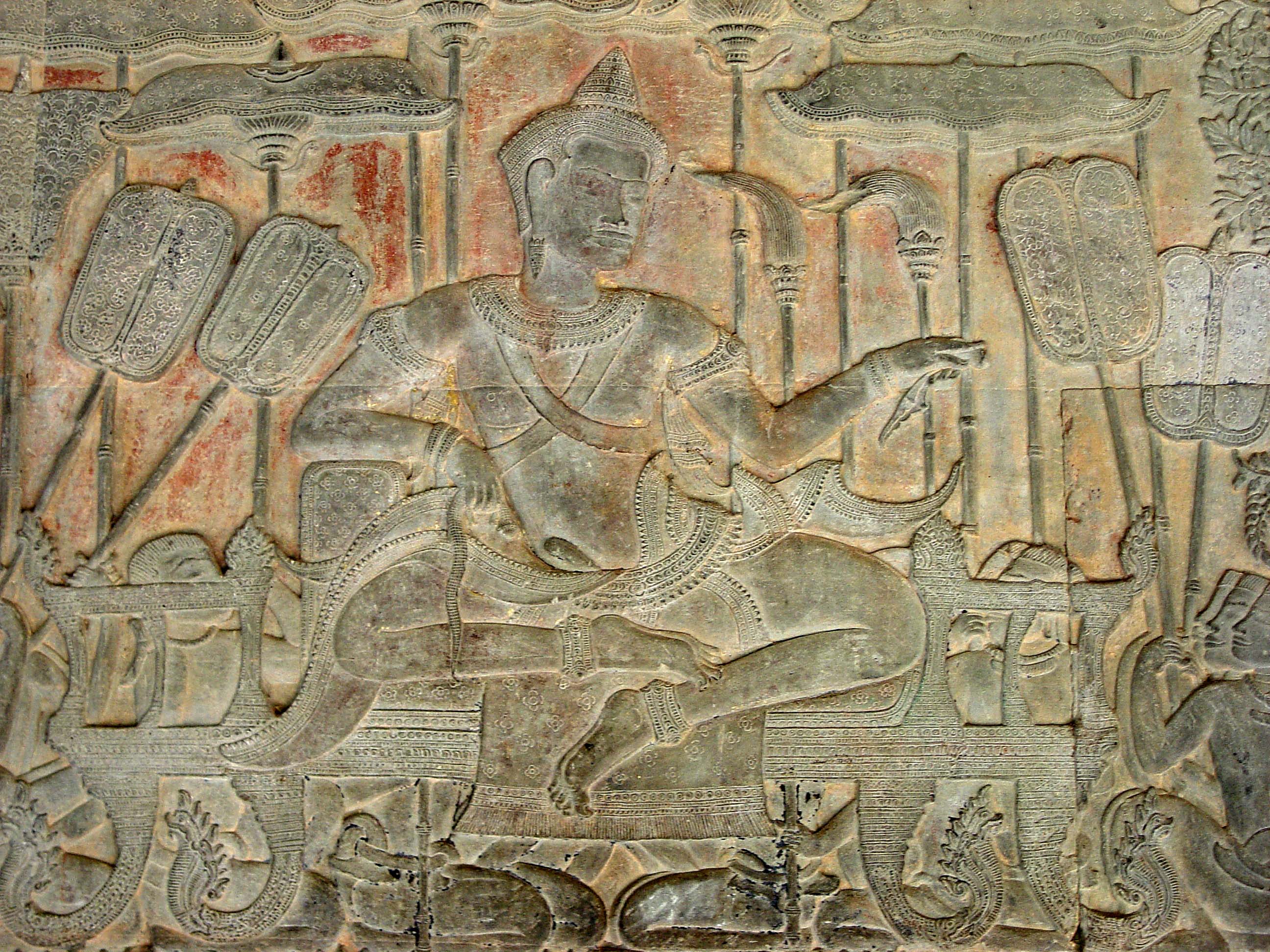
A young prince raised in the provinces during a period of fraying central authority, the future king Suryavarman II initiated his rise to power as soon as his formal studies ended.
To gaze upon the stone face of the Khmer Empire at its zenith is to look at a man who, quite literally, rode to power on the head of an elephant. In the south gallery of Angkor Wat, a twelfth-century bas-relief preserves the likeness of King Suryavarman II. He sits gracefully on an elaborate wooden dais, his legs folded beneath him, his torso curving with an air of absolute serenity. His ears are heavy with pendants, his wrists and ankles bound in metal, and his head crowned with a pointed diadem. Around him, a forest of parasols, fly whisks, and fans denotes his supreme rank, while whiskered Brahman priests prepare for a ritual and courtiers kneel with hands pressed over their hearts. It is a portrait of consummate composure. Yet the path to this quietude was carved through raw, kinetic violence. In the inscriptions of his reign, Suryavarman’s rise to power is recorded with a fierce, mythological grandeur: the young prince, having completed his studies and feeling the stirrings of "the royal dignity of his family," leapt onto the head of his rival's war elephant and slew him, "as Garuda on the edge of a mountain would kill a serpent."
When Suryavarman II seized the throne in 1113 CE, the Khmer Empire was fracturing, its central authority weakened by decades of provincial drift and rival claimants. He was born around 1094 or 1098 CE to Narendralakshmi and Ksitindraditya, growing up on a provincial estate during a time when the capital's grip on the provinces was slipping. To unify the realm, the young prince had to eliminate two obstacles: a southern rival named Nripatindravarman, and his own great-uncle, the elderly and ineffective King Dharanindravarman I. Whether the dramatic elephant-back duel claimed the life of the southern claimant or the reigning monarch is still debated by scholars, but the result was absolute. At just fifteen or nineteen years of age, Suryavarman consolidated the empire under a single, iron will. To legitimize his rule, he turned to the aged Brahmin sage Divakarapandita, a high priest who had already officiated the coronations of two previous kings. Divakarapandita performed the sacred rites in 1113 CE, and again during a grander, formal coronation in 1119 CE. In return, Suryavarman showered the priest with palanquins, crowns, fans, and rings, funding a grand tour of the empire’s sanctuaries. At the mountaintop temple of Preah Vihear, the priest left behind a golden statue of a dancing Shiva, cementing the union between the new king’s court and the ancient gods.
Suryavarman’s name, combining the Sanskrit root for "sun" with the traditional Pallava suffix meaning "shield" or "protector," signaled his dual role as a radiant source of cosmic order and a relentless military guardian. He immediately set about projecting this power outward. To the west, the Mon kingdom of Dvaravati was pulled into the Khmer orbit, bringing central-southeast Asia under Suryavarman's influence. To the north and east, he engaged in sophisticated, high-stakes diplomacy with Imperial China. Resuming formal relations in 1116 CE, he dispatched a fourteen-member embassy to the Chinese court. The emissaries, draped in special court garments gifted by the host emperor, declared themselves "filled with benefits" merely by contemplating the imperial glory. Another mission followed in 1120 CE, and by 1128 CE, the Chinese emperor formally recognized Suryavarman as a "great vassal of the empire," establishing structured trade agreements that enriched the Khmer treasury. Suryavarman even reached across the Bay of Bengal, sending a precious stone to the Chola Emperor Kulothunga Chola I of southern India in 1114 CE. This connection to the Cholas may have introduced new artistic and architectural ideas to the Angkorian court, sparking a sudden, brilliant wave of cultural innovation.
Connected to
- religionHinduism
- citizen ofKhmer Empire802 CE
+ 7 further connections to entries not yet ingested