Event · 192 CE – 1832 CE · Austronesian Expansion
Champa
- Also known as
- Campa
- Campa
- Campa
- Campo
- Campā
- Campā
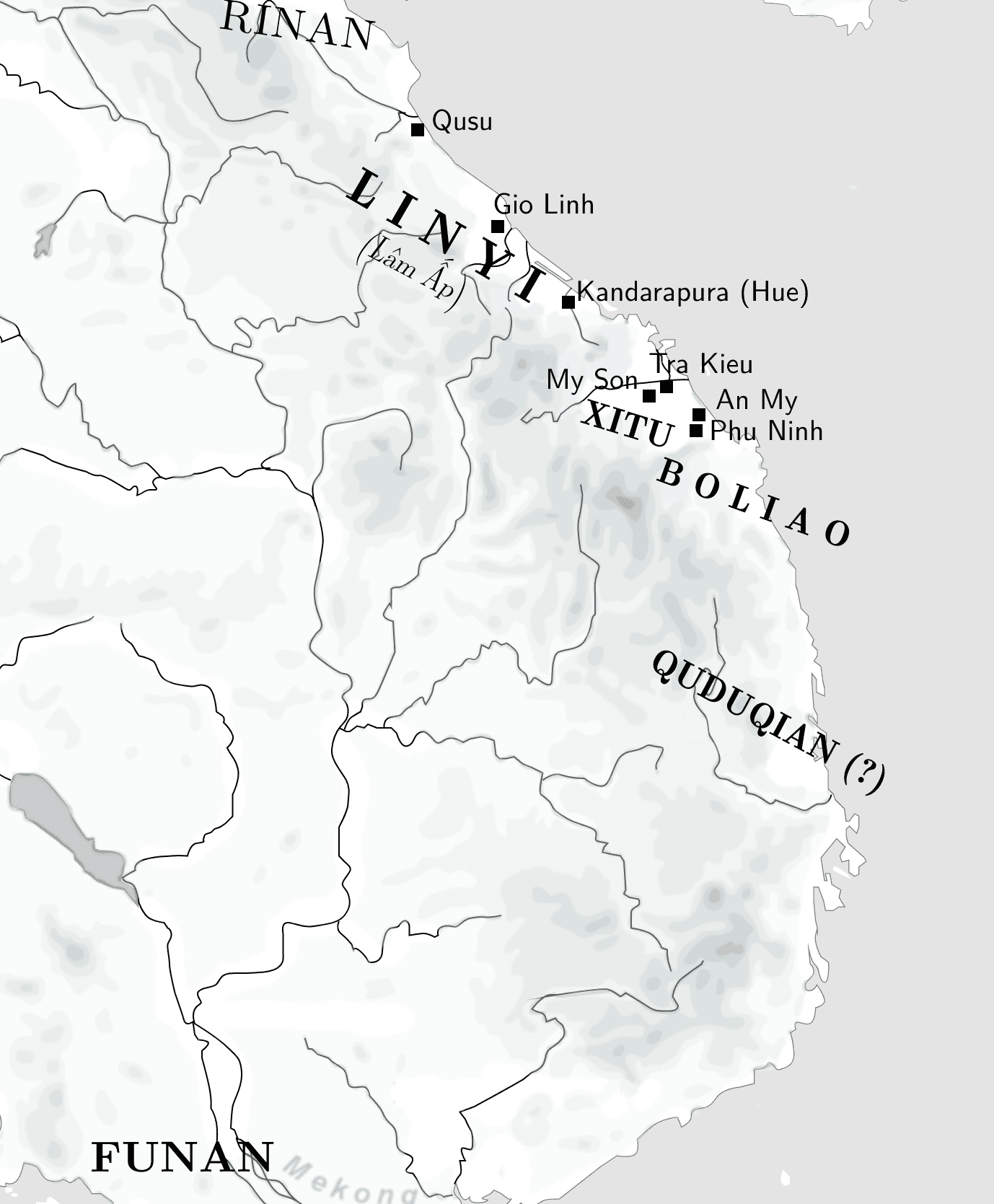
The origins of Champa are etched in a rebellion against Chinese rule.
Along the narrow, wave-battered shelf of sand and jagged granite that defines the central coast of modern Vietnam, the landscape is punctuated by sudden, arresting ruins. Rising from the scrub and the red dirt are towers of unmortared brick, weathered to the color of dried blood, their surfaces carved with dancing apsaras, multi-armed deities, and the heavy-lipped faces of kings. These are the prasats of Champa, the architectural remnants of a maritime civilization that for over sixteen centuries commanded the sea lanes of the South China Sea. Unlike the land-bound, rice-girdled empires of the Khmer or the Vietnamese, Champa was a civilization of the shore. Its back was pressed against the formidable wall of the Annamite Range; its face was turned resolutely toward the water. To understand Champa is to understand a world where the sea was not a barrier, but a highway—a network of bays and river mouths that connected the Indian Ocean to the markets of imperial China.
The genesis of this maritime power lies in a moment of imperial fracture. In 192 CE, a local official named Khu Liên led a successful rebellion against the fading authority of the Eastern Han dynasty in the northern reaches of what is now central Vietnam. Out of this rebellion emerged a polity known to Chinese chroniclers as Linyi, and to Vietnamese sources as Lâm Ấp. While the precise historical relationship between Linyi and the later Cham state remains a subject of scholarly debate, this early rebellion established a pattern of defiance against northern hegemony that would define the region for two millennia. By the fourth century, through conflict and territorial acquisition at the expense of the neighboring Kingdom of Funan to the south, the early Cham polities began to absorb a profound cultural transformation. Indian merchants, priests, and scholars, traveling along the monsoon trade routes, brought with them Sanskrit literature, cosmology, and statecraft. Hinduism—specifically Shaivism, the worship of Shiva as the supreme lord—became the spiritual scaffold of Cham royalty. The kings of Champa did not merely adopt this foreign faith; they localized it, identifying themselves with the deities they worshipped, and cementing their divine mandate in stone.
For decades, colonial-era historians viewed Champa through a Western lens of unified nationhood, imagining a single kingdom with a central capital that periodically migrated from north to south. Modern scholarship, however, has abandoned this monolithic view in favor of a more complex reality. Champa was not a centralized state, but a fluid, often fractious mandala—a federation of independent, Chamic-speaking principalities spread along the coast, united by a common language, culture, and Hindu-Buddhist heritage. In the tenth century, the historical record burns brightest in the northern principality of Indrapura; by the twelfth century, the focus shifts to Vijaya in the center; after the fifteenth century, it settles in the southern enclave of Panduranga. Rather than the migration of a single capital, these shifts reflect the rising and falling fortunes of individual coastal polities, each competing for dominance over the lucrative regional trade. It was a multiethnic world dominated by Austronesian Chamic-speaking peoples closely related to the maritime populations of the Malay Archipelago, but it also embraced upland Austroasiatic peoples, such as the Bahnaric and Katuic speakers of the interior, weaving them into a complex web of tribute and commerce.
The lifeblood of this decentralized federation was trade. Champa sat astride the maritime Silk Road, serving as an indispensable conduit for the global spice trade that stretched from the Persian Gulf to the ports of southern China. The Chams were consummate seafarers and merchants, offering the world precious forest products—most notably aromatic aloe wood, highly prized in the courts of China and the Abbasid Caliphate—alongside ivory, tortoise shells, and gold. Their harbors, such as the bustling port of Hội An, were cosmopolitan hubs where Cham merchants traded alongside Malays, Javanese, Chinese, and Arab sailors. Through these same maritime networks, a new faith arrived. Starting in the tenth century, Arab maritime trade introduced Islam to the Cham coast. The transition was gradual and syncretic; for centuries, Islam coexisted with the dominant Hindu courts. It was not until the seventeenth century that the ruling dynasty fully adopted the faith, creating a unique religious landscape. Even today, the Cham people remain divided into the Bani, who practice a distinct, localized form of Islam, and the Bacam, who preserve ancient, syncretic Hindu rituals—making them one of the very few surviving non-Indic indigenous Hindu societies in the world, alongside the Balinese of Indonesia.
The wealth of Champa, however, made it a constant target for its neighbors. The history of the federation is one of near-continuous warfare, fought both on land and in naval engagements along the coast. The Chams maintained a volatile relationship with the Khmer Empire to the west, characterized by alternating periods of intense warfare, trade, and royal intermarriage. But the existential threat to Champa lay to the north. As the Vietnamese state of Đại Việt threw off Chinese rule and began its long, southward expansion—a historical movement known as the Nam tiến—Champa found itself in the path of an inexorable pressure. Champa reached the zenith of its power and cultural expression in the ninth and tenth centuries, a golden age of temple construction exemplified by the sacred sanctuary of Mỹ Sơn, nestled in a lush valley guarded by cataclysmic peaks. Yet, from the eleventh century onward, the northern principalities of Champa began to yield to Vietnamese military campaigns. The fall of the great central citadel of Vijaya in 1471 marked the decisive collapse of Champa as a major regional power, triggering waves of migration. Some Chamic groups fled inland, merging with highland populations to form new linguistic identities; others sailed south to Aceh in northern Sumatra, leaving a profound linguistic imprint that survives in the Acehnese language today.
The final chapter of Champa was a slow, agonizing eclipse. The kingdom was reduced to its southernmost principality, Panduranga, which persisted as a vassal state under Vietnamese overlordship for more than three centuries. The end came in 1832, when the expansionist Nguyễn Emperor Minh Mạng formally annexed Panduranga, erasing the last vestiges of Cham autonomy. Yet, the legacy of this maritime civilization was not entirely extinguished. It lives on in the red brick towers that still stand sentinel over the Vietnamese coast, in the maritime vocabulary of the South China Sea, and in the diaspora of the Cham people in Vietnam and Cambodia. Champa was the crucial bridge between the Indian Ocean and East Asia, a civilization that proved that power in Southeast Asia did not always belong to the great river valleys, but could be built on the transient, glittering highway of the sea.
Connected to
- in country · containsChampa192 CE
+ 5 further connections to entries not yet ingested