Organization · 962 CE – 1806 CE · Medieval Europe
Holy Roman Empire
- Also known as
- A Német Nemzet Szent Római Birodalma
- An Emperoureth Romanek Sans
- an Impireacht Naofa Rómhánach
- An Naomh-Impireacht Rómhánach
- Banal na Imperyong Romano
- Baraan nga Imperyo Romano
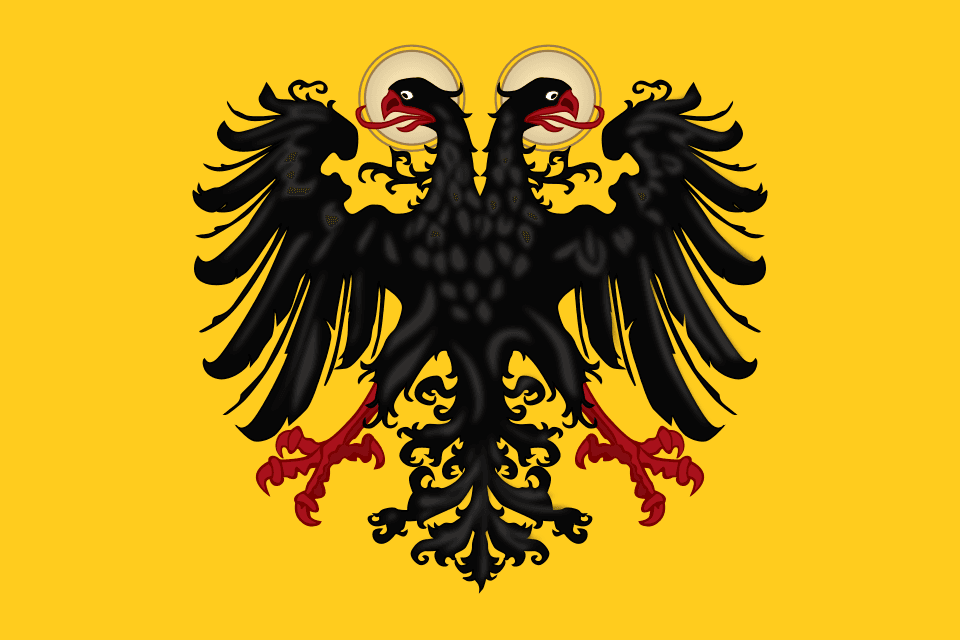
On Christmas Day in the year 800, Pope Leo III placed a crown on the head of the Frankish king Charlemagne, reviving the title of Roman emperor more than three centuries after the western empire had collapsed.
On Christmas Day of the year 800, inside the cavernous basilica of St. Peter’s in Rome, Pope Leo III stepped toward the kneeling Frankish king, Charlemagne, and placed a golden crown upon his head. The act was a brilliant theatrical coup. For over three centuries, since the deposition of Romulus Augustulus in 476, the Western Roman Empire had lain in ruins, its ancient administration replaced by a patchwork of Germanic kingdoms. In the East, the Byzantine court still claimed the Roman mantle, but the West regarded its current sole ruler, Empress Irene—who had deposed and blinded her own son—as illegitimate, believing that the Latin Church could only recognize a male emperor as the head of Christendom. By crowning Charlemagne, the papacy turned its back on Constantinople, claiming to restore the Roman Empire in the West under a formula of Renovatio imperii Romanorum. Though the crown would slip from the grasp of Charlemagne’s squabbling descendants, the ideological spark survived. In 962, Otto I, the formidable King of the Germans, was crowned by Pope John XII, permanently anchoring this resurrected Roman dignity within a massive, decentralized Central European state. For the next eight hundred and forty-four years, this complex, evolving political entity—later known as the Holy Roman Empire—would endure as the grandest, most paradoxical construction in the history of European statecraft.
At its core, the Empire rested upon a profound, mystical theory: the translatio imperii, the belief that supreme, universal world power had been legally inherited from the ancient Caesars of Rome. To the medieval mind, the universe was a singular, ordered hierarchy; just as there was one God in heaven and one Pope to guide the souls of humanity, there must be one Emperor to wield temporal authority over the Christian world, acting as first among equals of all Catholic monarchs. Yet this lofty ideal of a unified "World Monarchy" was constantly undermined by the messy realities of geography and dynastic competition. Initially, the Empire was a vast tripartite structure, comprising the kingdoms of Germany, Italy, and, from 1032, Burgundy. Under the Ottonian, Salian, and Hohenstaufen dynasties, the emperors possessed a sophisticated, inherited Carolingian military and bureaucratic apparatus, using it to build one of the most powerful monarchies in Europe. However, maintaining this authority required a constant, exhausting balancing act between the crown, independent regional vassals, and the papacy. It was Frederick I Barbarossa who, in 1157, first added the term sacrum ("Holy") to the imperial title, seeking to assert his divine legitimacy over Italy and a hostile papacy by declaring his realm a consecrated "Holy Empire." But this assertion of universal dominance proved an overextension. By the mid-thirteenth century, under the brilliant but erratic Hohenstaufen emperor Frederick II, the imperial authority in Italy collapsed, and the Empire entered a period of fragmentation from which its central monarchy would never fully recover.
Connected to
- had as participantBattle of Vienna
- in country · containsHoly Roman Empire962 CE
- had as citizenMartin Luther1483 CE
+ 12 further connections to entries not yet ingested