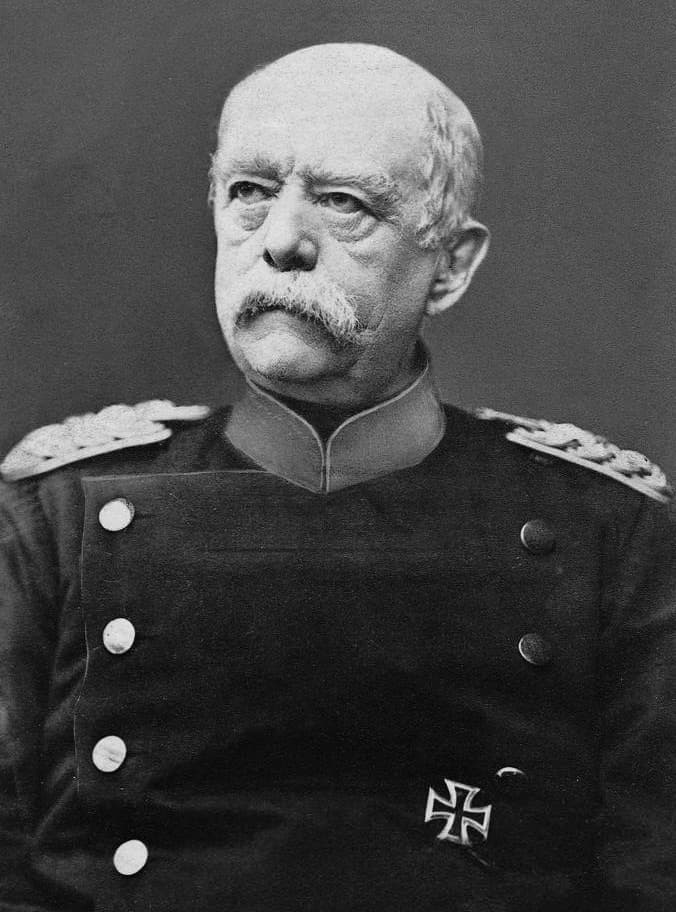
Germany was not born of national consensus, but of three short, calculated wars and the unrelenting will of Otto von Bismarck.
In the early spring of 1848, as revolutions swept through the capitals of Europe, a towering, thirty-two-year-old Junker named Otto von Bismarck watched in mounting fury as his own monarch, King Frederick William IV, succumbed to the liberal mob in Berlin. While Prussian officers let out a "rattling of sabres in their scabbards" at the news of their king’s capitulation, Bismarck took matters into his own hands. He attempted to rouse the peasants on his Pomeranian estate into a makeshift counter-revolutionary army to march on the capital in the king’s name. When that failed, he slipped into Berlin in disguise, offering his services to the military command, only to be told he could best serve the crown by organizing food supplies. Restless and desperate to stem the constitutional tide, he even approached Princess Augusta, trying to persuade her to bypass her husband and place her teenage son on the throne. Augusta refused, conceiving a lifelong hatred for the reckless young royalist. To the established conservative order of Prussia, Bismarck was a wild card: a backwoods landowner of immense physical stature, legendary for his drinking, his duel-fighting, and his fanatical devotion to the divine right of kings. Yet beneath the aggressive, country-gentleman persona lay a mind of liquid pragmatism, one that would soon realize the old world could not be saved by reaction alone; it had to be hijacked.
Bismarck’s path to this realization was shaped by a childhood spent suspended between two distinct Prussias. Born in 1815 at the family estate of Schönhausen in Prussian Saxony, he was the son of Karl Wilhelm Ferdinand von Bismarck, a Junker of ancient Swabian lineage whose mediocre agricultural skills kept the family’s finances decidedly average, and Wilhelmine Luise Mencken, the highly educated daughter of a senior Berlin bureaucrat. It was a marriage of old soil and urban intellect. Though Bismarck cultivated the image of the rustic Pomeranian lord, frequently wearing military uniforms and affecting a blunt, provincial manner, he was exceptionally well-educated. He studied law at Göttingen and Berlin, read widely, and mastered English, French, Italian, Polish, and Russian. His early twenties were defined by a restless, aimless energy; he abandoned a legal career in Potsdam after jeopardizing his standing to pursue two wealthy English girls, underwent a brief stint of compulsory military service in the army reserves, and eventually returned to manage the family’s Pomeranian estates following his mother's death. His transition into serious politics was catalyzed by his marriage to the deeply religious Johanna von Puttkamer in 1847, a union that anchored his volatile temperament, and his election to the newly formed Prussian legislature, the Vereinigter Landtag, where his stinging rhetoric quickly caught the attention of ultra-conservative royalists.
12 links to entries not yet ingested in the Library.
The crucible of Bismarck’s political transformation was not Berlin, but Frankfurt. In 1851, Frederick William IV appointed him as Prussia's envoy to the Diet of the German Confederation, a loose assembly of German states dominated by the Austrian Empire. Here, Bismarck engaged in a silent, petty war of status with the Austrian representative, Count Friedrich von Thun und Hohenstein. When Thun claimed the exclusive aristocratic privilege of smoking and removing his jacket during meetings, Bismarck immediately did the same, asserting Prussian equality through tobacco smoke and unbuttoned coats. This abrasive assertiveness even led to a bloodless duel with a political rival, Georg von Vincke. Yet, during his eight years in Frankfurt, Bismarck’s letters and memoranda to Berlin revealed a profound shift. Away from the dogmatic influence of his ultra-conservative friends, he abandoned pure reaction for Realpolitik. He realized that the German middle-class liberals’ desire for a unified nation was stronger than their desire for domestic social reform. If the conservative Prussian crown did not take the lead in uniting Germany, the liberals eventually would, sweeping the monarchy away in the process. To defeat Austria and secure Prussian dominance, Bismarck argued, Prussia had to shed its ideological purism. It had to be prepared to make alliances with anyone—including Napoleon III’s France or imperial Russia—treating the geopolitical landscape not as a moral crusade, but as a chessboard where no squares were ruled out of bounds.
In 1862, this pragmatic vision found its executive instrument. King Wilhelm I, facing a bitter constitutional deadlock with the Prussian parliament over military spending, recalled Bismarck from his diplomatic posts abroad—where he had served as ambassador to Russia and France—and appointed him Minister President and Foreign Minister. Bismarck immediately bypassed the legislature, collecting taxes and reorganizing the army without parliamentary approval, famously declaring that the great questions of the day would be decided not by speeches and majority resolutions, but by "iron and blood." What followed was a masterclass in calculated escalation. Over the course of seven years, Bismarck provoked and won three short, highly decisive wars. First, in 1864, he allied with Austria to wrest the duchies of Schleswig and Holstein from Denmark. Next, in 1866, he turned on Austria itself. Defeating the Austrian forces in a rapid campaign, Bismarck dissolved the old German Confederation and established the North German Confederation, a new federal entity that consolidated the northern German states under Prussian hegemony while deliberately excluding Austria. Finally, in 1870, recognizing that a common external threat would draw the independent South German states into the Prussian fold, he maneuvered France into a declaration of war. The resulting Prussian-led victory was swift and absolute. On January 18, 1871, in the Hall of Mirrors at Versailles, the German Empire was proclaimed, with Wilhelm I as Kaiser and Bismarck, now elevated to the rank of Prince, as its first Imperial Chancellor.
Having forged the empire through war, Bismarck spent the next two decades preserving it through a delicate, hyper-vigilant peace. He understood that a dominant Germany in the heart of Europe would naturally terrify its neighbors. To prevent a hostile coalition from forming, he constructed a complex web of overlapping alliances, constantly working to keep France isolated while maintaining stable relations with both Austria-Hungary and Russia. At home, however, his governance was far less stable, characterized by a series of aggressive campaigns against internal elements he deemed "enemies of the empire." In the 1870s, allied with low-tariff, anti-Catholic Liberals, he launched the Kulturkampf—a "culture struggle" designed to break the domestic influence of the Catholic Church. The campaign backfired spectacularly. Rather than capitulating, German Catholics mobilized, forming the powerful Centre Party and utilizing universal male suffrage to secure a massive, permanent bloc of seats in the Reichstag. Recognizing his defeat, Bismarck executed a characteristic pivot: he abandoned the Kulturkampf, broke with his Liberal allies, and forged a new coalition with the Centre Party to target a rising adversary—the Socialists.
To neutralize the appeal of the socialist movement, Bismarck pioneered a dual strategy of repression and co-optation. He banned socialist organizations while simultaneously establishing the world's first modern welfare state, introducing state-sponsored accident, sickness, and old-age insurance to convince the working class that they did not need the socialists to secure their material well-being. Throughout his chancellorship, Bismarck ruled autocratically, sidelining the Reichstag and ensuring that actual power remained concentrated in a strong imperial bureaucracy run by the traditional Junker elite.
This fragile balance of autocratic domestic control and intricate foreign diplomacy survived only as long as Bismarck’s authority remained absolute. In 1888, the accession of the young, ambitious Kaiser Wilhelm II shattered this dynamic. Wilhelm II, eager to rule in his own right and impatient with the aging Chancellor’s cautious, complex foreign policy, clashed openly with Bismarck. In March 1890, the Iron Chancellor was forced to resign. He retired to his estates to write his memoirs, watching from the sidelines as the intricate international system he had spent decades constructing began to unravel under the new Kaiser’s erratic leadership. By the time of his death in 1898, Bismarck had become an mythic figure to German nationalists, who erected towering stone monuments in his honor across the nation. He had successfully demonstrated that a conservative elite could harness the revolutionary force of nationalism to preserve their own power, leaving behind a united, industrial colossus in the center of Europe—but one whose constitutional weakness left it dangerously dependent on the genius of a single helmsman.