Event · 1871 CE – 1949 CE · Modern Europe
German Reich
- Also known as
- 3. Reich
- Alemanha Imperial
- Alemania
- Alemaniar Inperioa
- Alman Diyarı
- Alman İmparatorluğu
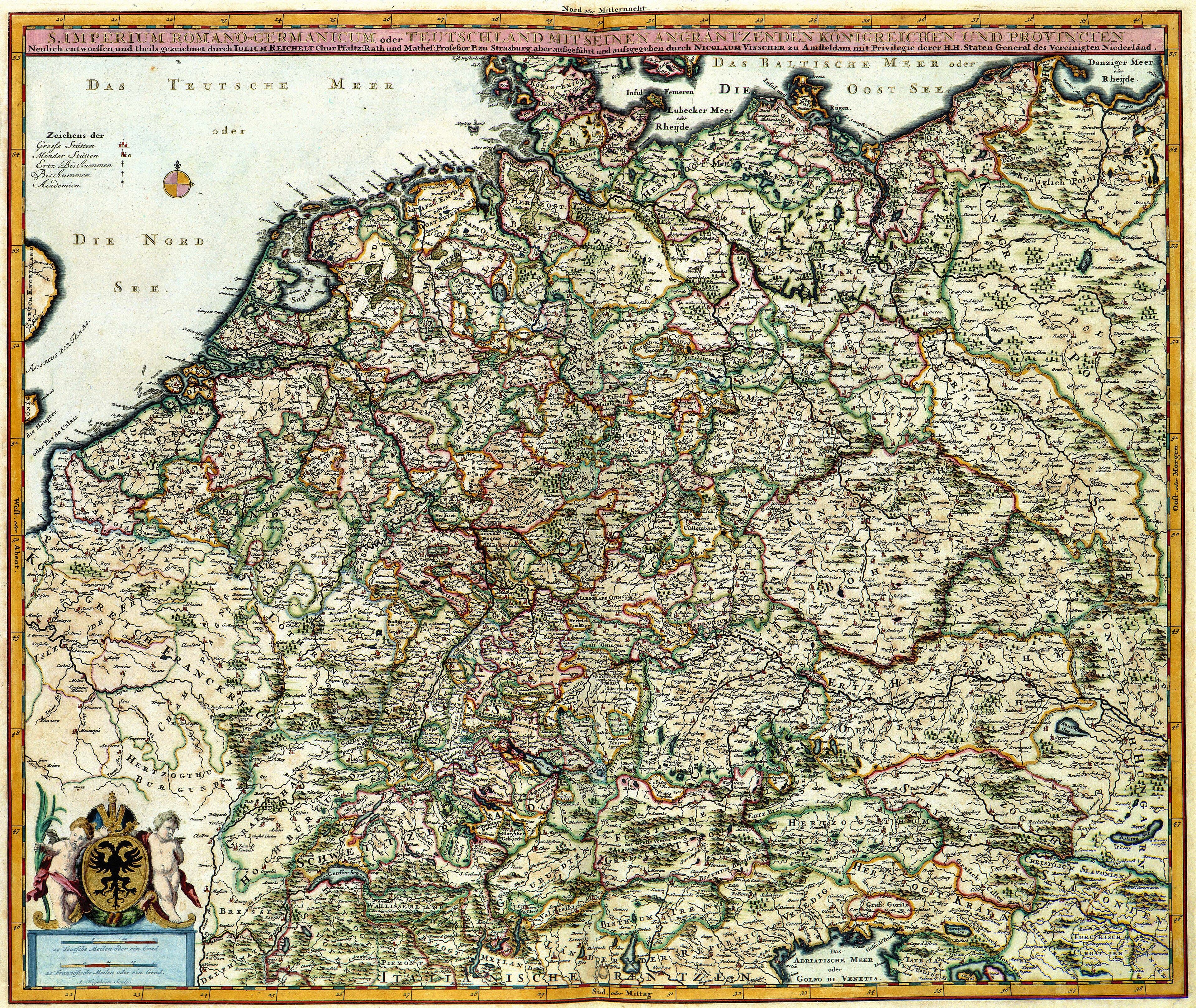
When Otto von Bismarck and Wilhelm I of Prussia stood in the Palace of Versailles on 18 January 1871 to proclaim the creation of the Deutsches Reich, they chose a title that did not carry inherently monarchical connotations.
On January 18, 1871, inside the Hall of Mirrors at the Palace of Versailles, a gathering of uniform-clad princes, aristocrats, and generals proclaimed the birth of the Deutsches Reich. The setting was a calculated humiliation of defeated France, but the title chosen for this new colossus was an exercise in deliberate ambiguity. To the outside world, and in English translations of the era, it was the "German Empire," a monarchy dominated by the Prussian King Wilhelm I, who was declared Deutscher Kaiser—German Emperor. Yet Otto von Bismarck, the architect of this unification, had fiercely resisted styling Wilhelm as "Emperor of Germany." Such a title would have suggested a monarchical supremacy over the other sovereign German kingdoms, like Bavaria and Saxony, which had reluctantly agreed to join the new federation. Instead, they revived a word older and more elastic than any single throne: Reich. Translating not strictly as empire, but as "realm," "domain," or "reach," the term was a vessel waiting to be filled with the shifting definitions of what it meant to be German.
This new nation-state was born out of a selective exclusion. It was the "Lesser German" solution to the long-debated German question, forged after Prussia’s military victory over Austria in 1866. By design, the borders of the 1871 Reich excluded Luxembourg and the Austrian crown lands that had historically belonged to the old German Confederation. Conversely, it swallowed vast swaths of territory that had never been part of the medieval Holy Roman Empire—which itself had occasionally been mapped as the Deutsches Reich—including the eastern reaches of Prussia, populated by millions of non-German speakers in regions like Posen and West Prussia. Almost from its inception, the territorial reality of the Reich was at war with its cultural imagination. While the 1871 constitution legally defined the Reich as a federation of specific monarchies with fixed borders, a more potent, romantic concept of the state was already taking root. This view, dictated by jus sanguinis (the law of blood), conceived of the Reich not as a collection of treaty-bound provinces, but as the physical manifestation of the Volk—a single, indivisible national people.
This tension between the Reich as a defined state territory and the Reich as an ethnic collective deepened as the nineteenth century closed. Despite Bismarck’s initial reluctance to engage in colonial expansion, the Reich soon acquired overseas colonies in Africa, Oceania, and China, accompanied by a rapid expansion of the Imperial German Navy to protect these far-flung possessions. Concurrently, powerful Pan-Germanic political movements began to argue that the borders of 1871 were merely a starting point. They envisioned a multiethnic, German-led Central European empire that would rival the Russian Empire to the east. When the cataclysm of the First World War arrived, the state was still universally referred to in English as the German Empire, ruled by "His Imperial and Royal Majesty" Wilhelm II. But when the monarchy collapsed in the revolution of 1918 and the Kaiser fled into exile, the constitution of the newly formed Weimar Republic—a name coined derisively by Adolf Hitler at a Munich rally in 1929 and later adopted globally—did not abandon the name .
Connected to
- in country · containsGerman Reich1871 CE
- had as citizenOtto von Bismarck1815 CE
- containsThe Holocaust1933 CE
+ 10 further connections to entries not yet ingested