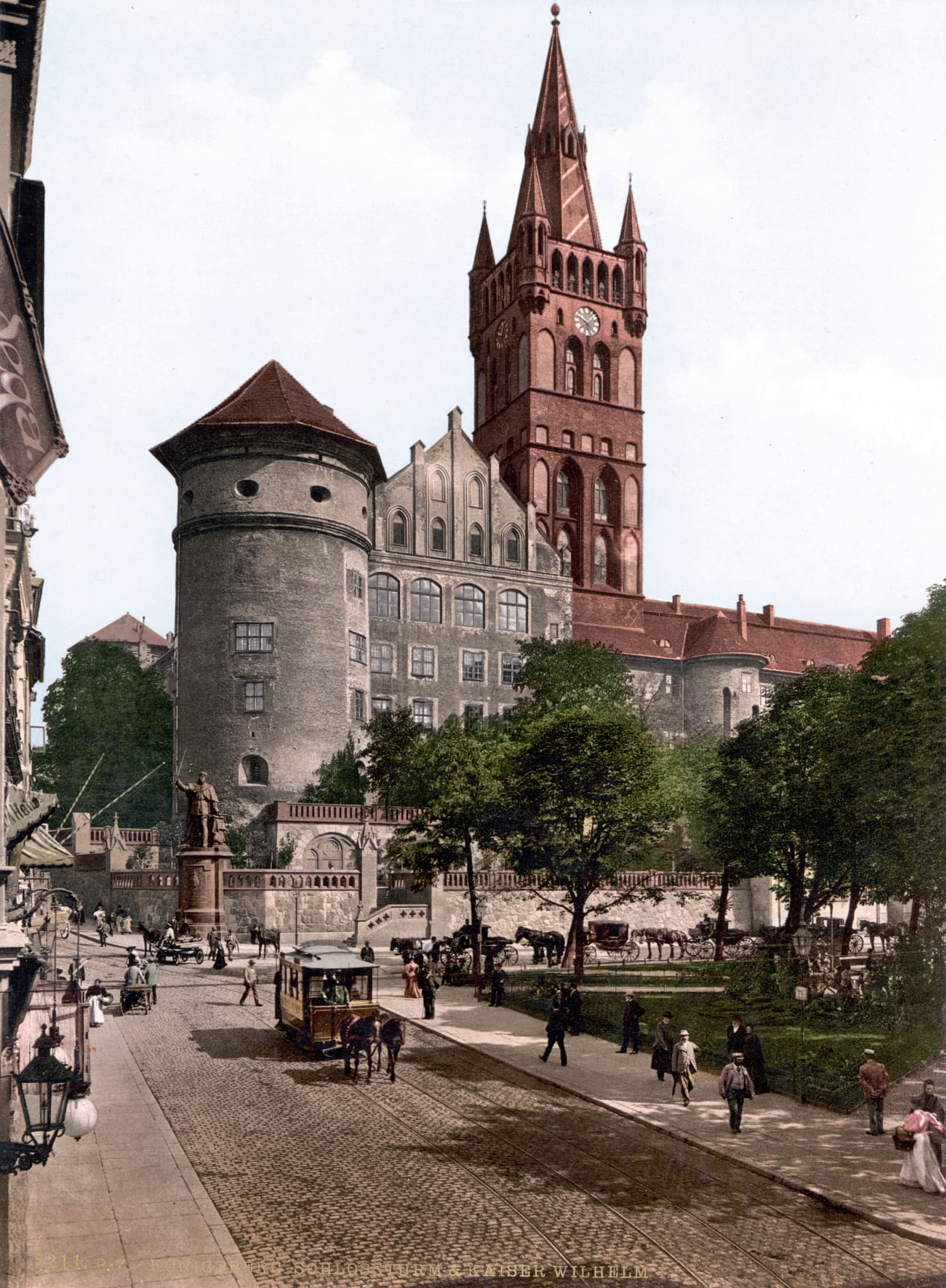
In 1255, during the Baltic Crusades, the Teutonic Knights established a fortress over the Old Prussian settlement of Twangste, naming it Königsberg—King's Mountain—to honor King Ottokar II of Bohemia.
When the Red Army finally breached the outer ring of twelve modern fortresses defending Königsberg in April 1945, they entered a city already half-pulverized by Royal Air Force incendiary bombs and relentless Soviet artillery. For nearly seven centuries, this Baltic port had stood as the easternmost bastion of German civilization—a brick-and-granite redoubt of Teutonic Knights, Lutheran scholars, and Prussian kings. But in the spring of 1945, the geography of Europe was violently remade. Within a year of the city’s surrender on April 9, its surviving German inhabitants were systematically expelled, replaced by hundreds of thousands of settlers from the interior of the Soviet Union. In 1946, the city’s very name was erased, replaced by "Kaliningrad" in honor of the Soviet head of state, Mikhail Kalinin, while its historic center, including the charred ruins of its medieval castle, was systematically bulldozed. Yet for generations before this total rupture, the city’s identity was defined by a strange, double-sided character: it was both a heavily armed frontier garrison and one of the most luminous intellectual sanctuaries in northern Europe.
The city’s origins lay in the violence of the thirteenth-century Baltic Crusades. In 1255, the Teutonic Knights, pushing north and east to Christianize the pagan Baltic tribes, destroyed an Old Prussian, or Sambian, fort known as Twangste. In its place, on a high ridge overlooking the Pregolya River, they erected a wooden fortress. They named the site Conigsberg—King’s Mountain—in honor of King Ottokar II of Bohemia, who had financed and led the campaign against the native Old Prussians. After local rebels burned an initial settlement at nearby Steindamm, a new settlement arose in the river valley beneath the castle walls. This "Old Town," or Altstadt, received its town charter in 1286. It was soon joined by two sister settlements: Löbenicht to the east in 1300, and Kneiphof, established on an island in the Pregolya in 1327. For more than four hundred years, these three towns existed as distinct municipal entities, separated by narrow channels of the river but bound together by their shared defense and commerce.
From this damp, riverine landscape, the Teutonic Knights built a formidable trading and military empire. Königsberg joined the Hanseatic League in 1340, acting as an intermediary for goods flowing between the Polish-Lithuanian hinterland and the ports of England, Flanders, and Scandinavia. Despite their commercial success, the Knights’ heavy-handed taxation to fund perpetual wars against Lithuania and Poland alienated the local merchant classes. In 1440, Königsberg’s towns helped found the anti-Teutonic Prussian Confederation, which openly rebelled against the Knights in 1454 and swore allegiance to King Casimir IV Jagiellon of Poland. The ensuing Thirteen Years’ War tore the city apart; while the island-town of Kneiphof remained loyal to the Polish crown, the artisan-dominated Altstadt and Löbenicht switched back to the Knights. Kneiphof was brutally subdued, and the shipyard of Altstadt was later destroyed by a Polish-allied force from Elbing. When the conflict ended with the Second Peace of Thorn in 1466, the defeated Teutonic Order was forced to surrender its historic capital at Marienburg and transfer its headquarters to Königsberg Castle, with the remaining monastic state becoming a fief of the Polish king.
12 links to entries not yet ingested in the Library.
The city’s destiny shifted permanently in the sixteenth century under the influence of the Protestant Reformation. Through the preaching of Georg von Polenz, the Bishop of Samland, Königsberg embraced Lutheranism. In 1525, the last Grand Master of the Teutonic Knights, Albert of Hohenzollern, secularized the monastic lands, transformed them into the Duchy of Prussia, and paid homage to the Polish king. Albert’s most enduring legacy was the founding of the Collegium Albertinum, or Albertina University, in 1544. Established as a "purely Lutheran" institution, the university transformed this remote northern port into a vibrant center of early modern printing and humanism. Königsberg became a vital laboratory for the vernacular languages of the eastern Baltic. It was here that the first book in Lithuanian and the first Lutheran catechism were printed in 1547, followed by the first Polish translation of the New Testament in 1551. Over the centuries, German, Old Prussian, Polish, Lithuanian, and French Huguenot communities mingled in its narrow streets, creating a highly literate, multicultural mercantile society.
Even as political power shifted toward Berlin—particularly after the Electors of Brandenburg inherited the Duchy of Prussia in 1618—Königsberg remained the spiritual heart of the Prussian state. It was here, in the chapel of the Gothic Schloss, that Elector Frederick I crowned himself King in Prussia in 1701, a ritual repeated by William I in 1861. Though Berlin became the political capital, Königsberg retained its status as the official coronation city. In 1724, King Frederick William I finally unified Altstadt, Löbenicht, and Kneiphof into a single administration. The eighteenth century also brought the city its greatest intellectual epoch, dominated by the figure of Immanuel Kant. Born in Königsberg in 1724, Kant spent his entire life within its limits, teaching at the Albertina and taking his famous, precisely timed daily walks through its streets. From this isolated corner of the Baltic, Kant’s "critical philosophy" revolutionized Western thought. The city became a magnet for other intellectual giants, including the writer and philosopher Johann Georg Hamann and, briefly, Johann Gottfried von Herder, cementing its reputation as a crucible of the German Enlightenment.
The nineteenth century forced Königsberg to adapt to the demands of modern industrialization and militarism. The city suffered under French occupation in 1807, but by 1813 it became the focal point for the Prussian mobilization that helped overthrow Napoleon. As the industrial era took hold, the city’s trade surged, fueled by the expansion of the East Prussian and Russian railway networks. It became the primary western outlet for Russian agricultural staples: grain, hemp, flax, and timber. To overcome the constant silting of the Frische Haff, a new deep-water shipping channel was dredged to the port of Pillau on the open Baltic, allowing large ocean-going vessels to reach the city’s quays. Elegant public parks like the Luisenwahl and the Hufen zoological gardens were laid out, and a grand new university building was completed in 1865. Yet, Königsberg remained fundamentally a frontier outpost. Recognizing its vulnerable position near the border of the Russian Empire, the Prussian state transformed it into a fortress of the first rank. Beginning in 1843, a massive ring of fortifications was constructed, consisting of twelve detached forts, an inner wall, and two great interior strongholds: the Friedrichsburg fort on an island in the Pregolya and the Kaserne Kronprinz on the city's eastern flank.
This double identity as a cultural capital and a military stronghold persisted into the twentieth century. The redrawing of borders after World War I, which created the Polish Corridor, left the province of East Prussia geographically severed from the rest of Weimar Germany, with Königsberg as its isolated regional capital. Yet, even as an exclave, the city remained an intellectual home to figures such as the artist Käthe Kollwitz, the mathematician David Hilbert, and the political theorist Hannah Arendt. This long history of intellectual and commercial vitality came to an abrupt end during World War II. In 1944, British air raids devastated the old medieval quarters, and the subsequent winter siege by the Red Army reduced the remaining urban fabric to ash and rubble.
Following the Potsdam Agreement of 1945, the northern half of East Prussia was annexed by the Soviet Union, and the city’s German past was methodically dismantled. Under the Final Settlement Treaty of 1990, a reunified Germany officially renounced all claims to the territory. Today, the geographical space that was Königsberg exists as the Russian oblast of Kaliningrad, a highly militarized exclave bordered by Poland and Lithuania. Though the old street plans have been erased and the medieval heart replaced by Soviet-era apartment blocks and administrative plazas, the ghost of the old city lingers in the restored Gothic cathedral on Kneiphof island, where the tomb of Immanuel Kant remains—a solitary monument to the European metropolis that once was.