The delicate equilibrium of European power had already been fractured by the rise of the German Empire and the slow decay of the Ottomans when a Bosnian Serb named Gavrilo Princip assassinated Franz Ferdinand, heir to the Austro-Hungarian throne, in Sarajevo on 28 June 1914.
In the late summer of 1914, a world that considered itself highly civilized slid, almost with relief, into an abyss. Before it was renamed in the shadow of a second and even larger cataclysm, this was known simply as the Great War—a conflict that, as one American journal noted in August of that year, "names itself." To those who lived through its opening months, it was a sudden, violent fracturing of a century-old order. For decades, the Concert of Europe had maintained a delicate, self-balancing peace, but beneath this surface of diplomatic summits and royal cousinhood lay a highly combustible architecture of secret treaties, runaway industrialization, and imperial anxieties. When the spark was struck in a dusty Balkan provincial capital, the machinery of modern mobilization ground into motion, dragging millions of citizens from their farms and factories into a landscape of mud, steel, and unprecedented slaughter.
The structural foundations of the conflict were laid decades earlier in the wake of the 1870–1871 Franco-Prussian War, which consolidated a powerful, economically dominant German Empire in the heart of Europe. Under the cautious stewardship of Chancellor Otto von Bismarck, German foreign policy sought to preserve this new status quo by isolating a resentful France. Bismarck constructed a web of shifting alliances, notably the 1879 Dual Alliance with Austria-Hungary—which became the Triple Alliance when Italy joined in 1882—and the secret 1887 Reinsurance Treaty with Russia. The system was designed to keep the rival empires of Eastern Europe from coming to blows over the decaying Ottoman Empire. But the delicate equilibrium shattered in 1890 when the young, ambitious Kaiser Wilhelm II forced Bismarck into retirement. Under the new Chancellor, Leo von Caprivi, Germany declined to renew its treaty with Russia, opening the door for a previously unthinkable partnership: the Franco-Russian Alliance of 1894. Within little more than a decade, Great Britain, shaken by Germany’s rapid rise and its aggressive pursuit of global influence, settled its colonial disputes with France and Russia, completing the informal alignment known as the Triple Entente.
This diplomatic polarization went hand-in-hand with an extraordinary escalation in military spending. Backed by the Kaiser, Admiral Alfred von Tirpitz attempted to build an Imperial German Navy capable of challenging the British Royal Navy, inspired by the strategic theories of American author Alfred Thayer Mahan, whose works on the necessity of blue-water fleets became mandatory reading for German officers. This naval arms race drove Britain into closer cooperation with France, but ultimately, the launch of the revolutionary battleship HMS Dreadnought in 1906 secured British maritime supremacy. Recognizing the futility of competing at sea, German Chancellor Theobald von Bethmann Hollweg enacted the (armaments turning point) in 1911, shifting resources back to the army. Germany’s strategic nightmare was no longer the British fleet, but the staggering speed of Russia’s recovery from its 1905 revolution and defeat in the Russo-Japanese War. Backed by French capital, Russia was rapidly expanding its railway infrastructure toward its western borders, threatening to nullify the German and Austrian logistical advantage of rapid mobilization. In response, a frantic continental arms race ensued; between 1908 and 1913, military spending among the six major European powers surged by more than fifty percent in real terms.
+ 12 further connections to entries not yet ingested
The epicenter of this instability was the Balkans, long referred to as the "powder keg of Europe." As the Ottoman Empire receded, it left behind a volatile vacuum of competing nationalisms and imperial ambitions. Russia, casting itself as the protector of the Slavic Orthodox states, sought leverage in the region, while Austrian statesmen viewed the rise of an expansionist, independent Serbia as an existential threat to their multi-ethnic empire. Tensions escalated sharply when Austria-Hungary unilaterally annexed Bosnia and Herzegovina in 1908, permanently damaging its relations with Russia, Italy, and Serbia. The regional instability deepened during the Balkan Wars of 1912–1913, which saw the newly formed Balkan League strip the Ottomans of most of their European territory, only to turn on one another in a short, bitter war over the spoils.
The breaking point arrived on June 28, 1914, in Sarajevo, the capital of the recently annexed Bosnia. A group of young Bosnian Serb militants from the Young Bosnia movement, armed by extremists within the Serbian Black Hand intelligence organization, positioned themselves along the motorcade route of Archduke Franz Ferdinand, the heir to the Austro-Hungarian throne. Among them was Gavrilo Princip, who stepped forward and fired the fatal shots. Convulsed with outrage and believing that Serbian state officials were complicit, Austria-Hungary saw an opportunity to crush its troublesome neighbor once and for all. Armed with a promise of unconditional support—a "blank check"—from Germany, Austria-Hungary declared war on Serbia on July 28, 1914.
The declaration triggered a rapid, terrifying domino effect. Russia mobilized its vast armies in defense of Serbia. Germany, viewing this as an imminent threat, declared war on Russia and its ally, France. To execute its long-prepared war plan—which dictated a rapid, decisive blow against France before pivoting to face the slower-moving Russian colossus—the German Army marched through neutral Belgium. This violation of international law forced Great Britain, which had guaranteed Belgian neutrality, to enter the conflict on August 4. By November, the Ottoman Empire joined the Central Powers of Germany and Austria-Hungary, turning a European crisis into a global war that eventually drew in Italy, Bulgaria, Romania, Greece, and nations across the globe.
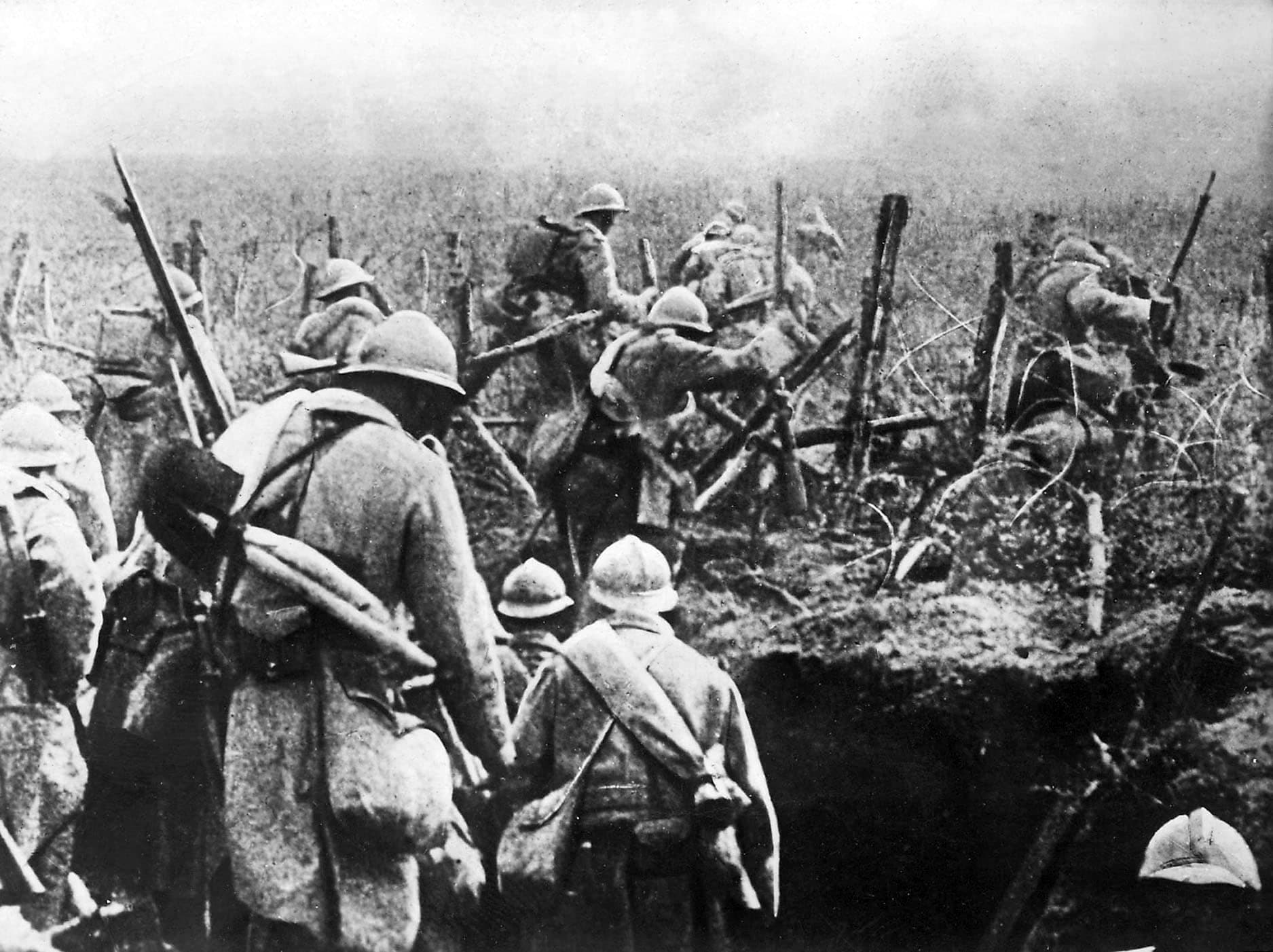
The German hope for a swift victory in the West dissolved in September 1914, when their advance was halted outside Paris. By the end of the year, the Western Front had frozen into a near-continuous, double line of trenches stretching from the English Channel to the Swiss border. This static, subterranean world of barbed wire, mud, and machine guns defied all traditional military doctrine. On the Eastern Front, the war remained more fluid and dynamic, but despite colossal troop movements and catastrophic casualties, neither side could achieve a decisive breakthrough. The conflict became a war of attrition, characterized by industrial slaughter on an unprecedented scale. At Verdun, the Somme, and Passchendaele, millions of men were hurled against fortified positions, supported by innovations in weaponry that transformed the nature of human combat: tanks, combat aircraft, sophisticated heavy artillery, rapid-fire machine guns, and clouds of lethal chemical gas.
As the stalemate dragged into its third year, the immense strain began to tear at the social fabric of the warring nations. In April 1917, the United States entered the conflict on the Allied side, provoked by Germany’s resumption of unrestricted submarine warfare against Atlantic shipping. This vital injection of American industrial and human resources arrived just as the Eastern Front collapsed. Exhausted by food shortages, military disasters, and economic ruin, the Russian Empire fell to revolution. By late 1917, the Bolsheviks had seized power; they signed an armistice with the Central Powers in December, followed by a formal peace treaty in March 1918.
Freed from the burden of a two-front war, Germany launched a massive spring offensive on the Western Front in 1918. The German troops made rapid initial gains, but they lacked the reserves to sustain the drive. The offensive left the German Army exhausted, undersupplied, and deeply demoralized. In August, the Allies launched the coordinated Hundred Days Offensive, utilizing combined-arms tactics to pierce the German lines. The Central Powers collapsed in rapid succession: Bulgaria surrendered in September following the Allied Vardar Offensive, followed by the Ottoman Empire and Austria-Hungary in early November. Left isolated, facing a naval mutiny and a spreading revolution at home, Kaiser Wilhelm II abdicated on November 9. Two days later, on November 11, 1918, an armistice silenced the guns of the Western Front.
The cost of the four-year struggle was catastrophic, leaving between 15 and 22 million military and civilian dead, and generating conditions that facilitated both systemic genocide and the rapid global spread of the deadly 1918 Spanish flu pandemic. The political landscape of the world was irrevocably redrawn. The Paris Peace Conference of 1919–1920 imposed severe terms on the defeated nations, most notably through the Treaty of Versailles, which stripped Germany of territory, restricted its military, and demanded immense war reparations. The ancient dynasties of Europe fell; the Russian, German, Austro-Hungarian, and Ottoman empires vanished from the map, replaced by a patchwork of new, independent states, including Poland, Finland, Czechoslovakia, Yugoslavia, and the Baltic states. Though the League of Nations was established in the war's aftermath to foster collective security, the deep economic scars, national resentments, and unresolved instabilities of this global trauma left a fragile peace—one that would endure for only twenty years before the world was pulled back into the flames.