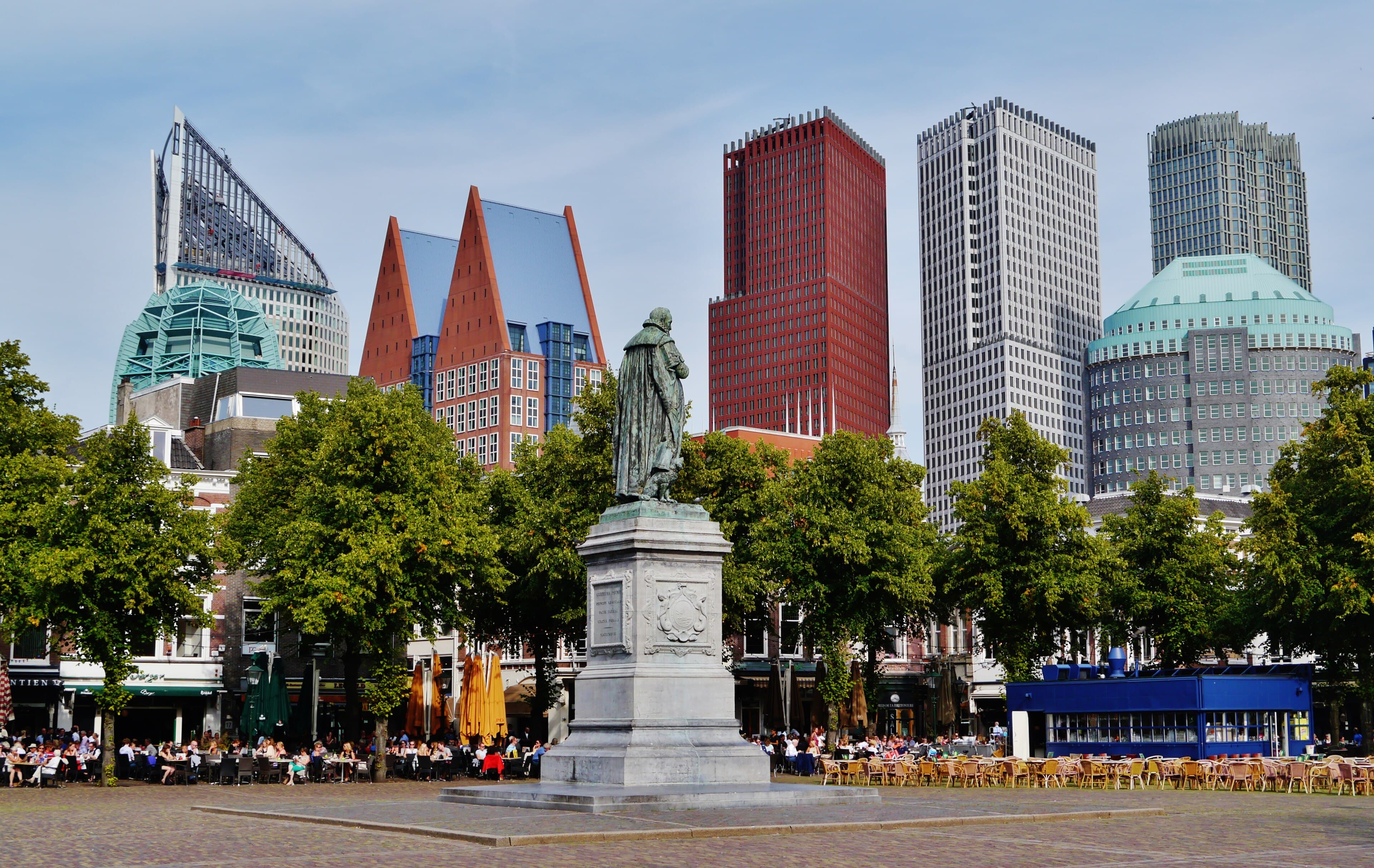
Before it became a global shorthand for international justice, the coastal settlement facing the North Sea was known in Middle Dutch simply as a hedge or hunting ground.
In the damp, coastal marshes where the dunes of the North Sea flattened into the peat bog of the Rhine-Meuse delta, there was once only a hedge. To the medieval inhabitants of the county of Holland, it was simply die Haghe—the enclosure, the hedge, the wooded hunting ground. It possessed no Roman walls, no deep-anchored cathedral foundations, and no ancient charter of municipal liberties. Yet by a strange, persistent historical inertia, this unfortified clearing in the woods grew to become the political heart of a global empire, the permanent theater of Dutch statehood, and eventually, the metonym for international justice itself. The Hague’s entire existence is defined by a peculiar paradox: it is a city that spent centuries refusing to be a city, a capital that is not officially the capital, and a place whose name has come to signify the containment of global violence through the quiet, bureaucratic administration of law.
The physical anchor of this paradox is the Binnenhof, a complex of brick and stone rising directly from the waters of the Hofvijver, a reflecting pool that was once a natural lake in the dunes. In 1229, Count Floris IV of Holland purchased a modest court here from a woman named Meilendis, intending to construct a grand castle. He died in a tournament in 1234 before the stones could be laid, but his son, William II—who was elected King of the Romans in 1248—returned to the site with imperial ambitions. He ordered his builders to transform the estate into a regale palacium, a royal palace. Though William met his death in 1256 before the grand design was realized, his son Floris V completed the work, including the soaring, timber-roofed Ridderzaal, or Knights’ Hall, which still stands today. Around this inner court, a village coalesced, first mentioned in a charter of 1242 as Die Haghe. To prevent the growing settlement from falling under the jurisdiction of local lords, the Counts of Holland carved it out of the rural district of Monster and established the Haagambacht—a distinct territory under their direct rule.
For centuries, this settlement existed as an anomaly. As the Burgundian Habsburgs inherited the lowlands in the fifteenth century, and as the Dutch later revolted against Spanish rule in the sixteenth, The Hague remained technically a village. It deliberately lacked the stone walls, towers, and defensive moats that defined the proud, self-governing cities of the Netherlands like Delft, Leiden, or Haarlem. This lack of fortification proved catastrophic during the Eighty Years’ War, when Spanish forces easily occupied and plundered the defenseless town. In 1575, the States of Holland, sheltering behind the walls of nearby Delft, went so far as to debate whether they should raze The Hague entirely to prevent it from serving as a permanent enemy base. Only the intervention of William the Silent saved the settlement. By 1588, with the birth of the Dutch Republic, the States General and the Stadtholder permanently established themselves back in the Binnenhof. Yet, to ensure that the central administration could maintain direct, unhindered control over its own seat of power, the government refused to grant The Hague official city rights. It was a metropolis in scale, the diplomatic nerve center of a merchant empire, but legally it remained a village—an administrative clearing governed by the state, for the state.
12 links to entries not yet ingested in the Library.
This tension between the official and the real defined the city’s identity well into the modern era. When Louis Bonaparte was installed by his brother Napoleon as the puppet king of Holland in 1806, he finally bestowed formal city rights upon the settlement. But the fall of the French Empire revived the old spatial compromise. When the United Kingdom of the Netherlands was formed as a buffer against France, the government split the difference between its northern and southern halves: Brussels and Amsterdam would alternate as the official capital every two years, but the actual administrative machinery remained firmly anchored in the palaces and offices of The Hague. After Belgium seceded in 1830, Amsterdam was named the permanent capital in the constitution, but the king, the parliament, the supreme court, and the foreign embassies remained in the city by the sea.
As the Dutch state expanded in the late nineteenth century, fueled by the immense wealth flowing from the administration of the Netherlands East Indies, The Hague transformed. The city expanded toward the sea, absorbing the old fishing village of Scheveningen into a grand seaside resort, and constructing elegant, leafy neighborhoods like Benoordenhout and the Statenkwartier to house returning colonial administrators and an army of domestic civil servants. It was during this era of late-nineteenth-century industrial wealth and imperial administration that The Hague’s destiny shifted from the governance of a nation to the arbitration of the world.
In August 1898, Count Mouravieff, the Russian Minister of Foreign Affairs, issued a circular note to the diplomatic corps in Petrograd. On behalf of Tsar Nicholas II, he proposed an international conference to address the ruinous spiral of global militarization and to seek "the most effectual means of ensuring to all peoples the benefits of a real and durable peace." The Dutch Queen Wilhelmina offered The Hague as the stage for this unprecedented gathering. When the First Hague Peace Conference convened in May 1899, it did not produce immediate disarmament, but it achieved something more enduring: the creation of the Permanent Court of Arbitration. A second conference in 1907 expanded these principles, codifying the laws and customs of war on land and sea, regulating everything from the status of merchant ships to the prohibition of "asphyxiating gases" and "expanding bullets."
These conferences transformed the name of a former hunting ground into a global synonym for international law. Andrew Carnegie was so moved by the potential of these assemblies that he donated the funds to construct the Peace Palace (Vredespaleis), a magnificent neo-Renaissance temple of justice completed on the eve of the First World War. Though the palace could not prevent the cataclysms of the twentieth century, it became the home of the Permanent Court of International Justice under the League of Nations, and subsequently the International Court of Justice, the principal judicial organ of the United Nations.
The twentieth century, however, did not spare the city from the very violence it sought to codify and restrain. During the German occupation in World War II, Nazi forces drove a massive scar through the city’s fabric, demolishing entire quarters to construct the Atlantic Wall—a defensive barrier of concrete bunkers and trenches designed to repel an Allied invasion from the sea. The Jewish population of the city was systematically deported and murdered. Then, in the final weeks of the war, tragedy struck from the air. On March 3, 1945, the British Royal Air Force, aiming to destroy German V-2 rocket launch sites in the Haagse Bos park, suffered a catastrophic navigational error. The bombs fell instead on the densely populated, historic residential quarter of Bezuidenhout, killing 511 civilians and leaving a smoking wasteland in the heart of the city.
The postwar era was defined by a desperate, massive reconstruction. In the 1950s and 1960s, The Hague became one of the largest building sites in Europe, expanding aggressively to the southwest to house a population that peaked at 600,000. In the decades that followed, middle-class flight to suburban towns like Zoetermeer and Rijswijk left behind a starkly divided city. The Hague of the late twentieth century was characterized by a sharp geographic and linguistic split: the affluent Hagenaars of the northern sand-dune neighborhoods, who spoke a refined, "posh" Dutch, stood in contrast to the working-class Hagenezen of the southern peat-soil neighborhoods, who spoke a robust, colloquial dialect.
Yet even as the city wrestled with these domestic transformations, its international footprint only grew. Today, the city is the host of the International Criminal Court, Europol, the Organisation for the Prohibition of Chemical Weapons, and more than two hundred international organizations and embassies. When the global community speaks of "bringing a case to The Hague," they are referring to a complex of modern glass offices and historic palaces situated just miles from the original medieval pond where Floris IV chose to build his court. The hedge that once merely marked a count's private hunting ground has become the boundary line for the conscience of the modern world.