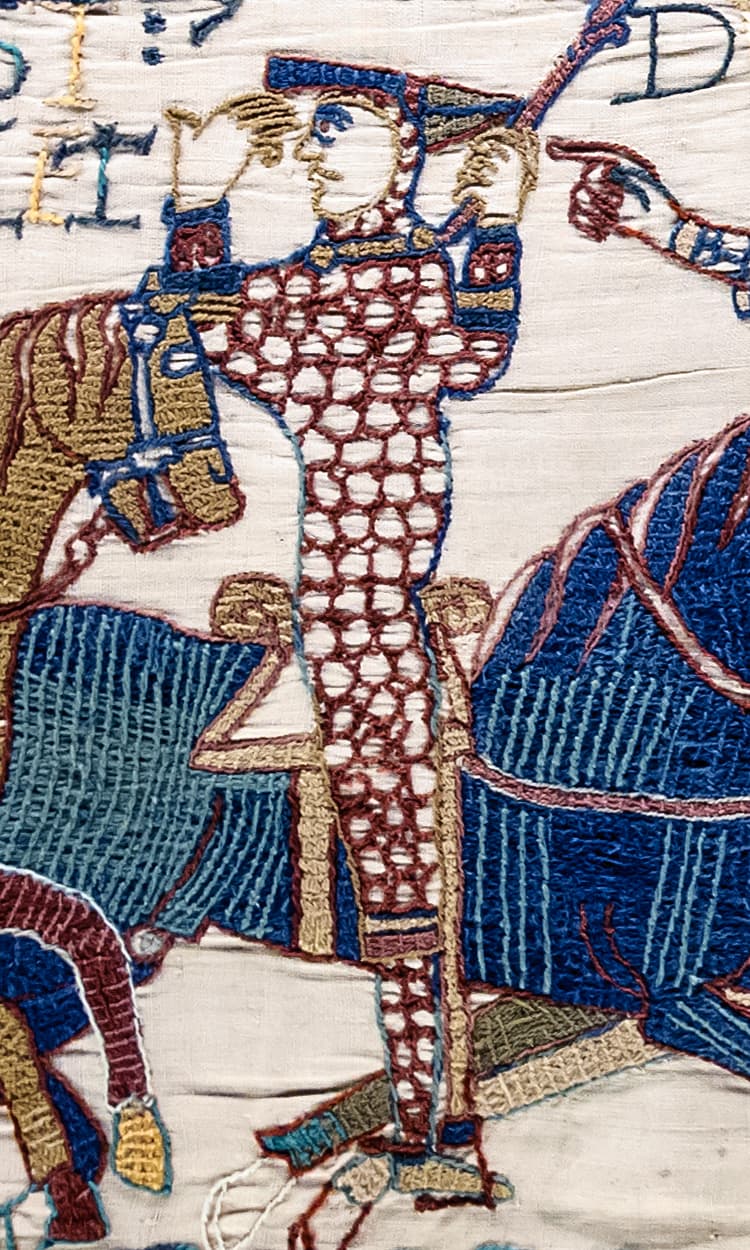
Before he was the Conqueror, he was William the Bastard, the illegitimate son of Duke Robert I of Normandy and his mistress Herleva.
He was born to a father who had likely poisoned his own brother to secure a duchy, and a mother who was the daughter of an undertaker or a tanner from the town of Falaise. To the courts of eleventh-century Europe, he was simply "William the Bastard." When his father, Robert I, Duke of Normandy, decided to walk to Jerusalem on a pilgrimage of penance in 1035, he forced his reluctant barons to swear fealty to this seven-year-old boy. It was a desperate precaution, and a necessary one: Robert died on the return journey, in the heat of Nicaea, leaving his young son as a solitary target in a land where the rule of law was merely a rumor. What followed was a decade of pure, desperate survival. The boy's guardians were murdered one after another in rapid succession. Alan of Brittany died mysteriously; Gilbert of Brionne was cut down; Turchetil was slain; and Osbern, the duke's steward, was throat-slit in the very bedchamber where the young William lay sleeping. For years, the child was a fugitive in his own land, dragged through the dark by his maternal uncle Walter, who hid him in the smoky, turf-walled cottages of peasants while aristocratic factions tore Normandy apart. This childhood of sudden flights, whispers in the dark, and the smell of blood in the sleeping quarters did not break William; it forged in him an icy, calculating vigilance and a profound, lifelong intolerance for disorder.
The anarchy of his youth ended not with a compromise, but in a slaughter. By 1046, the barons of lower Normandy had risen in open rebellion to replace him with his cousin, Guy of Burgundy. Escaping a midnight assassination attempt at Valognes, the teenage William rode hard to the court of King Henry I of France, begging the suzerain to protect his own investment in the Norman duchy. In 1047, the combined forces of the French king and the young duke met the rebels at the Battle of Val-ès-Dunes. It was a chaotic, brutal cavalry clash amid the plains of Caen, but when the dust settled, the rebel coalition was broken. William lost no time in asserting an absolute, almost sacred authority. He immediately promulgated the Truce of God across the duchy, legally banning warfare on certain holy days of the week—a clever political maneuver that framed any private aristocratic feud as an act of treason against both duke and God. Over the next decade, William systematically dismantled his enemies. He besieged Guy of Burgundy at Brionne for three grueling years until he broke him, drove the expansionist Count of Anjou, Geoffrey Martel, out of his borderlands, and seized the highly strategic frontier fortresses of Alençon and Domfront. By 1060, through relentless sieges and shifting alliances, the illegitimate boy had become the most formidable military strategist in northern Europe, his authority over Normandy absolute, his borders bolstered by his marriage to Matilda of Flanders, and his hand firmly on the appointments of the Norman church.
12 links to entries not yet ingested in the Library.
It was during this period of hard-won security that William turned his gaze across the English Channel. The English King, Edward the Confessor, was childless, and his court was a hotbed of intrigue. Edward was William’s first cousin once removed, and during Edward's long exile from the Danish kings who had seized England, the Norman court had offered him sanctuary. William claimed that during those years of exile, and again during a diplomatic visit in the early 1050s, Edward had promised him the English crown. The geopolitical waters were muddied further by Harold Godwinson, the Earl of Wessex and the most powerful noble in England. William maintained that Harold had once been shipwrecked on the Norman coast, where William had ransomed him, campaigned with him, and ultimately forced him to swear a solemn, relic-bound oath to support William's claim to the English throne. But oaths sworn in captivity are easily forgotten in the presence of a dying king. When Edward the Confessor expired in January 1066, he reportedly bypassed his distant Norman cousin on his deathbed and named Harold Godwinson as his successor. Harold was crowned almost immediately, setting the stage for a collision that would fundamentally reshape the Western world.
William’s response to Harold’s coronation was a masterclass in medieval logistics and psychological warfare. He did not merely summon his vassals; he advertised the invasion of England as a holy crusade, securing the blessing of the Pope and attracting land-hungry knights, mercenaries, and younger sons from Flanders, France, and Brittany to his banner. Throughout the summer of 1066, the banks of the River Dive groaned under the construction of a massive invasion fleet. When the winds finally shifted in September, William’s army crossed the Channel, landing at Pevensey while King Harold was away in the far north, exhausting his army to defeat a rival Viking invasion at Stamford Bridge. On October 14, 1066, the two armies met on a ridge near Hastings. For hours, the Anglo-Saxon shield wall held firm at the top of the hill, throwing back repeated Norman cavalry charges. The turning point came with the rumor of William’s death. Sensing panic, the duke ripped off his helmet to show his face, shouting to his men that he was still alive. He then ordered his cavalry to simulate retreats, drawing the defenders down from their secure high ground into disastrous, disorganized pursuits. By dusk, Harold Godwinson lay dead with his shield wall shattered, and the ancient Anglo-Saxon kingdom was conquered.
On Christmas Day, 1066, inside Westminster Abbey, William was crowned King of England. The ceremony was so tense that when the Norman soldiers stationed outside heard the congregation shout their assent in English, they mistook the noise for treason and began setting fire to the surrounding houses, filling the abbey with smoke and the screams of citizens. It was a fitting, ominous preview of the reign to come. The English did not submit quietly, and the decade following Hastings was a grueling sequence of rebellions. William crushed them with a chilling, systematic brutality, most notoriously during the winter of 1069–1070. To punish northern rebels who had allied with Danish raiders, William ordered the "Harrying of the North." His armies salted fields, burned crops, slaughtered livestock, and destroyed entire villages from York to the Durham border, causing a man-made famine so severe that contemporaries recorded people eating cats, dogs, and human flesh to survive. To cement this reign of terror, William introduced the castle to the English landscape—imposing stone keeps and wooden motte-and-bailey fortresses that towered over every major town, physical manifestations of an occupying force.
The conquest was not merely military; it was a total social and economic revolution. William systematically dispossessed the native Anglo-Saxon aristocracy, replacing them with a tiny, tight-knit network of Norman, Breton, and French barons who held their lands directly from the king in exchange for military service. To catalog this massive transfer of wealth and to calculate his taxes to the last penny, William ordered a comprehensive survey of his kingdom in 1086. The resulting document, which recorded every ox, hide of land, and tenant in the realm, was so absolute and inescapable that the conquered English compared it to the Last Judgment, naming it the Domesday Book. Yet, for all his revolutionary control over England, William never sought to forge his territories into a single, unified empire. He ruled England as king and Normandy as duke, keeping their administrations, laws, and languages entirely separate, constantly crossing the stormy Channel to defend his continental borders against the King of France, neighboring counts, and his own rebellious eldest son, Robert Curthose.
William’s end was as violent and turbulent as his beginning. In the summer of 1087, while campaigning in northern France against the French king, his horse stumbled on burning embers during the sack of Mantes. The high pommel of his saddle ruptured his internal organs, and he spent several agonizing weeks dying at the priory of Saint-Gervais near Rouen. On September 9, 1087, the great Conqueror breathed his last. What followed was a scene of grim dark comedy: his attendants immediately plundered his bedchamber, leaving his royal corpse stripped naked on the floor. When his body was finally taken to Caen for burial, it was found to be too bloated for the stone sarcophagus his stonecutters had prepared; when the undertakers tried to force the heavy corpse into the tomb, the abdomen burst, filling the church with a stench so putrid that the mourners fled into the streets. In his will, he divided his domains, leaving Normandy to his troublesome eldest son Robert, and England to his second surviving son, William Rufus. He left behind a transformed Britain, forever severed from its Scandinavian orbit and permanently bound to the politics, culture, and language of continental Europe.