Event · 733 CE – 1492 CE · Islamic Caliphates
Reconquista
- Also known as
- A Reconquista
- A Reconquista Cristã
- An Athghabháil
- Caiguda d'al-Àndalus
- Catholic conquest of Spain
- Conquesta cristiana hispànica
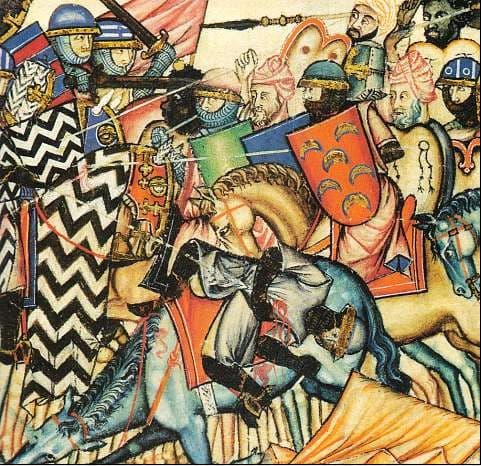
For nearly eight hundred years, the Iberian Peninsula was defined by a shifting, fragmented frontier where military ambition and religious identity collided.
In the summer of 711 CE, a commander named Tariq ibn Ziyad led a predominantly Berber army across the narrow strait separating North Africa from the Iberian Peninsula. He met the Visigothic king, Roderic, at the Battle of Guadalete amidst a backdrop of severe infighting and division within the Christian kingdom. Betrayed by deserting troops, Roderic was defeated and drowned in the waters of the Guadalquivir. Within a few years, the invading Islamic forces, numbering no more than sixty thousand men, swept across the peninsula. Major strongholds like Mérida, Córdoba, Zaragoza, and the Visigothic capital of Toledo fell in rapid succession, while other regions negotiated autonomy treaties to preserve their local governance. Yet, almost as soon as the conquest was complete, the seeds of a legendary counter-narrative were sown. In the high, fractured valleys of the northern Asturias, a small band of Christian holdouts achieved a modest victory over an Umayyad force at the Battle of Covadonga, traditionally dated to around 718 or 722 CE. It was a localized skirmish, but in the centuries that followed, this minor clash in the mountains would be transfigured into the opening salvo of the Reconquista—an eight-century crusade to reclaim the entire peninsula for the Christian faith.
The reality of those eight centuries was far more fluid, pragmatic, and collaborative than the myth of a continuous holy war allows. For long stretches of medieval Iberian history, the frontier was not a wall of fire, but a porous zone of cultural exchange, commerce, and political maneuvering. Christian and Muslim rulers routinely fought their own coreligionists, often forming cross-faith alliances to secure their borders or destroy domestic rivals. In the ninth century, Íñigo Arista, the Christian founder of the Kingdom of Pamplona, maintained a close and enduring alliance with the Muslim Banu Qasi clan. Mercenaries drifted between the courts of northern Christian kings and southern Muslim emirs, fighting simply for the highest bidder. Long episodes of relative religious coexistence and tolerance characterized daily life, nurturing environments like the Golden Age of Jewish culture in Spain. Documents from the tenth and eleventh centuries remain entirely silent on the concept of a grand "reconquest."
The ideological hardening of the conflict began to crystallize only in the late eleventh century, energized by the arrival of the Crusades. As northern Christian polities like León, Castile, Aragón, Navarre, and Portugal pushed southward, they encountered a fragmented Muslim south. By the early eleventh century, the formidable Umayyad Caliphate of Córdoba had shattered into dozens of petty successor states known as . The northern Christian kingdoms exploited this fragmentation, demanding heavy tribute payments, or , in exchange for military protection. In response to this mounting Christian pressure, successive waves of fundamentalist Berber dynasties—first the Almoravids and later the Almohads—crossed from North Africa to bolster the Muslim defense. These dynasties brought a staunch ideology of jihad that mirrored the crusading zeal of the north. On both sides, writers began to project a rigid cultural and religious divide onto the peninsula's history, crafting propaganda to justify their violence. It was during this era of escalating tension that northern chroniclers began looking backward, inventing an unbroken lineage of struggle connecting the lost Visigothic Kingdom to the contemporary Christian states.
Connected to
- participated inKingdom of Portugal1139 CE
- participated inUmayyad Caliphate661 CE
+ 12 further connections to entries not yet ingested