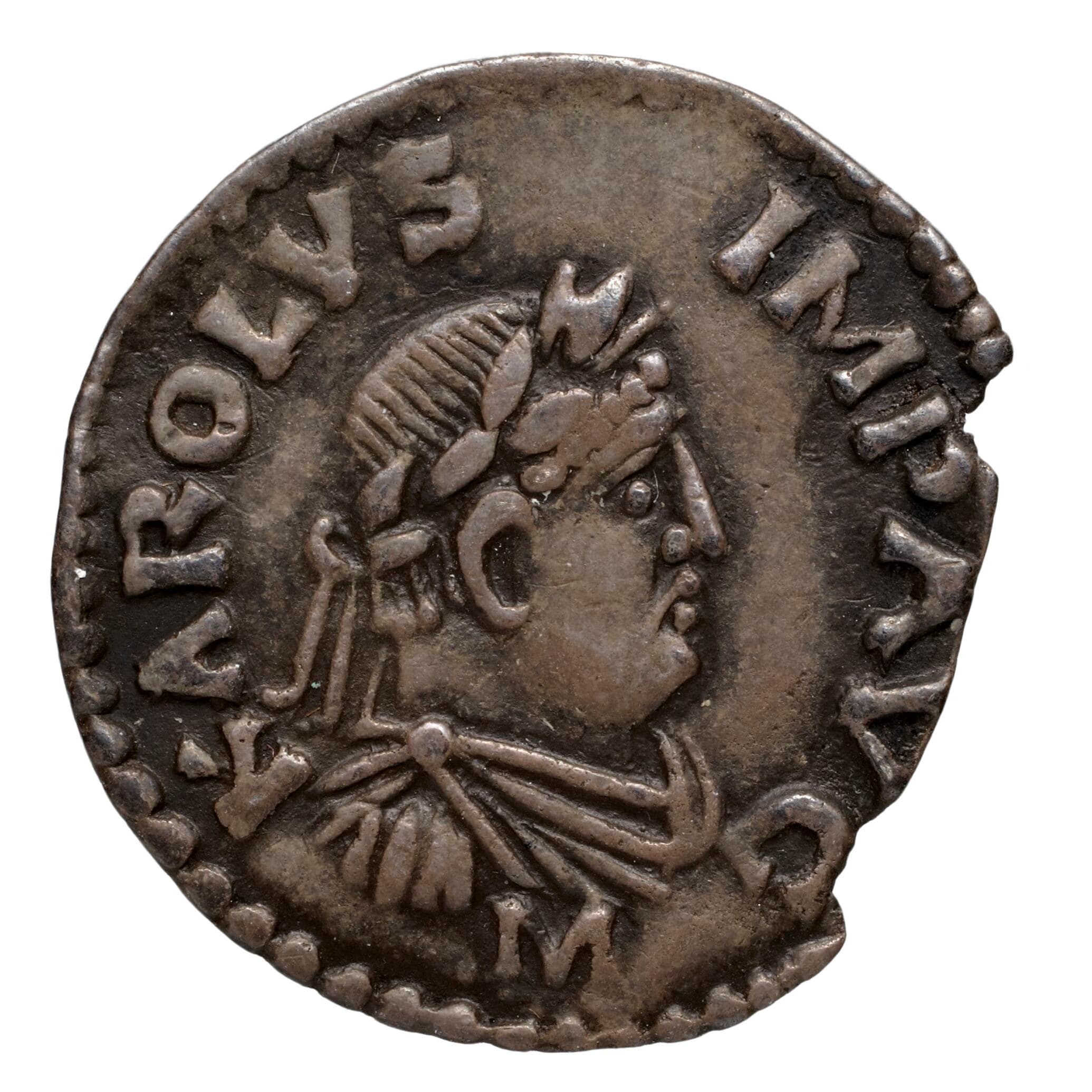
Three centuries after the collapse of the Western Roman Empire, a single ruler bound the fractured territories of Western and Central Europe back into a unified whole.
Late in the eighth century, a scribal copyist in the monastery of Lorsch set down a date: the second of April. He was recording the birth of a boy born some decades earlier, likely in the year 748, whose native tongue was a rough Germanic dialect of the Rhineland and whose future would redefine the geography of Europe. The child, named Charles after his grandfather Charles Martel, grew up in the itinerant, weapon-heavy atmosphere of the Frankish court, where the business of rule was conducted from the saddle and literacy was a rare, decorative luxury. He was a child of Austrasia, the northeastern heartland of a fragmented Frankish kingdom that had long outgrown its old Merovingian rulers. By the time he died in the damp winter of 814, his name would be fused with the Latin word for greatness, magnus, and in the Slavic tongues of the east, his very name, Karolus, would become the common noun for "king."
The rise of the Carolingian dynasty was a slow usurpation made legitimate by holy oil. Charles’s father, Pepin the Short, had sidelined the last of the faint-haired Merovingians with the quiet complicity of the bishop of Rome. In 754, Pope Stephen II traveled north to the abbey of Saint-Denis to anoint Pepin and his young sons, Charles and Carloman, marking them out as the divinely sanctioned protectors of the Roman Church. When Pepin died in 768, the Frankish custom of partible inheritance split the realm. Charles took the northern arc of the kingdom, crowning himself at Noyon, while his brother Carloman ruled the south from Soissons. It was a fragile, suspicious peace. When a chronic rebellion flared in Aquitaine, Carloman withdrew his forces, leaving Charles to finish the campaign alone. The sudden death of Carloman in December 771 averted a civil war. Charles moved swiftly to secure his brother’s lands, prompting Carloman's widow to flee with her children to the court of Desiderius, the king of the Lombards in northern Italy.
This flight shifted the gravity of Charles’s reign toward the south. Bound by his father’s promises to the papacy, Charles crossed the Alps in 773 to answer the pleas of Pope Adrian I, who was hard-pressed by Lombard incursions. The high mountain passes yielded to Frankish discipline. Charles besieged Desiderius in his capital of Pavia, and by the Easter of 774, the Frankish king was entering Rome in triumph. He renewed the vast, disputed territorial donations his father had promised the papacy—grants that ostensibly covered much of Italy and Corsica, though Charles remained pragmatic about where his actual sovereignty lay. Pavia fell that June. Desiderius was shorn of his crown and sent to a monastery, and Charles assumed the iron crown of the Lombards. He was no longer just a Frankish warlord; he was the Patrician of the Romans, his authority now straddling the Alps and anchoring itself in the ancient soil of the peninsula.
+ 12 further connections to entries not yet ingested
To the north and east, however, lay a far more stubborn frontier. For more than thirty years, from 772 until 804, Charles was locked in a brutal, intermittent conflict with the Saxons, a confederation of pagan tribes whose territories stretched across the great northern plains. This was not merely a war of territorial expansion but a campaign of cultural and religious erasure. The Saxons fought with the ferocity of those defending their ancestral gods, while the Franks marched with the conviction of a holy crusade. Conversion was enforced at the point of a sword; those who refused baptism or relapsed into pagan rites were systematically executed, most notoriously in 782 at the Massacre of Verden, where thousands of Saxon prisoners were put to death in a single day. Year after year, the Frankish hosts returned to lay waste to Saxon fields, destroy their sacred groves, and build stone churches where old idols had stood.
Even as he battered the northern forests into submission, Charles looked to the south and west. In 777, three Saracen chiefs arrived at his court in Paderborn, offering allegiance and Spanish cities in exchange for military aid against the Caliph of Cordova, Abd-ar-Rahman. Sensing an opportunity to push his borders beyond the Pyrenees, Charles marched into Spain in 778. The campaign yielded little but frustration. After taking Pamplona, Charles faced reversals and decided to retreat. As the Frankish baggage train defiled through the narrow, high passes of the Pyrenees on the fifteenth of August, the native Wascones—the Basques—ambushed the rearguard from the heights. The Frankish soldiers, caught in the gorges, were annihilated before the enemy melted back into the mountains. Among the dead was Hruodland, the margrave of the Breton march. It was a minor military disaster, quickly hushed up by contemporary annalists, but it would become immortalized in the collective memory of Europe as the Chanson de Roland, transforming a chaotic mountain skirmish into the quintessential medieval epic of chivalry and doom.
By the final decade of the eighth century, Charles’s court had settled in Aachen, a place chosen for its healing hot springs and its central position in the northern empire. Here, he sought to govern through intellect as much as by arms. Though he struggled to master the physical art of writing—keeping wax tablets under his pillow to practice the formation of letters in his spare hours—he was functionally bilingual in Germanic and Romance dialects, understood Latin, and could grasp some Greek. He gathered around him the finest minds of his age, initiating the cultural revival known as the Carolingian Renaissance. Through a series of capitularies, he reformed administration, standardized the coinage, abolished unauthorized tolls, and banned the sale of weapons to hostile peoples.
This consolidation of administrative and cultural power found its ultimate expression on Christmas Day in the year 800. While Charles knelt in prayer at the altar of St. Peter’s Basilica in Rome, Pope Leo III placed a crown upon his head, hailing him as Emperor of the Romans. Whether Charles was surprised by the act, as his biographer Einhard later claimed, or whether it was the carefully orchestrated climax of years of diplomacy, the coronation shattered the old Mediterranean order. For three centuries, the sole claimant to the Roman imperial title had resided in Constantinople. This new coronation in the West brought Charles into immediate diplomatic friction with the Eastern Roman Empire, but it also signaled a profound shift: the center of Western civilization had migrated north, away from the Mediterranean basin and into the fertile river valleys of Gaul and Germany.
Charles’s vast empire did not long survive the generation of his children; the Frankish habit of dividing inheritance, combined with the administrative impossibility of defending such borders against the rising threat of Viking and Magyar raids, would soon fracture his lands. Yet the mold had been cast. By bringing together the Germanic, Roman, and Christian traditions under a single administrative framework, he created the geopolitical blueprint of Western Europe. When he died of fever in January 814 and was buried beneath the stone arches of his Palatine Chapel in Aachen, he left behind a continent that had begun to recognize itself as a singular entity. The royal houses of Europe would trace their bloodlines to his court for a thousand years, and his name would remain preserved in the very vocabulary of kingship across the Slavic world—a permanent ghost in the architecture of European power.