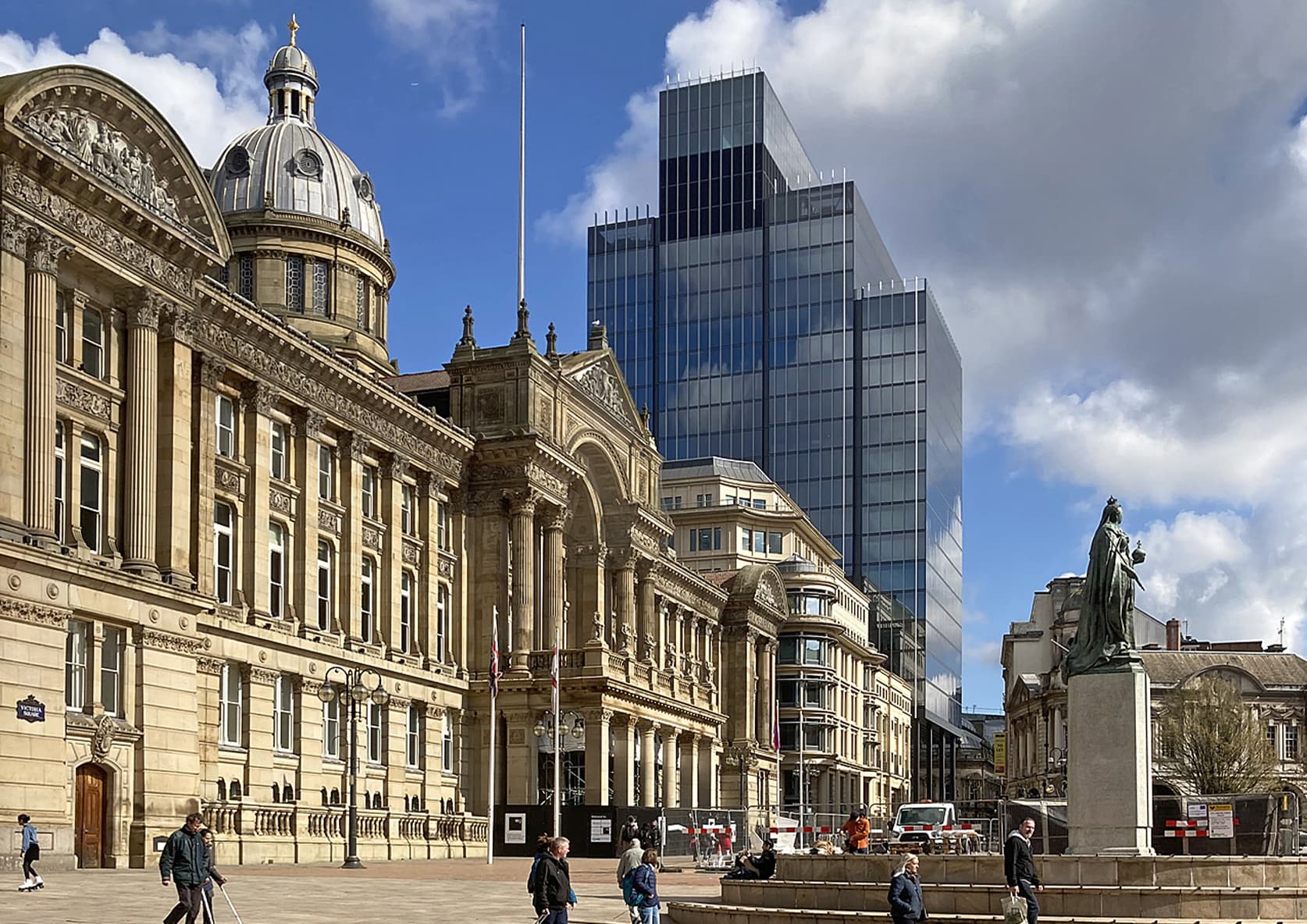
The foundations of modern industrial society were forged not in a traditional capital, but in a landlocked market town of Warwickshire.
Around the year 600 CE, deep within the heavily forested, shadow-dappled interior of the English Midlands, a leader named Beorma established a clearing. He was a man of the Anglo-Saxons, and his people, the Beormingas, gave their name to the place they claimed: Beormingahām, the home of Beorma’s people. The site was not chosen for its grandeur. Unlike the old Roman legions who had marched through these same dense woods of the Arden region over five centuries earlier, building the great fort of Metchley to secure their military roads, Beorma’s clan sought no strategic high ground. They settled on the Birmingham Plateau, a high, inland rise of land where no major rivers ran. Only the modest River Tame and its small, shallow tributaries, the Rea and the Cole, cut through the clay and sandstone. To the west lay the rugged Shropshire Hills; to the south, the rolling limestone of the Cotswolds. The settlement was an island of human habitation in a vast ocean of oak and birch, a fragile node of Mercian frontier life that seemed destined for the quiet obscurity of a farming hamlet.
Yet place-names ending in -ingahām denote primary, foundational settlements, and around this original clearing, the landscape slowly fractured into a mosaic of secondary hamlets. One by one, new clearings appeared: farms ending in -tūn, woodland pastures ending in -lēah, and enclosures ending in -worð. For five centuries, this cluster of woodlanders and farmers endured in relative isolation, until a single political act in 1166 set a different destiny in motion. In that year, Peter de Bermingham, the Lord of the Manor, obtained a royal charter to hold a weekly market at his castle. He did not merely host a market; he designed a town around it, platting a new seigneurial borough on his manorial estate at the site that would become known as the Bull Ring. The timing was exquisite. Population growth across England was driving the clearance of marginal lands, and Birmingham, situated at the geographic heart of the island, became the essential commercial crucible for the entire plateau. By 1327, the obscure Saxon clearing had outgrown almost all its ancient rivals, standing proud as the third-largest town in Warwickshire.
The true genius of the place, however, lay in its rejection of traditional English structures. Between 1536 and 1547, the principal institutions that had governed medieval Birmingham—the lordship of the de Birmingham family and the wealthy Guild of the Holy Cross—abruptly collapsed. This institutional vacuum did not breed chaos; instead, it birthed an unprecedented degree of social and economic freedom. While other English cities remained bound by medieval guild restrictions, rigid municipal charters, and the paternalistic deference owed to the landed gentry, Birmingham became a free-market frontier. As early as 1538, observers noted the extraordinary volume of ironworking in the town. Lacking the deep, navigable rivers that carried the commerce of other great cities, Birmingham’s craftsmen focused on highly finished, high-value metal goods that could be easily transported by road. Iron merchants flocked to the town, organizing finance, supplying raw materials, and marketing finished products. By the seventeenth century, Birmingham was the commercial hub of a metallurgical network stretching from South Wales to Cheshire, its merchants shipping nails, tools, and weapons as far as the West Indies.
11 links to entries not yet ingested in the Library.
This atmosphere of pragmatism and self-determination shaped a distinct civic psychology. During the English Civil War, the town’s booming economy and high social mobility produced a culture that had little use for the traditional hierarchies of the Crown or the established Church. In the 1630s, Birmingham became a stronghold of Puritanism, and by 1643, its fiercely Parliamentarian sympathies provoked a destructive assault by Royalist forces in the Battle of Birmingham. Following the Restoration of the monarchy, the town became a haven for Nonconformists, dissenters who were legally barred from living in older, chartered corporate boroughs. These religious and political exiles brought with them a fierce intellectual independence. By 1700, the population had increased fifteen-fold, transforming Birmingham into the fifth-largest town in England and Wales. It was here, in this melting pot of free-thinkers, that the Midlands Enlightenment erupted.
The eighteenth-century town became a theater of intense intellectual and practical collaboration, epitomized by the Lunar Society of Birmingham. In this informal club, natural philosophers, industrial pioneers, and writers met to discuss the mysteries of the physical world. Unlike the academic elite of Oxford or Paris, Birmingham’s thinkers were also its doers. Men like Matthew Boulton and James Keir bridged the gap between pure science and the workshop floor, igniting what has been described as a "chain reaction of innovation." In 1709, Abraham Darby I, who had trained in Birmingham, moved to nearby Coalbrookdale to construct the first blast furnace that successfully smelted iron ore with coke, a breakthrough that allowed cast iron to be produced on an unprecedented scale. In 1732, Lewis Paul and John Wyatt invented roller spinning, opening the world's first mechanized cotton mill in Birmingham’s Upper Priory in 1741. In 1746, John Roebuck invented the lead chamber process for manufacturing sulphuric acid, while James Keir developed a method for bulk alkali production, effectively founding the modern chemical industry.
By 1791, observers hailed Birmingham as "the first manufacturing town in the world." Yet its industrialization looked nothing like the dark, satanic mills of the cotton-spinning North. Birmingham did not rely on massive, capital-intensive factories staffed by low-paid, unskilled laborers. Instead, its prosperity was built upon an intricate web of thousands of small, specialized workshops. Highly skilled, well-compensated artisans practiced specialized trades, constantly diversifying their output to meet the whims of global fashion. This decentralized, entrepreneurial economy fostered an astonishing level of creativity: between 1760 and 1850, Birmingham residents registered more than three times as many patents as those of any other British city. To fuel this furious commercial engine, the town pioneered modern financial institutions. Lloyds Bank was founded here in 1765, followed in 1775 by Ketley's Building Society, the world's first building society. By the turn of the nineteenth century, the West Midlands boasted more banking offices per capita than any other region in Britain, London included.
This economic agility translated directly into political radicalism. The high level of social mobility in the workshops—where a journeyman could easily save enough to open his own tenement hearth—created a politically conscious working and middle class. Under the leadership of reformers like Thomas Attwood and, later, the municipal reformer Joseph Chamberlain, Birmingham exercised a political influence in the nineteenth century unmatched by any British city outside the capital, playing a pivotal role in the expansion of British democracy.
The twentieth century brought both devastation and transformation. Between the summer of 1940 and the spring of 1943, the German Luftwaffe subjected the city to the Birmingham Blitz, shattering its historic core. The post-war era saw a deliberate, often ruthless policy of demolition and reconstruction by municipal planners, who replaced damaged Victorian streets with modern concrete ring roads, towers, and shopping centers. Though the manufacturing supremacy that had sustained the city for four centuries began to wane in the late twentieth century, Birmingham reinvented itself once more. The city where Beorma’s people once cleared the woods of Mercia became a sprawling, modern metropolis of 1.2 million people—the heart of a wider metropolitan region of 4.3 million. Its economy shifted from the clatter of the metal workshop to the quiet transactions of the service, financial, and higher education sectors.
Today, Birmingham stands as the second-largest city in the United Kingdom, its landscape defined by the complex web of the Birmingham Canal Navigations and the glittering cultural institutions like the City of Birmingham Symphony Orchestra, the Birmingham Royal Ballet, and the sprawling Library of Birmingham. It is a city that, from its obscure, landlocked origins in 600 CE, has consistently reshaped itself through human ingenuity, converting a lack of natural geographic advantages into a triumph of sheer human enterprise.