Place · 3k BCE – 0k CE · Mesopotamian Civilizations
Babylon
- Also known as
- an Bhablóin
- Baabel
- Baabiyloon
- Babel
- Babel
- Babel
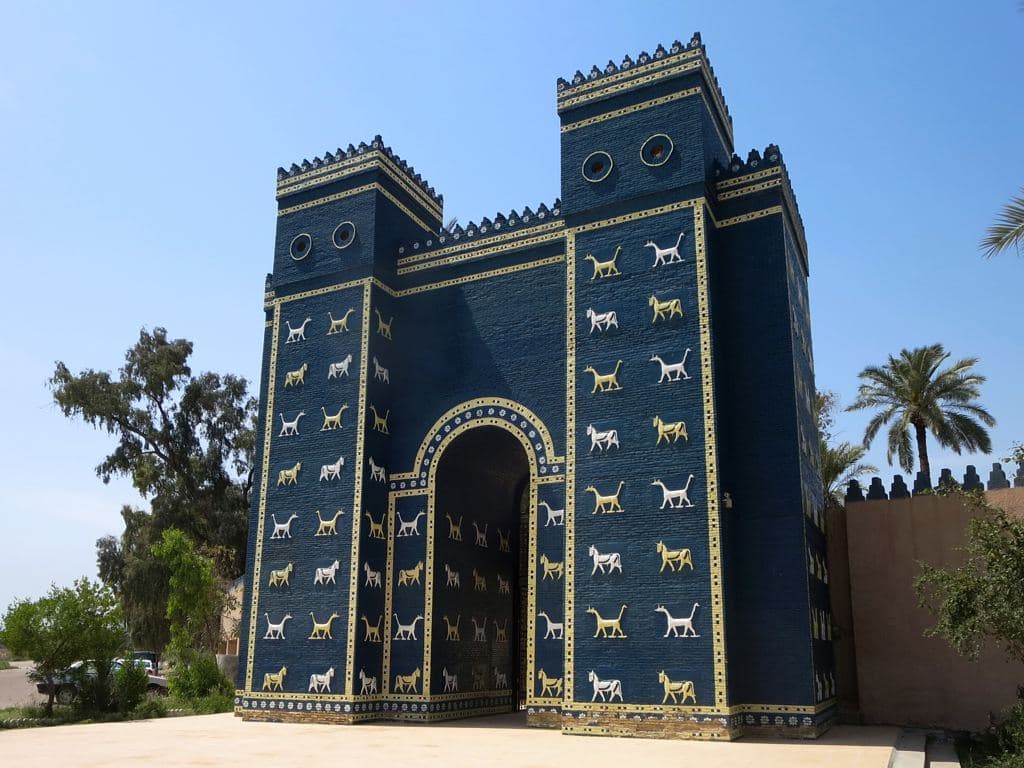
Long before it became a synonym for imperial grandeur, Babylon was merely a quiet religious outpost on the lower Euphrates River, subject to the whims of the Akkadian Empire.
Under the alluvial sun of southern Mesopotamia, where the lower Euphrates once split into shifting channels, there rose a city whose very name became an archetype of human ambition, splendor, and ruin. Long before it was a symbol of imperial hubris in the minds of Judean exiles, or a metropolis of glittering tiled walls described by Greek travelers, Babylon was merely a quiet sanctuary. On a clay tablet from the late third millennium BCE, during the reign of the Akkadian king Shar-Kali-Sharri, it appears not as a seat of kings, but as a provincial node centered on the temples of ancient deities. Locally, it was known by its Semitic folk etymology, Bābilim—the "gate of the god"—a name that scribes translated into the older, prestigious Sumerian tongue as Kan-dig̃irak. Yet this sacred gateway was destined to swallow the political landscape of the Near East, transforming from a subject town under the dynasties of Akkad and Ur into the center of gravity for an entire civilization.
The transformation of Babylon from a provincial shrine into an imperial capital began in earnest during the early second millennium BCE with the rise of its Amorite rulers. It was the sixth king of this line, Hammurabi, who in the eighteenth century BCE consolidated a vast territory, elevating Babylon to the undisputed political and cultural capital of southern Mesopotamia—a region thereafter known as Babylonia. Under Hammurabi’s administration, the city eclipsed older, venerated religious centers like Nippur. Babylon’s local deity, Marduk, was elevated to the summit of the Mesopotamian pantheon, establishing a theological hegemony that mirrored the city’s political dominance. To rule this world, a monarch had to "take the hands" of Marduk in his temple, receiving the god’s divine endorsement as his adopted son. This ritual was so potent that for the next fifteen hundred years, foreign conquerors—from Assyrian militarists to Persian emperors—sought legitimization through this symbolic submission to Babylon’s patron god.
The path of the city, however, was never one of uninterrupted triumph. The collapse of Hammurabi’s empire ushered in centuries of shifting fortunes, during which Babylon was ruled by Kassite and Elamite dynasties, and repeatedly coveted, sacked, and rebuilt by the militaristic Assyrians. The relationship between Assyria and Babylon was fraught with a tense cultural insecurity; the Assyrians revered Babylon’s deep antiquity and religious authority even as they sought to subjugate its people. When the Assyrian king Sennacherib, frustrated by persistent rebellions, chose in 689 BCE to utterly destroy the city—razing its walls and dumping its sacred ruins into the Arakhtu canal—the act sent a shockwave through the ancient world. It was viewed as a sacrilege so profound that Sennacherib’s subsequent assassination was widely interpreted as divine retribution. His successor, Esarhaddon, quickly set about rebuilding the city, restoring its temples and choosing to reside there for part of the year to heal the rift with the Babylonian priesthood.
The true architectural apotheosis of Babylon arrived with the fall of the Assyrian Empire and the rise of the Neo-Babylonian dynasty in the late seventh century BCE. Under Nabopolassar and his son, Nebuchadnezzar II, the city was rebuilt on a scale that stunned contemporaries. It was during this era, spanning roughly 612 to 320 BCE, that Babylon grew into what was likely the most populous city on earth, perhaps the first in human history to surpass two hundred thousand residents. To protect this immense population, Nebuchadnezzar encircled the city with a monumental system of double brick walls, Imgur-Bel and Nimitti-Bel. The great Euphrates split the city in two, spanned by a thirty-foot-wide drawbridge supported by massive stone piers, connecting the old palace of Nabopolassar on the east with new, sprawling royal complexes.
The visual landscape of Nebuchadnezzar's Babylon was designed to inspire awe. The Processional Way, paved with stone and bordered by walls of brilliant blue glazed brick depicting lions and dragons in relief, led to the towering Ishtar Gate. At the heart of the city rose the Etemenanki, a colossal ziggurat dedicated to Marduk, which classical authors frequently confused with the city’s defensive walls in their grandiose, exaggerated accounts. While Greek historians like Herodotus and Ctesias described walls of impossible heights and hundreds of bronze gates, archaeological realities present a city that was indeed massive—enclosing hundreds of hectares—but built of the earth itself: millions of sun-dried and kiln-baked clay bricks bound with bitumen. Among these wonders, the legendary Hanging Gardens were celebrated by later Roman and Greek writers, though they remain a historical specter, entirely unmentioned in the abundant cuneiform records left by the Babylonians themselves.
The zenith of the Neo-Babylonian Empire was brief, ending in 539 BCE when the city surrendered without a fight to Cyrus the Great of Persia. Under Persian Achaemenid rule, Babylon remained a prized regional capital, but the seed of its long, slow decline had been planted. Rebellions against Darius I and Xerxes led to the dismantling of some of its formidable defenses, and Xerxes reportedly pulled down portions of the great temple of Esagila. Yet the city’s allure remained potent enough that when Alexander the Great swept through the East, he intended to make Babylon the capital of his own global empire. It was in the palace of Nebuchadnezzar, amidst the brick and dust of Mesopotamia, that Alexander died in 321 BCE, his grand designs unfinished.
The death of Alexander marked the beginning of the end for the living metropolis. The subsequent Seleucid dynasty founded a new capital nearby, Seleucia on the Tigris, and systematically drained Babylon of its population. A cuneiform tablet from 275 BCE records the forced relocation of Babylon's citizens to this new Hellenistic city. Though priests continued to perform sacrifices in the ancient chambers of Esagila for another century, the grand palaces and temples gradually crumbled into mounds of clay. By the eleventh century CE, the city that had once ruled the Near East had shrunk to a tiny settlement known simply as the "small village of Babel."
The modern rediscovery of Babylon was a saga of imperial competition and archaeological transition. In the nineteenth century, early explorers like Claudius Rich and Hormuzd Rassam excavated the site, often using industrial-scale digging methods that retrieved thousands of cuneiform tablets but devastated the physical context of the ruins. A mid-century French expedition under Fulgence Fresnel ended in disaster when a boat carrying over two hundred crates of priceless artifacts was attacked by river pirates and sank into the Tigris. It was not until 1899, with the arrival of a German Oriental Society team led by Robert Koldewey, that systematic, scientific excavation began. Koldewey’s team worked for nearly two decades, racing against local brick miners who were dismantling Nebuchadnezzar's palaces to build dams and houses, eventually reconstructing the vibrant blue tiles of the Ishtar Gate in Berlin. Today, the ruins of Babylon, recognized as a UNESCO World Heritage Site, lie near the modern Iraqi city of Hillah. Surrounded by encroaching modern developments and rising water tables that threaten the deepest, oldest layers of its history, the site remains a quiet testament to the fleeting nature of human empires.
Connected to
- in countryAchaemenid Empire550 BCE
- place of death ofAlexander the Great356 BCE
- in countryMacedonia808 BCE
- place of death ofNebuchadnezzar II642 BCE
- in countryNeo-Assyrian Empire