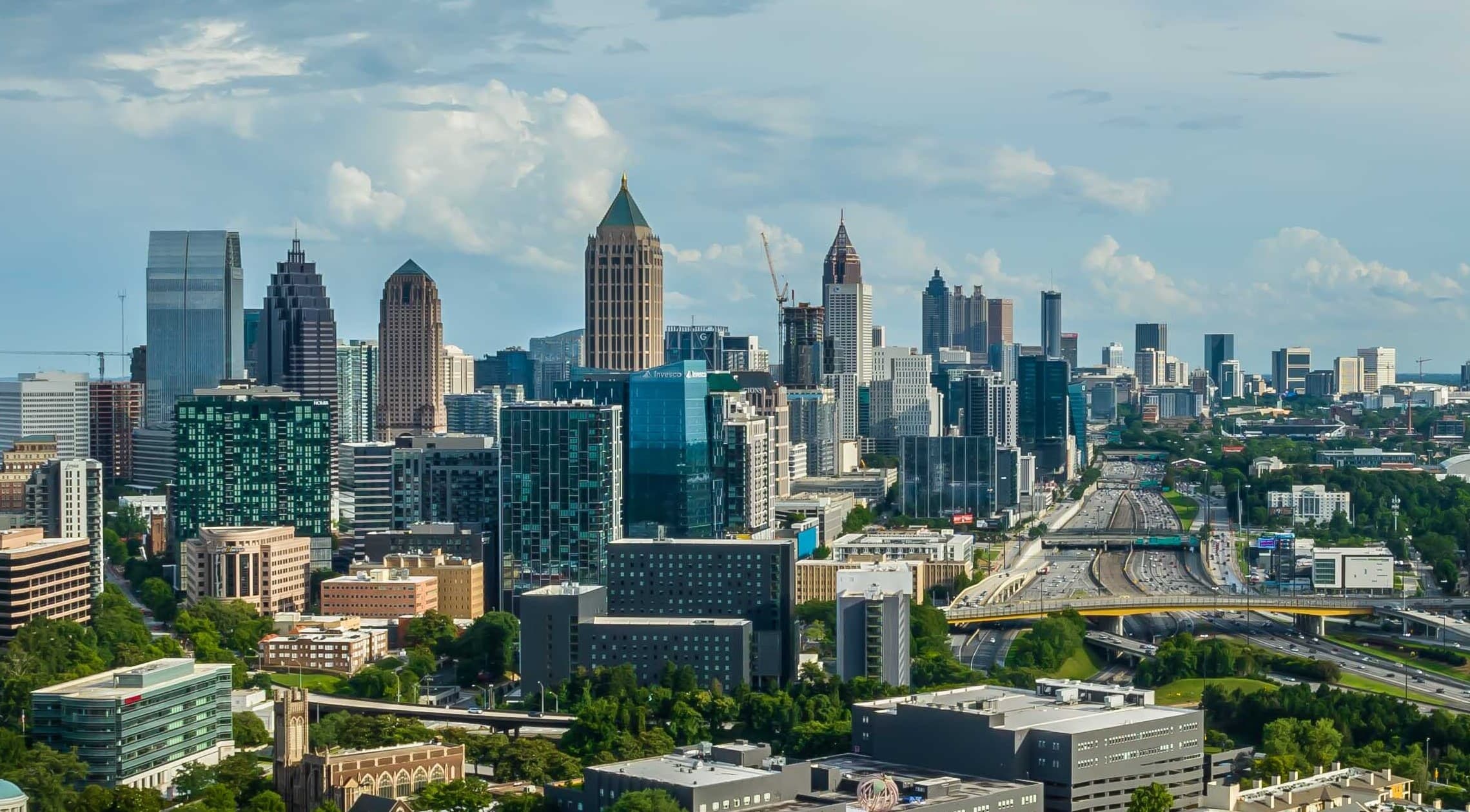
Before it was a city, Atlanta was simply a destination point—the designated terminus of a state-sponsored railroad winding through the foothills of the Appalachian Mountains.
In the winter of 1837, Stephen Harriman Long, a seasoned engineer surveying the rugged foothills of the southern Appalachian Mountains, stood near a freshly driven stake in the red clay of north Georgia. He had been tasked with finding the southern terminus for a ambitious, state-sponsored rail line designed to connect the Atlantic port of Savannah with the inland markets of the American Midwest. Looking out over the rolling, thickly forested hills, more than a thousand feet above sea level, Long was unimpressed by the isolated wilderness. When pressed on the future of the spot designated as the "zero milepost," he predicted it would prove suitable "for one tavern, a blacksmith shop, a grocery store, and nothing else." It was a spectacular miscalculation. Within a generation, this empty ridge on the Eastern Continental Divide—the water-parting line between the Atlantic Ocean and the Gulf of Mexico—would become the vital gate through which the commerce, conflict, and culture of the American South would flow.
Before the iron rails arrived, the land was defined by the deep, shaded valleys of Peachtree Creek and the Chattahoochee River, inhabited for millennia by the Creek and Cherokee peoples. The closest native settlement to the future city was Standing Peachtree, a Creek village perched where the creek met the river. Through the early decades of the nineteenth century, European-American settlers systematically encroached upon these ancestral grounds. By 1821, under the pressure of federal Indian removal policies, the Creek were forced to cede their lands, leaving the region open to a wave of white settlers who arrived the following year. When the Georgia General Assembly authorized the construction of the Western and Atlantic Railroad in 1836, the stage was set for a dramatic technological imposition upon the landscape. The humble settlement that grew around Long's zero milepost was initially known simply as Terminus. By 1842, it was a hamlet of six buildings and thirty residents, briefly renamed Marthasville to honor the daughter of former Governor Wilson Lumpkin. But the spirit of the age was industrial, not domestic. In 1845, John Edgar Thomson, the chief engineer of the Georgia Railroad, proposed a name that captured the grand maritime and continental ambitions of the project: Atlanta, a feminine play on the "Atlantic" of the Western and Atlantic line. The local citizens enthusiastically approved, and the newly christened town was formally incorporated on December 29, 1847.
Atlanta’s geography was its destiny. Unlike the older cities of the South, which relied on navigable rivers or ocean harbors, Atlanta was entirely a creature of the steam engine. By the eve of the American Civil War, it had grown into a bustling hub of 9,554 people, where four major rail lines converged. This artificial nexus made the city an indispensable strategic prize when war broke out. For the Confederacy, Atlanta was a vital heart of military manufacturing and supply distribution; for the Union, it was a critical artery that had to be severed. In 1864, Union General William Tecumseh Sherman pushed southward from Chattanooga, launching a grueling four-month campaign that culminated in a devastating siege. When Confederate General John Bell Hood evacuated the city on September 1, 1864, he ordered the destruction of all military assets and public buildings. The following day, Mayor James Calhoun surrendered the city, and Sherman ordered the immediate evacuation of its civilian population. Before embarking on his famous March to the Sea in November, Sherman completed the ruin, ordering the systematic burning of Atlanta’s remaining infrastructure.
+ 7 further connections to entries not yet ingested
The ashes, however, proved to be fertile ground. Because the underlying geography of the Southern rail network remained unaltered, Atlanta’s rebirth was almost immediate. During the Reconstruction era, the city rebuilt itself with a frantic, speculative energy that contrasted sharply with the genteel stagnation of other defeated Southern capitals. In 1868, its superior transportation links prompted the state government to move the capital from Milledgeville to Atlanta. By 1880, its population had surged to over 37,000, eclipsing Savannah as Georgia’s most populous city. This rapid ascent was championed by civic boosters like Henry W. Grady, the charismatic editor of the Atlanta Constitution, who used his platform to pitch Atlanta as the shining capital of a "New South." Grady envisioned a region liberated from its absolute dependence on slavery-based agriculture, transformed instead by industrialization, modern finance, and northern investment. To showcase this transformation, the city hosted a series of grand industrial expositions, culminating in the 1895 Cotton States and International Exposition, which drew nearly 800,000 visitors to Piedmont Park and cast Atlanta as a progressive, modern metropolis on the global stage.
Yet, this shiny vision of progress was built upon a fragile and deeply fractured social foundation. The rise of the New South did not dismantle the racial hierarchy; it codified it. Even as Atlanta became a premier national center for Black higher education—anchored by the Atlanta University Center, a pioneering consortium of historically Black colleges where the renowned sociologist W.E.B. Du Bois taught and wrote—racial animosity simmered beneath the surface. In September 1906, whipped up by sensationalist newspaper reports of alleged assaults, white mobs invaded Black neighborhoods in the Atlanta Race Riot, leaving at least twenty-seven people dead and destroying homes and businesses, particularly around the thriving Black commercial district of Sweet Auburn. Nine years later, the trial of Leo Frank, a Jewish-American factory superintendent convicted on dubious evidence of murdering a thirteen-year-old worker, exposed deep veins of antisemitism and populist rage. When the governor commuted Frank's death sentence to life imprisonment in 1915, an organized mob abducted him from a state prison and hanged him in nearby Marietta, sending shockwaves through the nation’s Jewish communities. These eruptions of violence revealed the stark limits of Atlanta’s self-proclaimed modernity.
Despite these deep systemic crises, the city's physical and economic expansion continued unabated into the twentieth century. Tall, steel-framed skyscrapers like the Equitable, Candler, and Flatiron buildings began to define a dense, modern skyline. In 1939, the city celebrated its mythological past with the glittering world premiere of the film adaptation of Margaret Mitchell’s Gone with the Wind at Loew’s Grand Theatre. While stars like Clark Gable and Vivien Leigh walked the red carpet, Hattie McDaniel, the African-American actress who would win an Academy Award for her performance, was barred from attending the screening due to Georgia’s strict segregation laws. World War II further transformed the city’s economic landscape. Led by figures like Georgia Tech President Blake Van Leer, civic leaders aggressively lobbied the federal government for defense contracts, securing massive installations like the Lockheed aircraft plant in nearby Marietta and launching major research facilities. This influx of federal dollars and industrial jobs triggered a post-war population boom, accompanied by the construction of a sprawling highway system that accelerated the flight of the white middle class to the surrounding suburbs.
By the 1950s and 1960s, the battle for the soul of the South found its epicenter in Atlanta. The city became the primary organizing headquarters of the American civil rights movement, driven by the intellectual and moral leadership of local figures like Martin Luther King Jr. and Ralph Abernathy. The city's leadership, anxious to protect its hard-won reputation as a stable, business-friendly metropolis, sought to navigate the era with less of the overt, explosive violence that characterized other Southern cities, adopting the famous civic motto: "The city too busy to hate." Yet, progress was hard-fought and met with intense local resistance. In 1955, a massive controversy erupted over whether the Georgia Tech football team should be permitted to play in the Sugar Bowl against a Pittsburgh team featuring Bobby Grier, a Black fullback. Georgia Governor Marvin Griffin vehemently opposed the racially integrated game and pressured the school to back down. In response, Georgia Tech’s president, Van Leer, threatened to resign, and thousands of students marched in protest to the governor's mansion. The Board of Regents ultimately relented, and the game proceeded, marking a quiet but symbolic crack in the wall of segregation.
At the dawn of the twenty-first century, the small rail terminus of 1845 had grown into a global colossus. The city's early mastery of transportation found its ultimate expression in Hartsfield-Jackson International Airport, which by 1998 had become the busiest airport in the world. Atlanta’s diverse, multi-billion-dollar economy—spanning logistics, media, biomedical research, and a massive film industry—was projected to the global audience when it hosted the 1996 Summer Olympics, an event that catalyzed immense investment in the city’s parks, universities, and urban infrastructure. Today, the city is defined by a striking paradox: it boasts the densest urban tree canopy of any major American city, yet it faces the intense pressures of rapid gentrification, epitomized by the construction of the Atlanta BeltLine rail trail, which has reshaped the demographics, culture, and physical landscape of its historic neighborhoods. From a single iron stake driven into the Georgia clay, Atlanta rose from its own ashes to become not only the capital of the American South, but an indispensable crossroads of the modern world.