Place · 1886 CE · Industrial Revolution
Johannesburg
- Also known as
- cohannes beirk
- EGoli
- eGoli
- EGoli
- EGoli
- eGoli
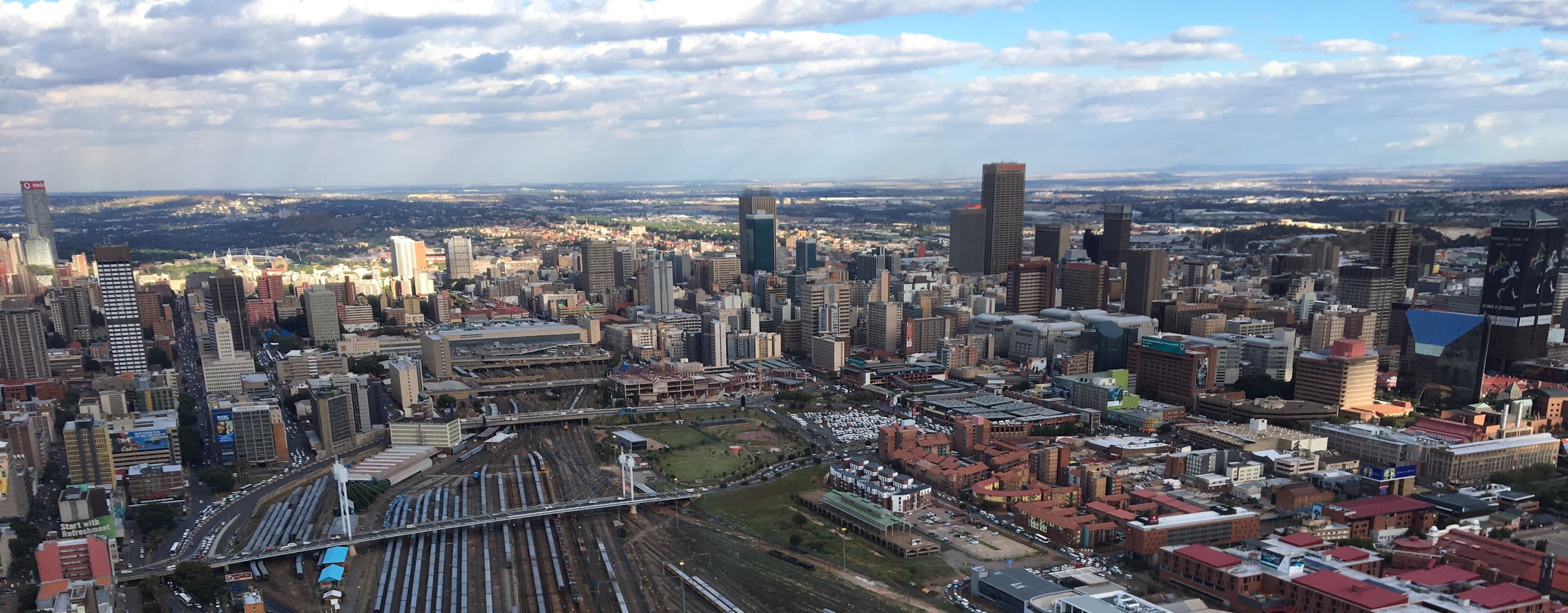
A single discovery in 1886 transformed quiet farmland on the Witwatersrand hills into a chaotic, roaring metropolis.
To understand the vertical velocity of Johannesburg, one must look not to the sky, but nearly four thousand meters into the dark of the earth. In the southern winter of 1884, Jan Gerritse Bantjes, the son of a pioneer, struck the main Witwatersrand gold reef on a farm called Vogelstruisfontein. Within two years, the high, frosty veld of the Transvaal—a silent, windswept ridge of hills sitting nearly six thousand feet above the sea—was transformed from a scattering of Boer ranches and ancient, stone-walled Sotho-Tswana ruins into a howling, chaotic canvas of canvas and corrugated iron. The world has seen gold rushes, but it has rarely seen one that built an empire so rapidly from nothing. By October 1886, a triangular scrap of state land named Randjeslaagte was surveyed, and the name Johannesburg was officially scrawled into the records of the South African Republic. Exactly who the name honored remains lost to history; it was likely a diplomatic nod to some combination of Johann Rissik, the surveyor-general, Christiaan Johannes Joubert, the chief of mining, or perhaps even Stephanus Johannes Paulus Kruger, the stern President of the republic. What is certain is that by 1896, a mere decade after the first tents of Ferreira’s Camp were pitched in the Fordsburg dip, the settlement had swelled to over one hundred thousand people. It was one of the fastest urban expansions in human history, constructed entirely on the back of a singular, glittering obsession.
This spectacular rise created an immediate, volatile friction between two incompatible worlds. On one side stood the South African Republic (ZAR), a fiercely independent, conservative Boer state of pastoralists who had migrated inland to live in isolated biblical simplicity. On the other side was the "Uitlander" population—a highly cosmopolitan, aggressive wave of foreign miners, engineers, and financiers who flooded the Rand from every corner of the globe. Johannesburg in the 1890s was a rough, disorganized, and hyper-masculine frontier outpost. White miners from Europe and the Americas rubbed shoulders with impoverished Afrikaners, German and British tradesmen, and a massive influx of African tribesmen recruited to perform the dangerous, unskilled labor deep in the rock. The social fabric was wild and precarious: African women brewed beer for migrant workers in informal settlements; a massive trade in European prostitution flourished; gangsters ran the streets; and, in a strange local quirk, Zulu men known as the "AmaWasha" dominated the city's commercial laundry sector.
By the mid-1890s, the tension between the Boer government in Pretoria and the British-dominated mining community of Johannesburg reached a boiling point. Under President Paul Kruger, the ZAR government grew deeply suspicious of the Uitlander majority, who paid eighteen-twentieths of the state’s tax revenue but were denied the right to vote. Initially, immigrants could obtain citizenship after five years, but as the gold seekers multiplied, the Boers passed restrictive new laws. A foreigner was now required to renounce his original allegiance and wait up to fifteen years for a franchise that the government could still arbitrarily deny. Compounding this political disenfranchisement were severe practical grievances: the state-supported dynamite and railway monopolies inflated mining costs; the state schools refused to educate English-speaking children; and a corrupt government liquor trust sold toxic, cheap whiskey to the native mine laborers, leaving thousands incapacitated or prone to falling down open mine shafts. In response, a secret Reform Committee of Johannesburg capitalists and engineers, including the prominent American mining engineer John Hays Hammond, began plotting an armed uprising. They coordinated with Dr. Leander Starr Jameson, an administrator in neighboring British territory, who was to ride across the border with an armed force to support the Johannesburg coup.
Connected to
- in countrySouth Africa1910 CE
+ 10 further connections to entries not yet ingested