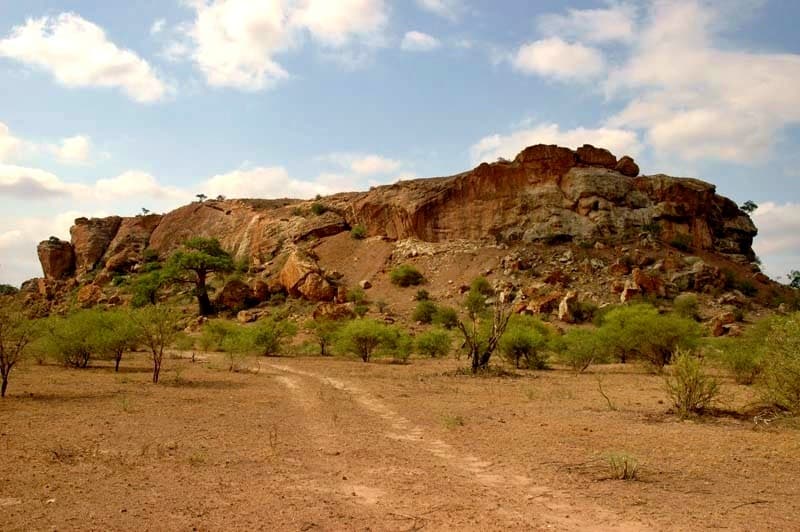
Where the Shashe and Limpopo rivers collide in Southern Africa, a dry landscape of sandstone hills and scrubland once flourished with seasonal floods and year-round harvests.
High above the scrubland where the Shashe and Limpopo rivers meet, a flat-topped sandstone hill rises abruptly from the floodplain. Today, the landscape is dry and silent, a territory of Kalahari sands, ancient baobabs, and the low hum of cicadas marking the borders of South Africa, Zimbabwe, and Botswana. But in the thirteenth century, this table of rock was the focal point of a revolution in human organization. On the summit of Mapungubwe Hill, a ruler lived in deliberate, ritualized isolation, looking down upon thousands of subjects who clustered in the valley below. This spatial division was not merely practical; it was a physical manifestation of a new cosmic order. For the first time in the history of Southern Africa, a society had fractured into distinct social classes, giving birth to a system of sacred kingship where the ruler was no longer merely a first among equals, but an intermediary between the heavens and the earth.
The origins of this state did not begin on the heights of the hill, but in the valleys and grasslands centuries earlier. Around 900 CE, attracted by the wealth of the ivory trade, Bantu-speaking Zhizo people settled at Schroda, near the Limpopo. They were pastoralists and farmers who coexisted, traded, and occasionally hunted with the indigenous San, whose ancestors had navigated these landscapes for a hundred thousand years. The Zhizo chief accumulated wealth in cattle and foreign goods, yet the society remained relatively egalitarian, organized around a traditional layout where livestock occupied the physical and social center of the community. By 1000 CE, a new group of Leopard’s Kopje people—speakers of an early Shona language, likely Kalanga—crossed the Limpopo from the north, settling at a site known to archaeologists as K2, beneath Bambandyanalo Hill. Their arrival coincided with the onset of a remarkably wet climatic period. The Limpopo periodically flooded, depositing rich nutrients across the plains, turning the valley into an agricultural haven where sorghum, pearl millet, ground beans, and cowpeas could be farmed year-round.
As K2’s population grew to some fifteen hundred people, its economy thrived on a sophisticated dual system. On one hand, it was deeply rooted in agropastoralism. To maximize their agricultural yields, the people of K2 herded their vast cattle wealth away from the capital, permitting their beasts to graze on the lands of neighboring communities. This was not simple pastoralism; it was a deliberate geopolitical strategy, using the sharing of grazing land to weave a complex web of social and political alliances. On the other hand, K2 became an active participant in the vast Indian Ocean trade network. Through Swahili city-states on the East African coast, local ivory, gold, and leopard skins were exchanged for exotic luxuries: colorful glass beads, glazed ceramics, and fine cotton and silk cloths.
2 links to entries not yet ingested in the Library.
For generations, Southern African societies had been structured by social ranking, where prestige was fluid and tied to cattle ownership. But the influx of trade wealth, combined with agricultural surpluses, began to warp this traditional structure. A profound gap emerged between a rising ruling class and the commoners. The old spatial arrangements at K2, designed for a community organized around a central cattle kraal, could no longer contain or represent these deep-seated inequalities. The physical world had to be rewritten to reflect the new social reality.
The catalyst for this transformation arrived around 1200 CE, when the long wet period came to a harsh, dry end. Faced with a deepening drought, the royal elites made a radical move. Around 1220 CE, they abandoned K2 and established a new capital at Mapungubwe Hill, a site that had long been used for rainmaking rituals. The commoners settled in a sprawling protective circle at the base of the hill, while the elite established their homes on the flat summit. To clear the way for this monumental shift, the old village may have been ceremonially burned down. By 1250 CE, the capital’s population had swelled to five thousand people, ruling over a state that would eventually cover some thirty thousand square kilometers.
Living on the summit, the king became a figure of divine mystique. Because hills were traditionally associated with the ancestors and the control of rain, the king’s physical occupation of the summit positioned him as the sole guardian of the rains—a vital role in an era of drought. He lived in strict ritual seclusion. Visitors who scaled the steep sandstone cliffs were subjected to a rigorous vetting process in a specialized receiving room, and those permitted to speak with the monarch did so through an intermediary, separated by a physical divide. The king’s life was entirely ritualized; his very actions were performative, to the point that if he sneezed, a royal praise singer would announce it to the court. He slept in a secret wooden hut, surrounded by a court of soldiers, diviners, praise singers, and musicians playing mbiras and xylophones. To maintain the domestic and regional alliances that held the kingdom together, the king took many wives, placing some in outlying districts to act as royal anchors across the realm.
This state was likely governed through a five-tiered hierarchy stretching from the king down to senior chiefs, petty chiefs, headmen, and family heads. While the elites on the hill constructed stone walls to symbolize their elevated status, these walls also served a defensive purpose. Though archaeological evidence of warfare is difficult to parse, scholars suggest that coercion and physical violence were essential tools for maintaining state power. The kingdom’s dominance was further fueled by its position as the preeminent trade hub of the Limpopo-Shashe Basin. Lacking local deposits of copper, gold, and tin, the rulers of Mapungubwe acquired these precious metals through tribute paid by subordinate communities, refining the gold and exporting it, alongside ivory, to the coastal port of Sofala.
By 1300 CE, however, Mapungubwe’s golden age was over. The collapse was swift, and its causes remain a subject of debate. Some suggest that centuries of intensive cattle grazing, coupled with persistent droughts, severely degraded the fragile valley environment. Others point to a seismic shift in global trade routes. During the thirteenth century, the northern Swahili ports of Kilwa and Mogadishu rose to dominance, bypassing the southern trade networks. Under Kilwan influence, the gold trade shifted directly to the Zimbabwean Plateau, sidelining Mapungubwe and drying up its supply of prestigious trade goods. Without these imported luxuries, the king could no longer sustain the alliances that depended on the exchange of gifts and grazing rights. As the spiritual and material divide between the commoners and their secluded king grew too wide to justify the high demands of tribute, the people simply "voted with their feet." The basin was abandoned, and the population scattered to the northwest and south, never to regroup.
For centuries, Mapungubwe lay silent, its memory preserved by the Venda and Kalanga peoples who claim its legacy, but hidden from the wider world. When the academic community and the colonial government "rediscovered" the site in 1933, they found a treasure trove of archaeological wonders, including the famous golden rhinoceros—beaten from sheets of gold and pinned with tiny tacks—now housed in Pretoria. For decades, twentieth-century historians assumed Mapungubwe was the absolute birthplace of statehood in Southern Africa. Modern excavations, however, have revealed that at Mapela Hill, nearly two hundred years before the elite of K2 ascended Mapungubwe, a similar system of sacred kingship had already begun to take shape. Mapungubwe was not a singular miracle, but the brilliant culmination of a regional evolution. When it fell, its culture did not vanish; its sophisticated spatial layouts, its stone masonry, and its concept of sacred, secluded leadership moved north, finding their ultimate expression in the monumental stone rises of Great Zimbabwe.