Place · East African Civilizations
Sofala
- Also known as
- Sofala (tanàna tranainy)
- Sofala Nova
- São Caetano de
- Сафала
- Софала
- Софала
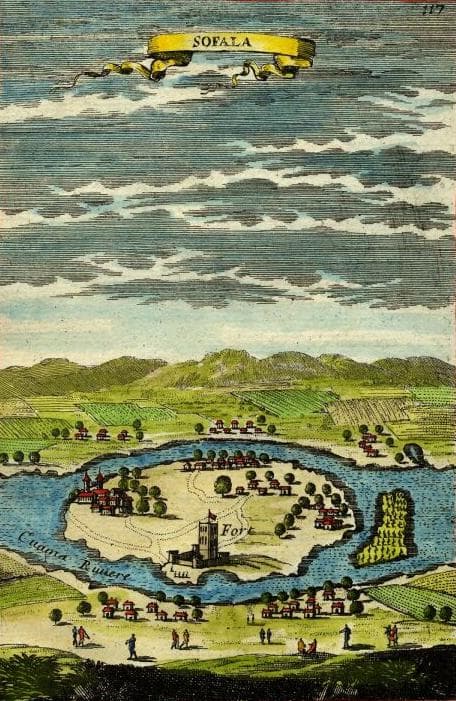
Sometime in the tenth century, Mogadishan merchants pushed south along the East African coast, searching for the source of the gold that whispered through the Indian Ocean trade networks.
To the Renaissance imagination, the name Sofala was synonymous with the glittering hoards of antiquity. When Portuguese chroniclers first set eyes on this low-lying stretch of the East African coast, they did not see merely a muddy Swahili trading post; they saw Ophir, the biblical treasury from which King Solomon fetched gold to gild his temple in Jerusalem. They imagined the legendary dynasty of the Queen of Sheba ruling over its hinterland, an identification so evocative that John Milton would later place "Sofala, thought Ophir" among the great empires shown to Adam from the hill of Paradise. In reality, the site was far more fragile, and far more fascinating, than any biblical fable. It was a watery, precarious gateway where the fortunes of the deep interior of Southern Africa met the global trade winds of the Indian Ocean, built upon a foundation of gold that was already slipping away by the time Europe arrived to seize it.
The geography of Sofala was an exercise in paradox. It was one of the oldest documented harbors in Southern Africa, yet by any physical measure, it was a terrible place to anchor. Situated on the Sofala Bank in what is now Mozambique, the medieval port was built at the edge of a wide, shifting estuary formed by the Buzi River. To reach the harbor, ships had to navigate a treacherous, moving sandbank and dodge hazardous shoals that made the port accessible only at high tide. The shoreline was a dense, suffocating fringe of mangrove swamps, thick with stagnant water and breeding clouds of malarial mosquitoes. Yet, merchants braved these waters because the Buzi and Save rivers offered a direct, natural highway into the interior. Up these rivers, shallow-draft Swahili dhows could journey toward the market town of Manica, and from there to the legendary goldfields of the Great Zimbabwe plateau.
Long before the Portuguese arrived, Sofala belonged to the cosmopolitan world of the Swahili Coast. Its first recorded pioneers were merchants from the Sultanate of Mogadishu, far to the north, who arrived sometime in the tenth century. In the Somali tongue, one potential etymology for the town's name translates to "go and cultivate" or "go and dig"—a direct nod to the mineral wealth that drew them. For generations, the Mogadishans kept the existence of this gold emporium a closely guarded secret from their rivals in Kilwa, who rarely ventured south of Cape Delgado. But secrets are difficult to keep when they are written in gold. In the 1180s, Sultan Suleiman Hassan of Kilwa seized control of Sofala, formally integrating it into the Kilwa Sultanate and the broader Swahili cultural sphere.
Despite this conquest, Sofala was never a passive colonial outpost. It was a major city-state in its own right, home to a proud local elite, sophisticated merchant communities, and its own sphere of influence stretching south to Cape Correntes and east across the Mozambique Channel to Madagascar. Politically, the town existed in a delicate balance. It stood on territory that belonged to the Kingdom of Mwenemutapa, to whom the Swahili merchants paid tribute for the right to reside and trade. The Sultan of Kilwa’s governor in Sofala acted more like a consul than an absolute ruler, exercising jurisdiction only over the Swahili residents. If the court at Kilwa tried to meddle too deeply in local affairs, the Sofalese elites were notoriously quick to assert their autonomy.
This fragile balance was shattered at the turn of the sixteenth century. The first European to walk Sofala’s streets was the Portuguese spy and explorer Pêro da Covilhã, who in 1489 traveled overland disguised as an Arab merchant. His secret dispatches to Lisbon confirmed that Sofala was indeed the throat through which the region’s gold passed, even if the trade was already beginning to decline. In 1502, a Portuguese fleet under Pedro Afonso de Aguiar (or perhaps Vasco da Gama himself) sailed into the harbor, finding Sofala ruled by an elderly sheikh named Isuf.
Isuf was locked in a bitter political dispute. In Kilwa, a powerful minister named Emir Ibrahim had murdered the legitimate sultan and usurped the throne. Refusing to recognize the usurper, Isuf was looking for a way to break free from Kilwa's orbit. The arrival of the heavily armed Portuguese caravels offered a dangerous but tempting opportunity. Recognizing that it was wiser to have these formidable newcomers as allies rather than enemies, Isuf signed a commercial and military treaty with Portugal. Three years later, in 1505, Pêro de Anaia arrived with the Seventh Armada and secured Isuf’s permission to build a factory and a stone fortress. Named Fort São Caetano, it was constructed using stone painstakingly shipped all the way from Europe. It was only the second fortress the Portuguese built in East Africa.
The European triumph, however, was swiftly undone by the very landscape they sought to conquer. Within months of the fort’s completion, malaria decimated the Portuguese garrison. The harbor’s natural defects—the shifting sands, the shoals, the stifling heat of the swamps—proved ruinous for the deep-draft Portuguese ships. In 1507, looking for a healthier and more accessible base, the Portuguese captain Vasco Gomes de Abreu seized Mozambique Island to the north. Slowly, the administrative machinery, the officers, and the garrison were relocated there, leaving Fort São Caetano as a lonely, isolated outpost in the mangroves. Even so, the prestige of the old gold port was such that the colonial governors of Portuguese Mozambique continued to carry "Captain of Sofala" as their grandest official title.
Ultimately, the gold that had summoned Sofala into existence failed both the Swahili and the Portuguese. By the sixteenth century, the old southern goldfields were largely depleted, and the center of production had shifted north toward the Zambezi escarpment. New inland market towns arose, finding easier outlets to the sea through the rising ports of Quelimane and Angoche. Sofala, bypassed by the changing geography of trade, began a slow, inevitable decline.
The final blow was delivered by the environment itself. Over the centuries, deforestation along the banks of the Buzi River led to massive soil erosion, silting up the great harbor that had once allegedly held a hundred vessels. The sea, aided by the shifting sands of the estuary, steadily reclaimed the land. In 1890, the establishment of the modern port city of Beira—built on the site of an old Sofalese northern outpost at the mouth of the Pungwe River—stripped Sofala of its remaining commercial relevance.
Today, almost nothing remains of the medieval emporium that Milton fantasized about and Portuguese explorers died to protect. The tides of the Indian Ocean have swallowed the stone walls of Fort São Caetano, its masonry later salvaged to build the cathedral in Beira. In the quiet settlement of Nova Sofala, there are virtually no ruins left to betray the fact that this muddy coast was once the legendary gateway to the riches of Southern Africa, a place where empires traded in gold and kings dreamed of the treasures of Sheba.
Connected to
3 links to entries not yet ingested in the Library.