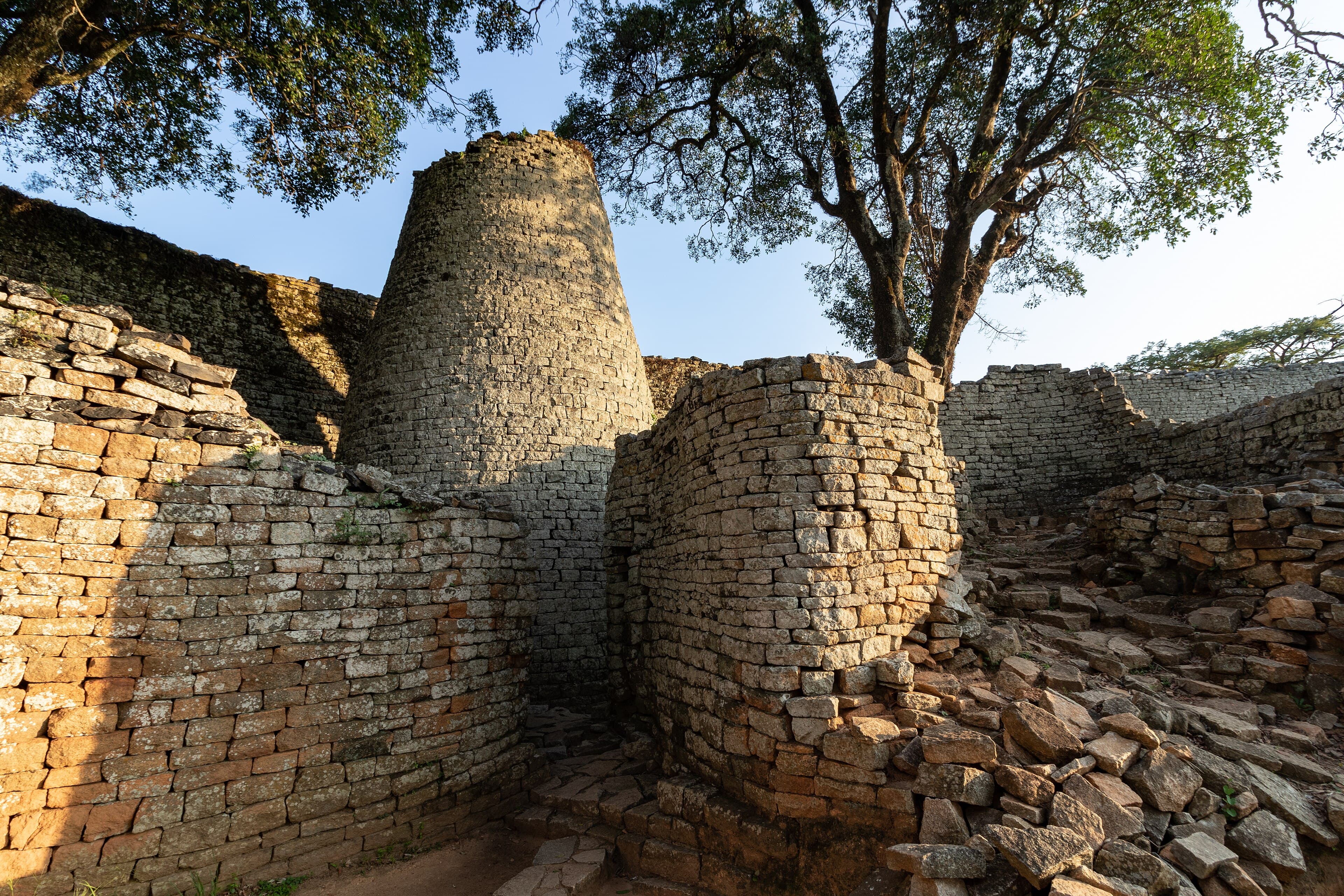
High on the south-eastern hills of modern Zimbabwe, a vast city of mortarless stone rises from the landscape, representing the largest precolonial stone structure in Southern Africa.
In 1531, Vicente Pegado, the captain of the Portuguese garrison at the coastal port of Sofala, recorded rumors of a massive stone fortress rising from the inland plains between the Limpopo and Zambezi rivers. The local people, he wrote, called these structures Symbaoe, a word signifying "court." Pegado described a tower rising more than twelve fathoms high, surrounded by hills crowned with similar structures, all built of stones of marvelous size joined entirely without mortar. For centuries, this stone city in the southeastern hills of modern-day Zimbabwe remained a landscape of myth and projection for outsiders who could not, or would not, believe that such architectural sophistication could belong to the ancestors of the people who lived in its shadow.
The site we now know as Great Zimbabwe—the word "great" distinguishing it from more than four hundred smaller stone ruins, or zimbabwes, scattered across the southern African highveld—spans over seven square kilometers. It is the largest stone structure of the precolonial era in Southern Africa, an architectural triumph built entirely of dry-stone masonry. From the eleventh to the fifteenth centuries, its builders, the ancestors of the Shona people, quarried granitic stone to erect monumental walls that curved organically around the landscape, shielding elite residences, temples, and public squares from view. Unlike the monumental architecture of Europe or the Mediterranean, which relied heavily on lime mortar, arches, and straight lines, the builders of Great Zimbabwe relied on gravity, friction, and precision. They shaped and stacked millions of granite blocks into undulating, free-standing walls that reach up to eleven meters high and stretch across hundreds of meters, mimicking the natural contours of the hills.
Long before the first stone was laid, the valley was a landscape of human movement and settlement. San communities occupied the region for millennia, followed around 150 BCE by Bantu-speaking agriculturalists who established chiefdoms. By the fourth century CE, communities belonging to the Gokomere or Ziwa cultures were farming the fertile valley, mining iron, and cultivating the soil, though they lived in timber and clay dwellings. It was not until the eleventh century, with the rise of the Gumanye people—the ancestors of the south-central Shona—that the first stone walls began to rise. This architectural evolution was fueled by a dramatic transformation in the region’s economy. The local elite, enriched by vast herds of cattle and the growing exploitation of goldfields on the Zimbabwean Plateau, began to consolidate political power. As their wealth grew, the ruling dynasty abandoned simple mud-and-pole dwellings in favor of thick, luxurious (earthen daub) houses, constructing the first dry-stone walls as monumental screens to partition space and shield the royal court from the gaze of commoners.
6 links to entries not yet ingested in the Library.
Great Zimbabwe’s rise as a regional metropolis after 1300 was closely tied to the decline of Mapungubwe, a major trading center to the south, and an increasing global demand for African gold and ivory. The city became the heart of a vast state that likely exercised influence over fifty thousand square kilometers. Its economy rested on a dual foundation: a sophisticated local pastoral system and a sprawling international trade network. The ruling court managed massive cattle herds that were moved seasonally across the highveld, serving as a form of currency and social glue that allowed the elite to distribute wealth and secure political loyalty. Concurrently, regional trade routes brought salt, copper, grain, and iron from as far north as the Kundelungu Plateau in the modern-day Democratic Republic of the Congo.
But it was Great Zimbabwe’s connection to the Indian Ocean that transformed it into a global hub. Traversing the Save and Runde rivers in locally-produced canoes, traders transported gold and ivory from the interior down to Swahili coastal city-states like Sofala. From these coastal ports, African goods entered the vast maritime trade networks of the Indian Ocean, reaching Arabia, India, and China. In return, luxury items flowed back up into the African interior. Archaeologists excavating the ruins have unearthed glass beads, Persian coins, and fragments of Chinese ceramics, including fourteenth- and fifteenth-century Longquan green-glazed stoneware and blue-and-white porcelain. Yet, despite these deep commercial ties with the wider world, the architecture of Great Zimbabwe remained entirely indigenous; there is no evidence that its builders adopted or copied foreign structural concepts.
At its peak, Great Zimbabwe was a bustling urban center. While older estimates placed the population as high as twenty thousand, modern archaeological and statistical modeling suggests a more modest, yet still remarkable, peak of around ten thousand residents. The city was divided into three distinct architectural sectors. The oldest is the Hill Complex, perched on a steep granite cliff overlooking the valley, which was occupied from the eleventh to the thirteenth centuries. This was the spiritual and political nerve center of the early state, featuring a high balcony enclosure and a massive natural boulder that resembles a bird in flight. Below the hill lies the Great Enclosure, constructed during the thirteenth and fourteenth centuries. With its outer wall stretching roughly 250 meters, the Great Enclosure is the city’s crowning achievement. Tucked between its inner and outer walls is the Conical Tower, a solid stone structure standing nine meters high. Finally, the Valley Complex, divided into Upper and Lower ruins, was built and occupied between the fourteenth and sixteenth centuries.
Scholars remain divided over how these spaces were used. Some argue that the complexes represent the successive residences of different kings who moved their courts to new locations upon ascending the throne. Others favor a structuralist interpretation, proposing that the complexes served different, simultaneous functions: the Hill Complex as a sacred arena for rain-making and ancestor rituals; the Valley Complex as the domestic quarters of the general citizenry; and the Great Enclosure as the private domain of the king. To support this dense population, the inhabitants developed a sophisticated water management system. Deep, closed depressions known as dhaka pits served as reservoirs, wells, and springs, capable of storing more than eighteen thousand cubic meters of water to sustain the city through dry seasons.
Within these stone walls, artisans practiced specialized crafts, particularly gold working, which required immense skill and dedicated workshops. Among the most significant artifacts recovered from the ruins are eight soapstone birds, carved from micaceous schist on monoliths the height of a human. These birds, believed to represent the bateleur eagle—a protective spirit, a messenger of the gods, and a harbinger of good fortune in Shona culture—once stood on platforms within the Hill Complex. Other excavations have yielded elaborate iron gongs, worked ivory, bronze spearheads, gold beads, and delicate copper and iron wire.
By the sixteenth or seventeenth century, the great city was abandoned. The reasons for its decline remain a subject of historical debate, but the depletion of local resources, shifting trade routes, and environmental changes likely forced the population to disperse. For centuries, the massive stone walls stood silent, swallowed by vegetation, until late nineteenth-century European travelers and antiquarians "discovered" them. Between the 1890s and the 1920s, early European visitors systematically looted the site, destroying vital archaeological layers in search of gold and exotic treasures.
For decades, the physical reality of Great Zimbabwe was weaponized by colonial authorities. The white minority government of Rhodesia actively pressured archaeologists and historians to deny that the monument could have been constructed by black Africans, attributing its creation instead to Phoenicians, Arabs, or Europeans. It was not until the 1950s that the scientific consensus firmly and irreversibly established the site’s African origin. When the nation achieved independence in 1980, the new state shed its colonial name of Rhodesia and adopted the name of the ancient stone city: Zimbabwe. The soapstone birds found in the ruins became the central symbol of the national flag. Today, Great Zimbabwe stands not only as a UNESCO World Heritage Site but as a monument to the complexity, wealth, and global reach of precolonial African civilization, its mortarless walls serving as a lasting testament to the people who shaped the stone, and the continent, centuries ago.