Place · 455 CE · Late Antique and Byzantine
Tbilisi
- Also known as
- di bi li si
- i-Tbilisi
- K'alak'i T'bilisi
- karti
- Tbiliisi
- Tbilis
The city took its name from the warmth of its earth.
There is a persistent story told about the founding of Tbilisi, one that concerns a king, a bird, and the steaming, mineral-rich belly of the earth. In the mid-fifth century CE, around the year 455, King Vakhtang I of Iberia rode out to hunt in the dense, silent forests that then covered the banks of the Kura River. During the chase, his hunting falcon struck a pheasant. The two birds fell from the sky, tumbling into a natural spring hidden beneath the thick canopy of trees. When the king’s retinue found them, both predator and prey had been boiled to death by the scalding waters. Rather than mourning his prize falcon, King Vakhtang was so struck by the warmth of these subterranean waters that he ordered the ancient forests cleared. On that spot, he decreed, a new city would rise.
The story is a foundation myth, but it rests on a physical, linguistic, and geological reality. The very name Tbilisi derives from the Old Georgian tpili, meaning "warm." For more than a millennium and a half, the city’s identity has been anchored to these thermal sulfur springs, which still bubble up from the volcanic faults beneath its foundations. Yet if the warm waters gave the city its name, its geography gave it a far more turbulent destiny. Tucked into the deep valley of the Kura River, where the Caucasus mountains taper into trade corridors, Tbilisi was positioned precisely at the pivot point between Europe and Asia, directly alongside the lucrative networks of the Silk Road. It was a site of immense commercial promise, but also a geographic choke point that virtually guaranteed centuries of foreign envy, siege, and ruin.
For the first decades of its existence, Tbilisi remained in the shadow of Mtskheta, the ancient capital of the Iberian kingdom. It was Vakhtang’s successor, King Dachi, in the early sixth century CE, who formally transferred the royal seat to Tbilisi and threw up the first stone fortress walls to define its limits. Dachi’s move was a calculation of survival. The new capital was easier to defend and sat squarely on the emerging trans-continental transit routes. Almost immediately, the world took notice. For the next five hundred years, Tbilisi was less a sovereign capital than a highly contested prize, continuously battered and reshaped by the competing empires of the classical and medieval worlds. The Sassanid Persians seized it in the late sixth century, only to be driven out in 627 by a devastating combined assault of Byzantine and Khazar armies. By 736, the armies of the Umayyad Caliphate under Marwan II had marched into the valley, establishing the Emirate of Tbilisi. For three centuries, this Christian city was ruled by Muslim emirs, acting as an Islamic outpost on the northern fringes of the Abbasid world. It was a time of complex synthesis; the city minted its own dirhams inscribed with both Arabic and Georgian characters, adapting to its conquerors while preserving its distinct regional character.
The true golden age of the city arrived on the heels of a siege. In 1121, King David IV—known to history as David the Builder—shattered the Seljuk Turk forces at the Battle of Didgori. The following year, his victorious troops took Tbilisi, and David moved his royal court there from Kutaisi, declaring it the capital of a unified Georgian kingdom. This ushered in a spectacular century of cultural and economic ascendancy. By the end of the twelfth century, Tbilisi was home to roughly one hundred thousand people, a bustling, cosmopolitan metropolis where merchants, theologians, and poets mingled. Under the legendary reign of Queen Tamar, the city became the literary heart of the Eastern Orthodox world. It was here that the poet Shota Rustaveli composed The Knight in the Panther's Skin, the monumental epic that would define Georgian literature.
This medieval renaissance was brilliant, but fragile. In 1226, the Khwarezmian Shah Jalal al-Din breached the city’s walls, slaughtering tens of thousands of its Christian inhabitants and dismantling its defenses. The destruction left Tbilisi entirely vulnerable to the westward march of the Mongol Empire. By 1236, Georgia was forced to submit to Mongol rule. Though the kingdom retained a fragile, semi-independent statehood, the city’s cultural and political life was heavily subjugated for nearly a century. Even when the Mongols finally withdrew in the 1320s, respite was brief; the Black Death devastated the population in 1366, and by 1386, the armies of Timur invaded, initiating a succession of eight separate campaigns that repeatedly left the city burned and looted.
For the next three centuries, Tbilisi existed in a state of perpetual vulnerability, trapped between the geopolitical grinding stones of the Ottoman and Safavid Empires. Vassalage became the price of survival. From the early sixteenth century onward, the city was repeatedly garrisoned by Persian forces, briefly reclaimed by Georgian kings, captured by Ottoman commanders, and returned to Iranian oversight. The Safavid shahs ruled the region through Georgian vassal kings on whom they bestowed the Persian title of vali. Yet, despite these centuries of occupation, the city retained a stubborn, multi-ethnic complexity. It was a place where Gregorian Armenians, Catholic missionaries, Persian administrators, and Georgian Orthodox priests shared the same narrow, winding streets. In 1718, the Venetian Senate even found it necessary to petition the Safavid Emperor Soltan Hoseyn to protect the city's Catholic Capuchin monks and Armenian inhabitants from local religious disputes.
By the late eighteenth century, exhausted by perpetual Iranian and Ottoman incursions, Georgia’s rulers looked north toward a rising Christian power. In 1783, King Heraclius II signed the Treaty of Georgievsk, seeking the protection of the Russian Empire. The decision brought immediate, catastrophic retaliation. In 1795, the Iranian Qajar founder Agha Mohammad Khan invaded, sacking Tbilisi and leaving much of the city in ashes. Seeing the Georgian monarchy fatally weakened, the Russian Empire formally annexed the kingdom of Kartli-Kakheti in 1801, absorbing Tbilisi into its imperial domain.
Under Russian rule, the city—rechristened Tiflis—underwent a radical physical and social transformation. Imperial administrators laid out a new Western-style grid, cutting wide, straight avenues through the old medieval fabric. They built roads and railways connecting the city to the Black Sea ports of Batumi and Poti, integrating Tbilisi into the global industrial economy. Golovin Avenue—now Rustaveli Avenue—became the grand artery of the city, lined with neoclassical and Beaux-Arts buildings, and anchored by the palace of the Russian Viceroy of the Caucasus. Tiflis became the administrative and cultural command center of the entire Caucasus region, attracting a glittering array of European entrepreneurs, Russian intellectuals, and local writers. Leo Tolstoy, Alexander Pushkin, and Mikhail Lermontov spent formative periods here, captivated by its exotic mix of European sophistication and Near Eastern warmth.
Yet, the population of this nineteenth-century imperial hub was remarkably distinct from its medieval predecessor. For much of this period, the largest ethnic group in Tbilisi was not Georgian, but Armenian—at one point accounting for nearly three-quarters of the city's inhabitants. It was a dense, polyglot world where Azerbaijani intellectuals, Armenian merchants, Russian officers, and Georgian aristocrats lived side-by-side.
When the Russian Empire collapsed in the fires of the 1917 Revolution, Tbilisi briefly became the stage for a dramatic experiment in self-determination. In the spring of 1918, the city served as the capital of the short-lived Transcaucasian Democratic Federative Republic. When that federation fractured after only a few weeks, the national councils of Georgia, Armenia, and Azerbaijan each gathered in the former palace of the Russian Viceroy. Over three intense days in May 1918, they declared their respective national independence. For three brief years, Tbilisi served as the capital of the democratic, sovereign republic of Georgia, a fleeting moment of self-governance before the Red Army marched into the valley in February 1921, drawing the city back into the orbit of an empire.
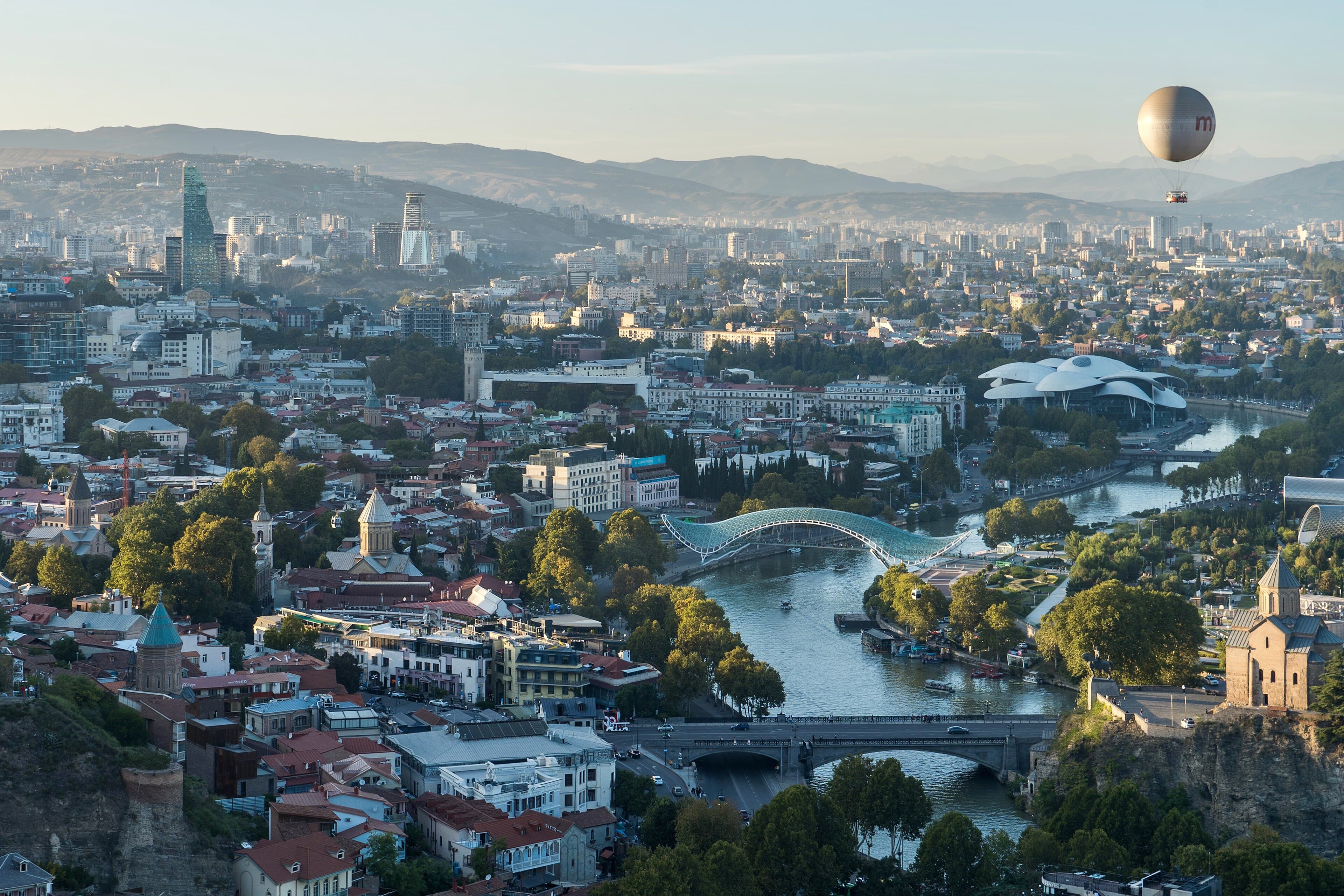
Today, the architecture of Tbilisi offers a physical archive of this long, layered history. In the old town, medieval stone churches stand within sight of the pseudo-Moorish lines of the Opera Theater, neoclassical Russian mansions, and the austere, monumental blocks of the Soviet era. High above the valley, the ruins of the ancient Narikala Fortress still look down upon the Kura River, guarding the narrow pass where kings, emirs, tsars, and merchants have passed for fifteen centuries. Beneath it all, the sulfur springs still run hot, a quiet, hydrothermal pulse that outlasted every empire that ever fought to claim them.
Connected to
- in countryRussian Empire1721 CE
+ 12 further connections to entries not yet ingested