Person · 356 BCE – 323 BCE · Classical Greece
Alexander the Great
- Also known as
- A Lịch Sơn Đại đế
- Ahlijsanda Daihdaeq
- Alakszandira
- Alasdair Mòr
- Alastar Mór
- Alecsander Fawr
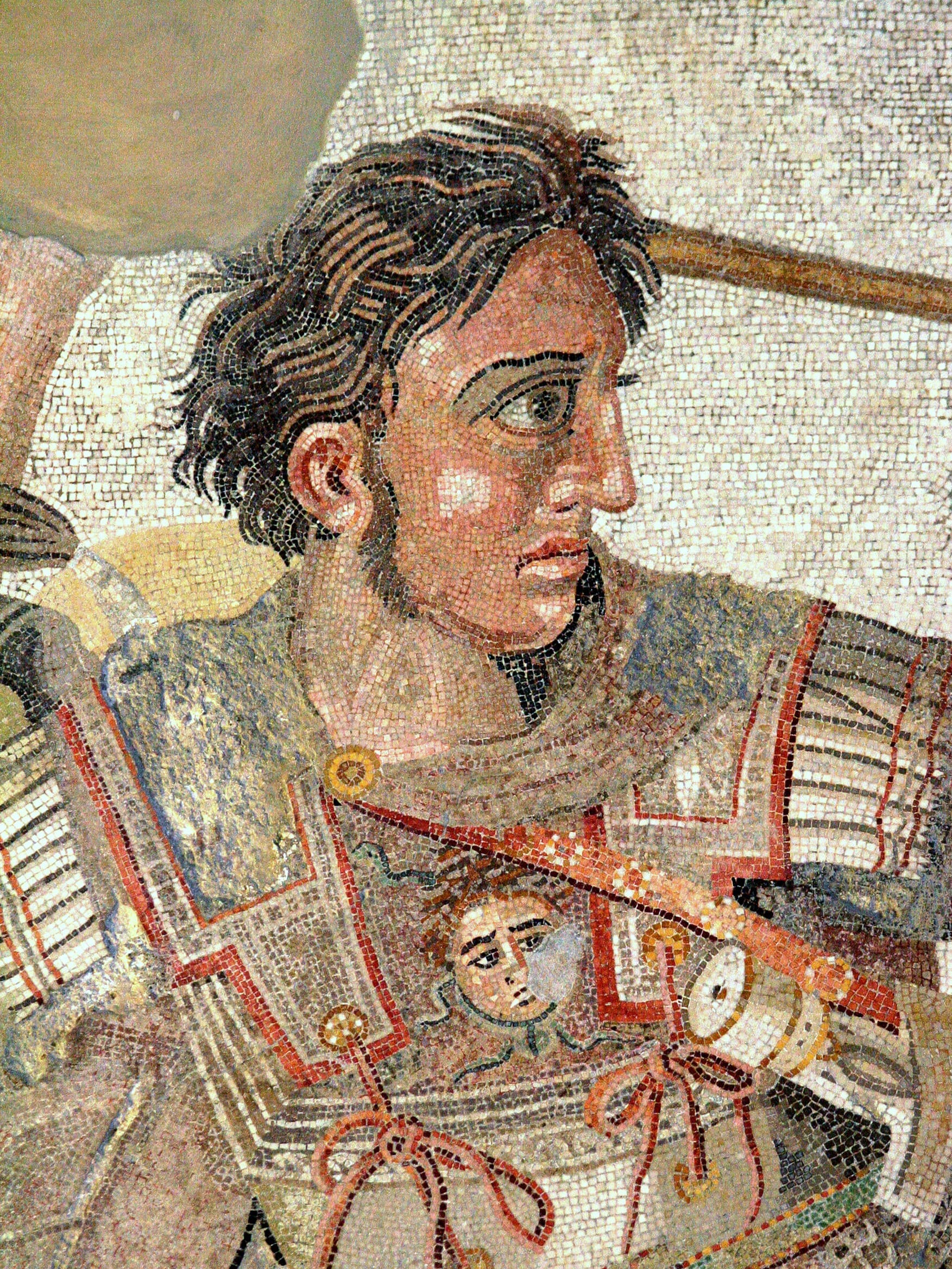
By the time he was thirty years old, Alexander III of Macedon had carved an empire out of the ancient world that stretched from the Adriatic Sea to the waters of the Indus River.
In the summer of 356 BCE, on the night the Temple of Artemis burned to the ground in Ephesus, Olympias, the fourth wife of King Philip II of Macedon, was said to have dreamed of a thunderbolt striking her womb. It was a flame, she recalled, that spread far and wide before dying away. Her husband, meanwhile, dreamed of sealing her womb with a wax stamp bearing the image of a lion. Whether these portents of divine parentage were the genuine dreams of expectant parents or stories circulated later to satisfy a king’s appetite for the superhuman, the boy born in Pella that July was never allowed to view himself as merely mortal. He was named Alexander, and from his childhood, his world was shaped by an agonizing paradox: he was heir to a brilliant, hard-drinking father whom he desperately wanted to surpass, yet whose shadow threatened to eclipse him entirely. When his father’s horses won at the Olympic Games on the day of his birth, it was a prelude to a life spent in an obsessive chase after a glory that could never be shared.
Alexander’s education was designed to temper this fierce ambition with the sharpest intellectual tools of the Greek world. At thirteen, he was sent to the quiet sanctuary of the Temple of the Nymphs at Mieza, a boarding school established by Philip. His tutor was Aristotle. In this rural retreat, alongside the sons of the Macedonian nobility—boys like Ptolemy, Hephaestion, and Cassander, who would become his "Companions" and eventually partition his world—Alexander studied medicine, logic, art, religion, and philosophy. It was here that he fell in love with the Iliad, carrying an annotated copy prepared by Aristotle throughout his life. He saw himself in Achilles, the tragic, brilliant warrior who chose a short, glorious life over a long, forgotten one. This literary romanticism was balanced by a highly practical exposure to statecraft; the Macedonian court was a sanctuary for Persian exiles, including the nobleman Sisines and the satrap Amminapes, whose presence gave the young prince an intimate, sophisticated understanding of the vast empire to the east.
By sixteen, the classroom was exchanged for the battlefield. When Philip left to wage war against the Thracians, he appointed Alexander as regent. The young prince wasted no time, crushing a revolt by the Maedi tribe and founding his first colony, Alexandropolis—a naming convention that would soon span three continents. Two years later, at the Battle of Chaeronea in 338 BCE, Alexander commanded the Macedonian left wing against the combined forces of Athens and Thebes. While Philip lured the Athenian hoplites into a false pursuit, Alexander broke the elite Theban lines, securing a decisive victory that established Macedonian hegemony over the Greek mainland. Yet, the relationship between father and son remained volatile, fractured by Philip’s subsequent marriages and the shifting court politics of Pella. When Philip was assassinated in 336 BCE, the twenty-year-old Alexander took the throne not just as a king, but as a young man with everything to prove. He immediately crushed rebellions in Thrace and Illyria, and when the city of Thebes revolted, he destroyed it utterly as a warning to the rest of Greece, before assuming leadership of his father's pan-Hellenic coalition, the League of Corinth.
Connected to
- died inBabylon3k BCE
- citizen ofMacedonia808 BCE
+ 12 further connections to entries not yet ingested