Place · 8th c. BCE · Silk Roads
Samarkand
- Also known as
- maracanda
- Maracanda
- Samarcand
- Samarcand
- Samarcanda
- Samarcanda
To understand the vast, shifting networks of the Silk Road is to understand Samarkand.
To climb any elevated ground in the valley of the Zarafshan River during the tenth century was to gaze upon an ocean of unbroken green. For eight days of travel in any direction, the land was a tapestry of gardens, sown fields, and thick orchards, nourished by the ancient Syob and Darg’om canals that had been cut into the earth during the early Iron Age. Here, where the river emerged from the western spurs of the Tian-shan mountains before dissolving into the Bukhara steppes, lay a city whose very name was synonymous with the edge of the known world. To the Sogdians, it was Samar-kand, the "stone fort." To the Karakhanid Turks, it was Sämizkänd, the "fat city," named for its sheer, unbelievable abundance. Every home possessed its own garden, its own cistern, and its own source of flowing water. It was a paradise of brick and turquoise built on a fertile terrace twenty-two hundred feet above the sea, a place where the trade winds of China, India, Persia, and Europe crossed, collided, and left behind their deposit of gold, faith, and clay.
The ground beneath Samarkand is thick with these deposits. Long before it was a node on the Silk Road, the site drew human activity; forty-thousand-year-old Paleolithic tools have been pulled from the suburban clay, alongside Mesolithic settlements at Sazag'on and Okhalik. Though its formal foundation has no single date, archaeologists trace the origins of the urban center to between the eighth and seventh centuries BCE. By the time the Persian Achaemenid Empire established its grip on Central Asia, the city was already the glittering capital of the Sogdian satrapy. It was here, in 329 BCE, that Alexander the Great arrived, his historians recording the name of the place as Maracanda. Alexander destroyed much of the city during his conquest, but the Greek presence transformed it. Local builders abandoned their traditional oblong bricks for square Hellenistic ones, adopting superior methods of masonry and plastering. Classical Greek aesthetics seeped into the workshops of local artisans, creating a syncretic Greco-Bactrian culture that persisted through successive waves of rule by the Seleucid Empire and the Kushans.
When Kushan control faded in the third century CE, Samarkand fell into a brief, dark sleep, only to revive in the fifth century under a succession of nomadic and imperial dynasties. It was conquered by the Persian Sasanians around 260 CE, becoming a vital corridor for the spread of Manichaeism. Then came the Xionites, the Kidarites, and the Hephthalites, or "White Huns," who held the city until the Göktürks of the Western Turkic Khaganate swept down from the Altai Mountains in the mid-sixth century. Through all these migrations, the city remained resolutely cosmopolitan. By the early Middle Ages, Samarkand was protected by four concentric rings of defensive walls pierced by four gates. Within those walls, a Nestorian Christian bishopric, established in the fifth century, was elevated to a metropolitanate by the eighth. In the city's markets and plazas, Sogdian Christians debated theology with Manichaeans, Zoroastrians, Buddhists, and Hindus.
The decisive transformation of Samarkand began around 710 CE, when the armies of the Umayyad Caliphate, commanded by Qutayba ibn Muslim, wrested the region from the sphere of the Chinese Tang dynasty. Unlike other Central Asian cities where Arab commanders merely demanded tribute and moved on, Samarkand was systematically integrated into the Islamic world. Qutayba established a permanent Arab garrison, demolished the city's Zoroastrian fire temples, erected a mosque, and oversaw the conversion of the majority of the population. By the mid-eighth century, the city had become the seat of Abu Muslim, the Abbasid general who led the uprising that toppled the Umayyads. Abu Muslim ringed the metropolis with a massive, multi-kilometer wall and constructed a grand palace. Legend holds that it was during this early Abbasid golden age that two Chinese prisoners captured at the Battle of Talas in 751 CE revealed the secret of papermaking. In Samarkand, the first paper mill in the Islamic world was born, igniting a bureaucratic and literary revolution that would eventually travel through the Middle East and into Europe.
Under the Samanids, who ruled from 875 to 999 CE as nominal vassals of the Caliph, Samarkand became a brilliant capital of Islamic scholarship. When the Samanids were supplanted by the Turkic Karakhanids, this intellectual energy only intensified. The Western Karakhanid ruler Ibrahim Tamgach Khan, who reigned from 1040 to 1068 CE, used state funds to build a magnificent madrasa and a public hospital where medicine was taught systematically. In the eleventh century, Karakhanid rulers also laid the foundations of the Shah-i-Zinda, a monumental necropolis that grew around the grave of Kasim ibn Abbas, a cousin of the Prophet Muhammad who had come to the region with the early Arab armies.
Though Turkic dynasties—including the Seljuqs and the Khwarazmshahs—held political sway from the eleventh century onward, the soul of Samarkand remained deeply Persian. Its poetry, its administrative language, and its urban culture were tied to the Iranian world. This brilliant, wealthy synthesis was shattered in 1220 CE. The Mongol hordes of Genghis Khan descended upon the city. Though Samarkand was said to have been defended by an army of 110,000 men, the Mongol siege was devastating. The city was systematically pillaged, its defensive walls razed, and its population reduced to a quarter of its former size.
Yet Samarkand's greatest era of physical majesty was born from this ruin. In 1369 CE, the Turco-Mongol conqueror Timur, known to history as Tamerlane, made Samarkand the capital of his vast empire. Timur possessed an insatiable appetite for architectural grandeur and the resources of a continent to satisfy it. He dragged artisans, stonemasons, and builders from every land he conquered to his capital. The population swelled to 150,000. Under Timur and his successors, the city became the cradle of the Timurid Renaissance. It was Timur who built the colossal Bibi-Khanym Mosque—erected, according to tradition, by his Chinese wife—and it was here that he was laid to rest under the turquoise arabesques and golden inscriptions of the Gur-e Amir mausoleum.
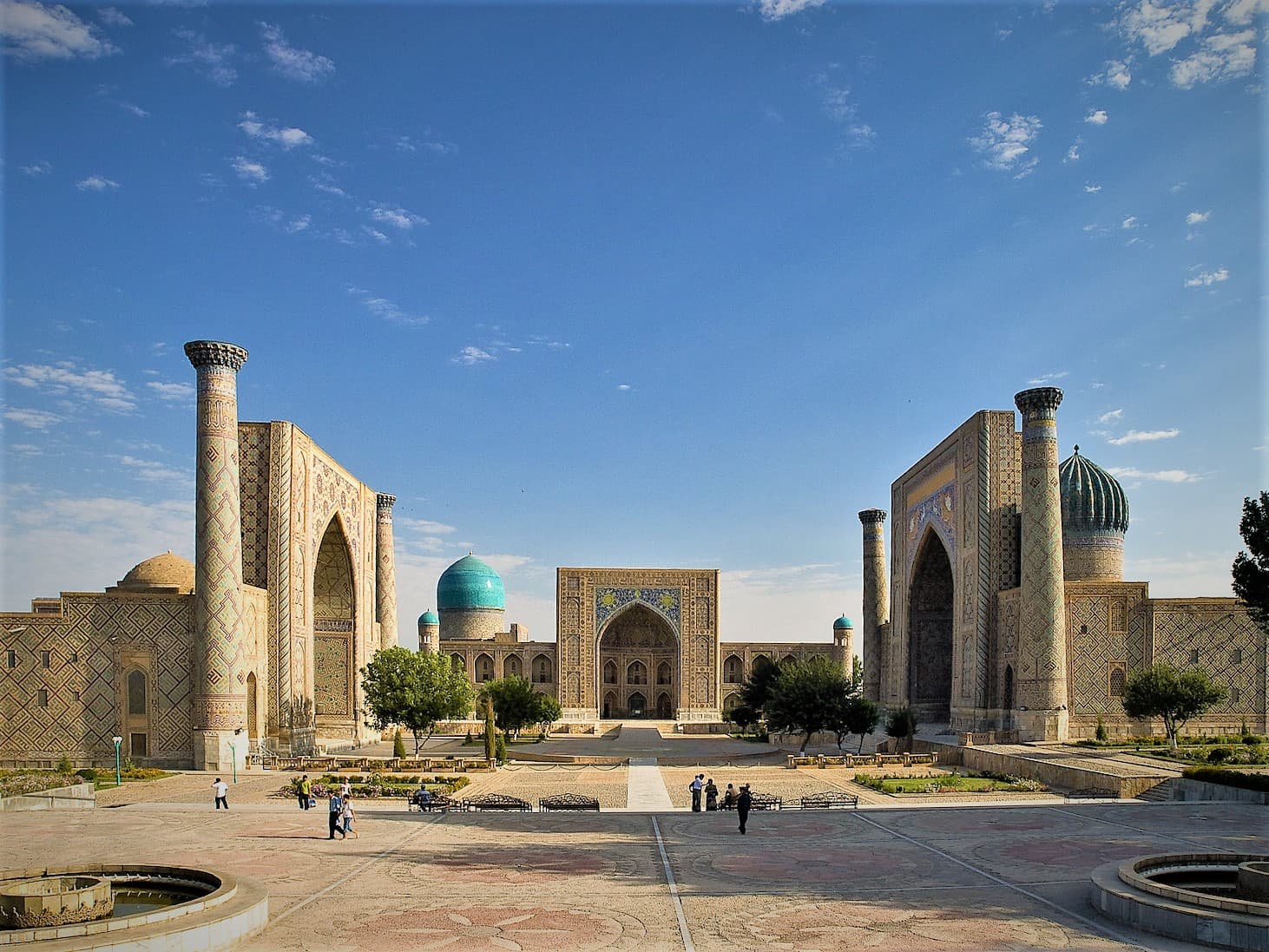
The architectural crown of Samarkand, however, belongs to the Registan. This ancient public square is bounded on three sides by three monumental madrasahs: those of Ulug-beg, Shir-dar, and Tilla-kari. Ulug-beg, Timur’s grandson and a brilliant astronomer, built his college in 1434, establishing a school of mathematics and astronomy that made Samarkand the intellectual capital of the fifteenth century. The buildings are exercises in sublime geometry. High, deep-pointed porches reach toward the sky, flanked by massive quadrilateral pillars and elegant, slightly inclined towers. The façades and interior courts are wrapped entirely in enamelled tiles of blue, green, pink, and gold—with turquoise-blue dominant, mirroring the high Central Asian sky. Over these structures sit heavy, bulbous, melon-like domes, catching the desert light.
Like the empires that preceded it, the Timurid golden age eventually dissolved. By the beginning of the eighteenth century, war and shifting trade routes had emptied the city; reports from the era suggest it was briefly left almost entirely without inhabitants. It passed under Chinese dominion, and subsequently under the control of the Emir of Bukhara. Yet its spiritual magnetism never completely faded; for centuries, no Muslim entered its gates without a sense of treading on holy ground, even as its great colleges began to crumble and its political power ebbed.
In the late nineteenth century, a new empire arrived. The Russian Empire took the city in 1868 after a fierce struggle. In 1871, Russian engineers began constructing a new town to the west of the ancient citadel, designing a grid of broad, tree-lined boulevards radiating outward in stark contrast to the labyrinthine, clay-walled alleyways of the old Islamic city. This division remains visible in modern Samarkand: the old city of private courtyard houses, bustling bazaars, and ancient monuments stands alongside the administrative buildings and educational institutions of the Russian and Soviet eras.
Today, Samarkand is the third-largest city in Uzbekistan, its population exceeding half a million. It is a city of layered languages—where Uzbek is the official tongue, Russian remains the language of public administration, and a Tajik-Persian dialect is still spoken in the streets, preserving a linguistic lineage that outlived the rise and fall of Khans and Tsars. In 2001, UNESCO inscribed the city on the World Heritage List under the title "Samarkand – Crossroads of Cultures." Inside its ancient quarters, craftsmen still practice the specialized arts of their ancestors: goldwork, silk weaving, copper engraving, and the production of vibrant ceramics. In September 2022, the city hosted the Shanghai Cooperation Organisation summit, welcoming heads of state to the very edge of the old citadel. It was a modern echo of the ancient caravanserais, a reminder that while empires are fleeting, the stone fort at the crossroads of the desert remains.
Connected to
- located inTimurid Empire1370 CE
+ 12 further connections to entries not yet ingested