Place · Islamic Caliphates
Bukhara
- Also known as
- Bocara
- Bochara
- Bochara
- Bocharia
- Boechara
- Bokhara
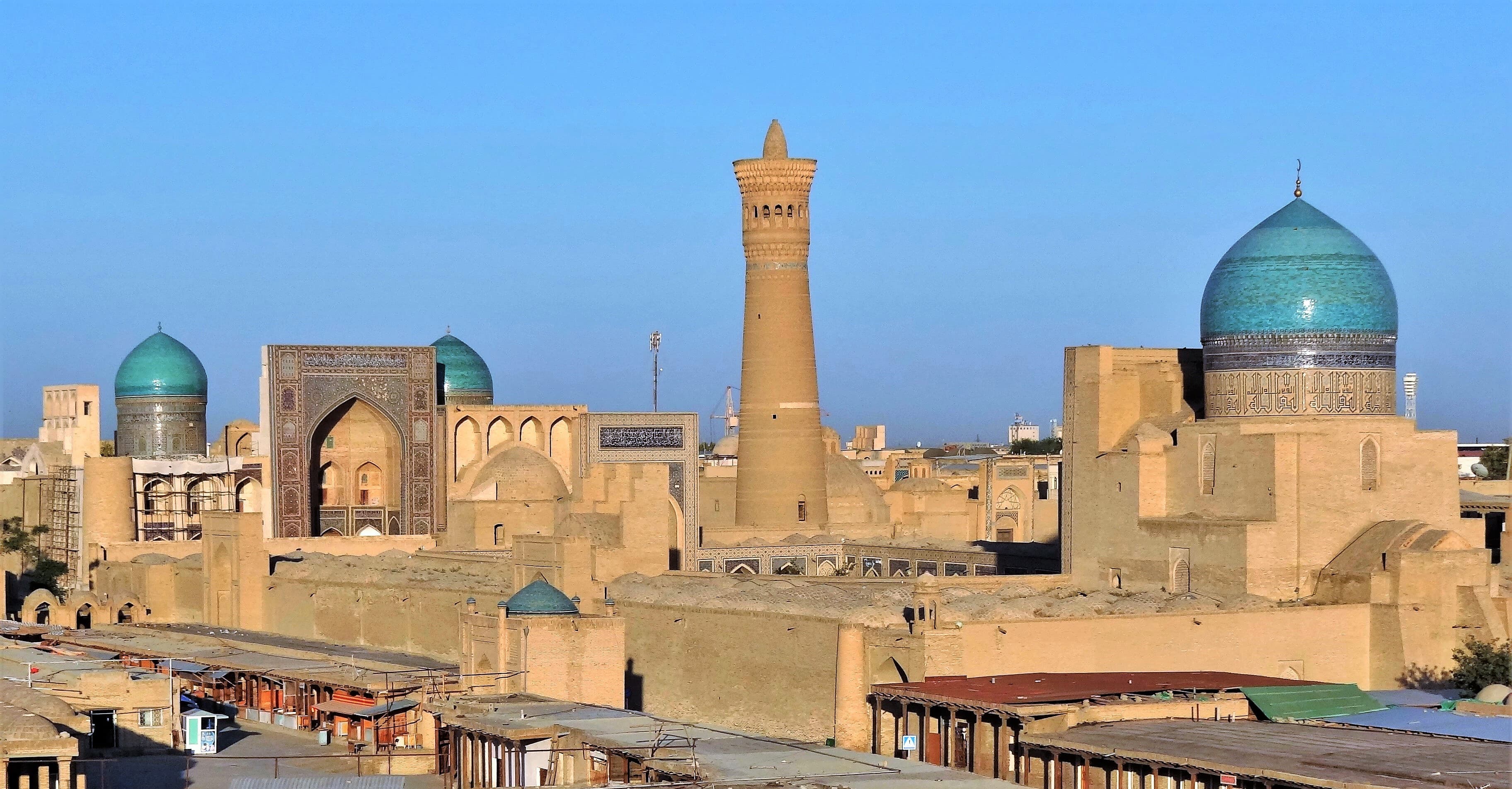
Long before it was mapped as a major artery of the Silk Road, the oasis of Bukhara accumulated names like layers of desert dust.
A traveler arriving in Bukhara in the tenth century would have entered a city of aliases. It was Numijkat to its oldest inhabitants, Bumiskat to others, and to the Arabic merchants who filled its caravanserais, it was known alternately as Madinat al-Sufriya—the Copper City—and Madinat al-Tujjar, the City of Merchants. But its enduring name, Bukhara, carries an older, quieter ancestry. Most scholars trace it to the Sanskrit vihāra, a Buddhist monastery, a word carried along the trade arteries of Central Asia by Uyghur and Chinese pilgrims. Long before the green banners of Islam were raised over its walls, the oasis was a landscape of monasteries and fire-temples, populated by Buddhists and Zoroastrians. When the first Arab invader, Ubaidullah bin Ziad, crossed the Oxus River, he found a wealthy oasis ruled by a queen regent governing on behalf of her young son, presiding over a land where the chanting of sutras and the tending of sacred hearths defined the rhythm of daily life.
By the ninth century, however, the city had been utterly transformed, rising to become the intellectual and cultural beating heart of the Persian world. Under the Samanid Empire, which established Bukhara as its capital around 850, the city staged a brilliant, defiant rejuvenation of Persian culture far from Baghdad, the center of the Islamic world. The Samanid court, claiming noble descent from the Sasanian general Bahram Chobin, gathered the finest minds of the age. Here, New Persian flourished as a literary language; Rudaki, the father of Persian poetry, was born and raised in Bukhara’s fertile orbit, composing his most famous verses to celebrate the city’s intoxicating beauty. It became a city of legendary libraries, a magnet for scholars, theologians, and scientists, and the birthplace of Imam Bukhari, whose compilations of Islamic traditions would shape Sunni jurisprudence for a millennium. To the wider world, it was now Bukhārā-ye sharīf—Noble Bukhara.
The physical architecture of the city still tells the story of the dynasties that fought to possess this crown jewel of the Silk Road. When the Turkic Karakhanids took the city at the dawn of the eleventh century, they embarked on a monumental building campaign, leaving behind the Magoki Attori mosque and the breathtaking Kalyan minaret. Completed in the early twelfth century, the minaret—the Minâra-i Kalân, or Grand Minaret—is a marvel of engineering designed by an architect known to history simply as Bako. Rising forty-five and a half meters over the flat Central Asian plains, the circular-pillar brick tower narrows elegantly as it climbs toward a sixteen-arched rotunda and a magnificent stalactite cornice. It was an instrument of immense visual power. Though its name is derived from the Arabic manāra, meaning a lighthouse or a place where fire burns—suggesting an evolution from the fire-towers of the region's Zoroastrian past—its scale far exceeded the practical needs of a muezzin calling the faithful to prayer. For centuries, it also served a darker purpose, earning the moniker "The Tower of Death" as the site where condemned criminals were executed by being flung from its dizzying heights.
Yet, for all its structural majesty, Bukhara was repeatedly subjected to the brutal geopolitical tides of the steppe. In 1220, Genghis Khan besieged the city for fifteen days, breaching its defenses and subjecting it to the fury of the Mongol conquest. But the city’s position at the crossroads of global commerce ensured its eventual resurrection. As a premier hub of the Silk Road, it welcomed travelers, diplomats, and merchants from every corner of the known world, including a permanent community of medieval Indian merchants from Multan who owned land within the city limits. In the West, its wealth and exoticism became the stuff of legend; by 1483, the Italian poet Matteo Maria Boiardo had mythologized the city as "Albracca" in his epic Orlando Innamorato.
By the sixteenth century, the golden age of Persian hegemony began to yield to a succession of Uzbek dynasties. Though its political influence in the wider Islamic world began to dim, Bukhara remained a vital spiritual epicenter, particularly through the legacy of Sheikh Naqshbandi, whose mystical Sufi teachings redefined Islamic spirituality and theology across Central Asia. Under the Shaibanid dynasty, the city’s architectural landscape was finalized into the grand complexes visible today. The great Kalyan Mosque was completed around 1514, its vast courtyard capable of holding twelve thousand worshippers, supported by two hundred and eighty-eight monumental pylons. Facing it, raised on a platform to compensate for the slope of the public square, stands the Mir-i-Arab Madrassah. Built in the 1530s, the seminary was funded by Ubaidullah Khan using the ransoms of more than three thousand Persian captives taken during his campaigns in Herat. The khan, deeply devoted to Sufi traditions, chose to be buried not in a grand mausoleum of his own, but in a simple wooden tomb within the madrasah, laid at the feet of his spiritual mentor, the Yemeni sheikh Mir-i-Arab.
As the centuries ground on, Bukhara’s isolation from the shifting global trade routes of the maritime age slowly turned the city inward. By the nineteenth century, it was the capital of the Emirate of Bukhara, ruled by local emirs who presided over a state that had become a peripheral, conservative enclave. Alongside neighboring Khiva, the city became notorious as one of the "slave capitals of the world," where major slave markets traded in captives taken from the Persian frontiers and the northern steppes. It was during this era that Bukhara became a key chessboard in the "Great Game," the quiet, desperate cold war between the British and Russian empires for dominance over Central Asia. English officers and diplomats, writing of "Bokhara," depicted a place of immense medieval beauty shadowed by fanatical isolation.
The end of the old emirate arrived with explosive violence during the Russian Civil War. In late August 1920, the Red Army, commanded by the Bolshevik general Mikhail Frunze, launched a devastating assault on the city. After four days of fierce fighting, the Ark—the emir’s ancient citadel—lay in ruins, and the last emir, Alim Khan, fled east toward Dushanbe and ultimately into exile in Kabul. On September 2, 1920, the red flag was raised from the top of the Kalyan Minaret. For four brief, chaotic years, the city served as the capital of the Bukharan People’s Soviet Republic, surviving a temporary capture by the Basmachi counter-revolutionaries during Enver Pasha’s 1922 campaign, before being formally dissolved and integrated into the Uzbek Soviet Socialist Republic in 1924.
When Fitzroy Maclean, a young British diplomat, slipped away from his post in Moscow to make a surreptitious visit to Bukhara in 1938, he found a city caught between its imperial past and its Soviet present. Sleeping in public parks to avoid the authorities, Maclean was mesmerized by what he called an "enchanted city," possessing public squares and brickwork that rivaled "the finest architecture of the Italian Renaissance." He was looking at places like the Lab-i Hauz, a quiet public square built around one of the city's few surviving stone-faced ponds—remnants of a medieval system of public reservoirs that the Soviets had systematically drained in the name of public hygiene.
In the latter half of the twentieth century, Bukhara’s demographic landscape shifted once more, as the Soviet war in Afghanistan and the civil war in neighboring Tajikistan drove waves of Dari- and Tajik-speaking refugees into the ancient city. These refugees integrated into the local Tajik population, reinforcing the city's ancient, deeply rooted Persian identity. Today, Bukhara stands as the capital of its namesake region within independent Uzbekistan, its historic center preserved as a UNESCO World Heritage Site. To walk its narrow alleys, past the towering blue dome of the Kalyan Mosque or the quiet water of the Lab-i Hauz, is to touch a place that has survived the transition from Buddhist monastic oasis to Islamic intellectual capital, from imperial battleground to Soviet outpost, remaining throughout it all an irreplaceable repository of the human spirit.
Connected to
10 links to entries not yet ingested in the Library.