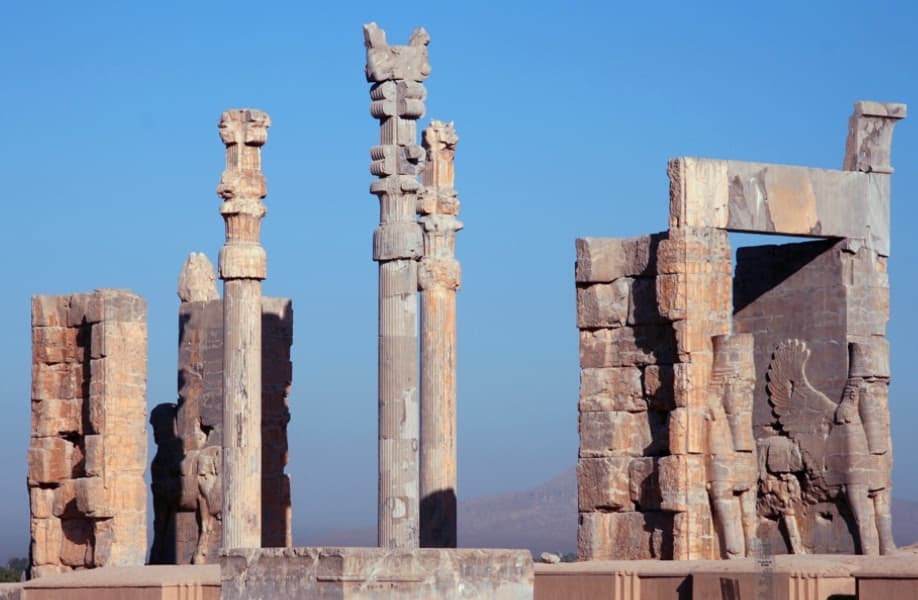
High on a walled platform in the plains of Marvdasht, encircled by the southern Zagros Mountains, the kings of the Achaemenid Empire raised a grand ceremonial complex that defied the typical definition of a city.
High upon a vast, artificial terrace of grey limestone, where the plain of Marvdasht meets the jagged, red-hued slopes of the Zagros Mountains, stands a silent forest of stone. Today, the ruins are known to the people of Iran as Takht-e-Jamshid—the Throne of Jamshid, a mythical king of Persian lore—but to the ancient Greeks who feared and eventually destroyed them, they were Persepolis: the city of the Persians. For nearly two centuries, this colossal stone platform, measuring some one hundred and twenty-five thousand square meters, served as the ceremonial heart of the Achaemenid Empire. Yet it was an empire ruled from elsewhere. The great kings of Persia held court, managed their vast bureaucracies, and received foreign emissaries in the sprawling lowlands of Susa, the ancient chambers of Babylon, or the cool highlands of Ecbatana. Persepolis was something altogether different. It was not a metropolis of teeming streets, but a grand, seasonal theater of statecraft—an architectural hymn to imperial harmony carved into the living rock of Fars, occupied only when the spring equinox heralded the arrival of the Persian New Year, Nowruz.
The genesis of the complex belongs to Darius I, who in 515 BCE began constructing the great terrace parallel to his works at Susa. Seeking to anchor his rule after the crown passed to a new branch of the royal house, Darius selected a site backed by Rahmat Mountain, the Mount of Grace, and set about reshaping the landscape. He did not build with mortar; instead, his masons laid massive blocks of dark-grey limestone with such precision that many remain in situ more than two millennia later. Over the next several decades, under Darius and his successor Xerxes I, the terrace rose between fourteen and forty-one feet above the plain, protected by angled walls designed to allow defenders to sweep any advancing force. To ascend this platform, visitors did not climb a steep, defensive ramp, but rather a magnificent, wide double stairway of exceptionally shallow steps, designed so elegantly that horses and emissaries in long, flowing robes could mount them with effortless dignity. At the summit, they were met by a succession of colossal buildings: the Apadana, the great imperial Treasury, the Council Hall, and grand residential palaces. It was an unfinished masterpiece; even as the empire neared its sudden end, stonecutters were still chiseling the mountain rock, leaving behind heaps of mason's rubbish that archaeologists would discover centuries later, still waiting to be cleared.
To walk through Persepolis during its seasonal zenith was to witness a meticulously choreographed display of global dominion. As the spring equinox approached, representatives from every corner of the known world—from the banks of the Indus to the shores of the Aegean, from the deserts of Libya to the fertile valleys of Mesopotamia—converged on the plain of Marvdasht. They carried the finest treasures of their homelands: vessels of gold, fine textiles, exotic animals, and weapons. This grand pageant remains frozen in time on the exquisite reliefs carved into the grand staircases of the Apadana. Here, the tributary nations of the empire are depicted not as humiliated, chained captives, but as dignified subjects, led hand-in-hand by Persian ushers to present their voluntary gifts to the Great King. It was a projection of an imperial Pax Persica, a statement that the diverse peoples of the earth were unified under the benign custody of the Achaemenid crown. The king himself remained elusive, shrouded in the architectural geometry of the terrace; even today, archaeologists debate where the royal private quarters actually lay, or whether the complex was entirely abandoned once the spring rituals concluded and the court retreated from the summer heat of Fars.
+ 12 further connections to entries not yet ingested
For all its grandeur, this mountain-ringed sanctuary remained virtually unknown to the Mediterranean world. Tucked deep within an alpine fastness, Persepolis was shielded from the gaze of Greek travelers and historians, who wrote extensively of Susa and Babylon but left no contemporary mention of the ceremonial capital. When Alexander of Macedon marched his army into the Persian heartland in 330 BCE, he was seeking not merely a military victory, but the ultimate prize of the Achaemenid world. His journey to the city was marked by grim omens and desperate battles. According to historical accounts, as the Macedonian army neared the city, they were met by a crowd of eight hundred elderly Greek artisans. These men had been captured by the Persians, who mutilated them—cutting off hands or feet—to prevent their escape while exploiting their highly specialized skills. The sight of these maimed craftsmen deeply unsettled Alexander and his officers. Soon after, the army encountered a far more formidable obstacle at the Persian Gates, a narrow mountain pass where the Persian satrap Ariobarzanes mounted a fierce defense. For thirty-one days, Ariobarzanes held the Macedonians at bay, inflicting heavy casualties until a captured tribal chief betrayed the defenders, showing Alexander a mountain path to outflank the Persian position. Ariobarzanes was killed in the ensuing struggle, and the road to Persepolis lay open.
What followed remains one of the ancient world's most debated tragedies. After allowing his troops to systematically plunder the city for several months, Alexander presided over a great feast. During the drunken revelry, a fire broke out, starting in the Hadish Palace—the former residence of Xerxes I—and rapidly consuming the wooden roofs and cedar beams of the complex. The Roman and Greek historians Plutarch, Diodorus Siculus, and Quintus Curtius Rufus attribute the conflagration to the instigation of Thaïs, an Athenian courtesan and mistress of the general Ptolemy. In the midst of the symposium, she reportedly urged the intoxicated king to torch the palace of Xerxes as a symbolic act of revenge for the Persian burning of the Acropolis of Athens some one hundred and fifty years earlier. Whether the fire was indeed a drunken whim of a courtesan, an accidental mishap of a wild celebration, or a calculated political act by Alexander to destroy the preeminent symbol of Achaemenid legitimacy and prevent it from becoming a rallying point for Persian resistance, the result was absolute. The great archives of Persepolis, which later Zoroastrian texts like the Book of Arda Wiraz claim held the entire Avesta and Zend written in gold ink upon cow-skins, were reduced to ash. Yet in a striking historical paradox, the very fire that destroyed the empire’s literary memory served to preserve its daily administrative reality. The heat of the conflagration baked and hardened thousands of clay tablets stored in the northern fortification walls, shielding the Persepolis Fortification Archive from decay and delivering to modern historians an unparalleled record of Achaemenid governance, diet, and economy.
Persepolis did not vanish immediately from the map after the fire. In the immediate aftermath, under the Macedonian empire in 316 BCE, it remained the capital of the province of Persis, but its decline was inexorable. The population drifted away from the high terrace, and the lower settlement at its foot gradually crumbled. Just a short distance away, the city of Estakhr rose to prominence, built in part with the scavenged stones and rubble of the ruined palaces. When the Sasanian dynasty established the second great Persian Empire in the third century CE, they chose the vicinity of Persepolis to carve their own monumental rock reliefs at Naqsh-e Rustam, placing their images beneath the cliff-side tombs where Darius I and his successors lay buried. To these later kings, and to the Arab conquerors who arrived in the seventh century, the giant columns of the terrace were a source of profound mystery. Estakhr itself offered a fierce, desperate resistance to the Islamic armies, remaining an important regional center until it was eclipsed by the rise of Shiraz and eventually dwindled into obscurity by the tenth century. By then, the original identity of Persepolis had faded into myth. It became a landscape of legends, known to locals as "Forty Minarets" or the "Throne of Jamshid," its true builders forgotten by the very land they had ruled.
The resurrection of Persepolis as a historical reality began in the early seventeenth century, when European travelers began to venture into the ruins of Fars. In 1618, García de Silva Figueroa, the Spanish ambassador to the Safavid court, became the first Western scholar to correctly identify the vast ruins of "Chehel Minar" as the Persepolis of classical antiquity. Visitors like Pietro Della Valle in 1621 noted that of the seventy-two monumental columns that once graced the Apadana, only twenty-five still stood erect against the Iranian sky. These early encounters did more than inspire romantic reflections on the transience of empires; they initiated the birth of modern archaeology. The strange, wedge-shaped characters carved into the doorframes and window ledges of the ruins caught the attention of scholars. Studies of these trilingual inscriptions, written in Old Persian, Elamite, and Babylonian, eventually provided the key to deciphering cuneiform script in the early nineteenth century, unlocking the written history of the ancient Near East. Today, the skeletal columns of Persepolis stand as one of the world's most evocative ruins—a monument to an empire that sought to gather the nations of the earth under a single, harmonious terrace, only to be consumed by the very forces of conquest it had helped unleash.