Place · 330 CE – 1922 CE · Late Antique and Byzantine
Constantinople
- Also known as
- Bizancio
- Byzantium
- Caergystennin
- Carigrad
- Cathair Chonstaintín
- Cařihrad
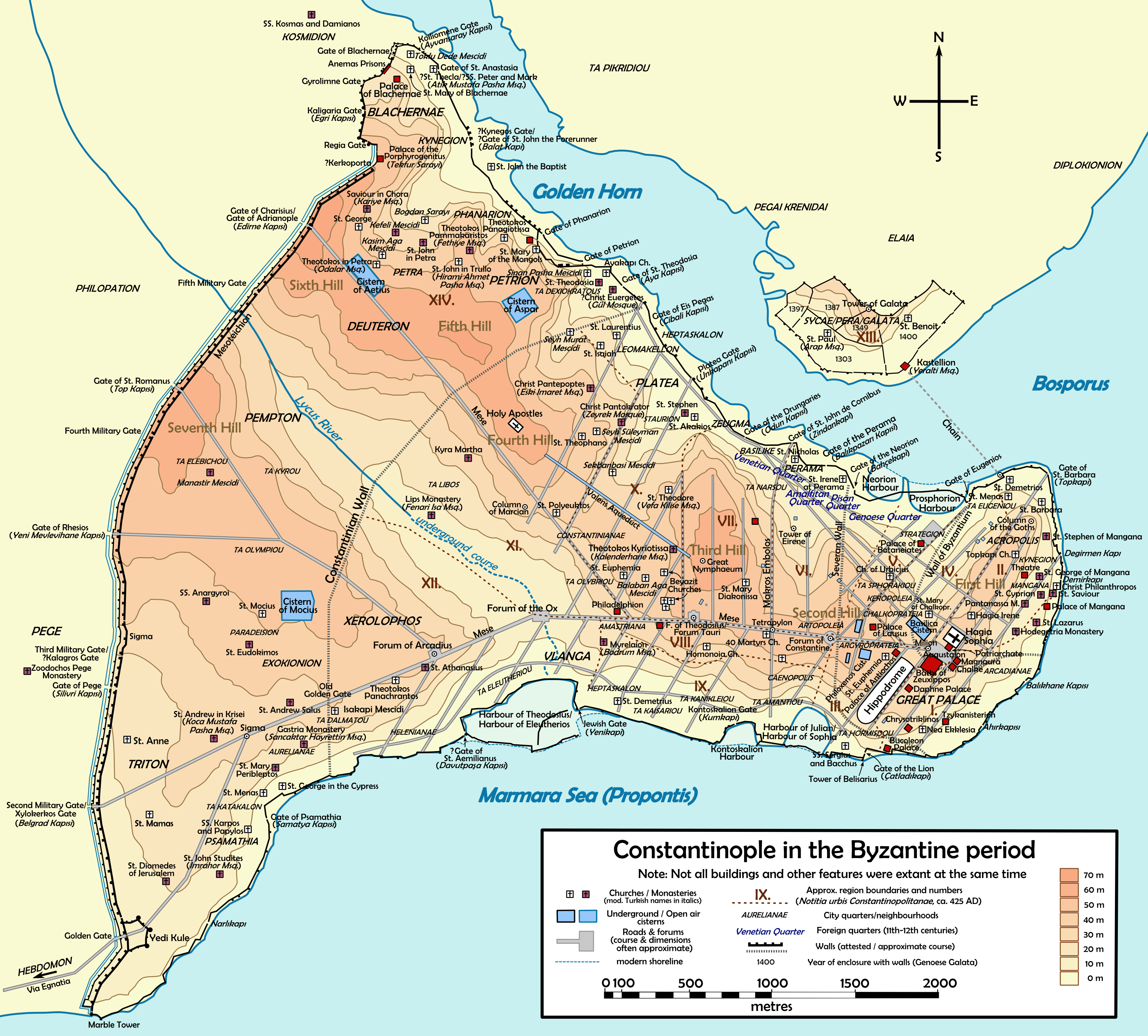
To understand the history of power in the medieval world, one must look to the tip of the Thracian peninsula, where a single city commanded the watery threshold between Europe and Asia.
On a map of the ancient world, the southeastern tip of Thrace appears as a finger of land reaching out to touch Asia, only to be held back by the swift, cold current of the Bosporus. It is a landscape defined by water: the Sea of Marmora to the south, the narrow strait to the east, and the deep, four-mile-long inlet of the Golden Horn to the north, which together form a natural moat around a hilly peninsula. According to Pliny the Elder, the earliest human footprint here was a Bronze Age Thracian settlement called Lygos. By 657 BCE, Greek colonists from Megara, led by the legendary Byzas, recognized the commercial and strategic genius of the site and founded Byzantium directly across from Chalcedon. For centuries, this small town guarded the gateway between the Mediterranean and the Black Sea, holding its ground against empires until Septimius Severus razed its walls in 196 CE to punish it for backing a political rival. Rebuilt and briefly renamed Augusta Antonina, the city awaited a grander destiny, one that would make it not merely a regional outpost, but the pivot upon which a millennium of human history would turn.
The transformation of Byzantium into Constantinople, consecrated on May 11, 330 CE, was not a sudden burst of imperial whim but the logical conclusion of a shift in the Roman world. For decades, the Western empire had been buckling under barbarian incursions, while the wealthier, more populous East had become the true center of economic vitality and political danger. Diocletian had already decentralized the government, bypassing Rome to rule from Nicomedia in Asia Minor. When Constantine the Great emerged from the civil wars as sole ruler, he recognized that the empire’s survival depended on a capital positioned to defend both the Danube and the Persian frontier. He chose Byzantium, vastly expanded its borders, and named it Nova Roma—New Rome. Though the old name of Byzantium clung to the territory like an echo, the world soon knew it simply as Constantinople, the "city of Constantine." It was designed deliberately to rival and surpass its Italian predecessor. The city’s undulating terrain was divided into seven elevations to match Rome’s famous hills, and upon these heights rose the monuments of a new civilization. The first hill was crowned by the great Hippodrome, the sprawling Imperial Palace, and the early foundations of what would become the Hagia Sophia.
For nearly nine hundred years, the city’s defenses proved utterly impenetrable. The vulnerability of any coastal capital is its landward side, but Constantinople’s geography meant its land frontier was remarkably short. In the fifth century, this gap was sealed by the massive Theodosian Walls—a sophisticated double wall of brick and stone fronted by a deep moat and palisades, running from the Golden Horn to the Sea of Marmora. Behind these barriers, Constantinople grew into the largest, wealthiest, and most culturally dazzling city in Europe. It became the self-conscious cradle of Orthodox Christian civilization, guarding the most revered relics of Christendom, including the Crown of Thorns and the True Cross. To the Vikings who sailed down the rivers of Eastern Europe, it was , the "Big City." To the Slavs, it was , the "City of the Caesar." In the Arabic tongue, it was called the Great City of the Romans, and to its own citizens, it was simply —the City. Within its walls, Greek literature was preserved, Roman law was codified, and the Ecumenical Patriarch presided over a theological empire that stretched from the Mediterranean to the forests of Rus.
Connected to
- birthplace of · place of death ofAnna Komnene1083 CE
- place of death ofBelisarius505 CE
- in countryByzantine Empire395 CE
- containsFall of Constantinople1453 CE
- place of death ofHeraclius