Person · 1736 CE – 1819 CE · Enlightenment and Revolutions
James Watt
- Also known as
- Canmuse.wate
- Ceyms Vatt
- Ceyms Vatt
- Ceyms Watt
- Džeimsos Vats
- Džeimss Vats
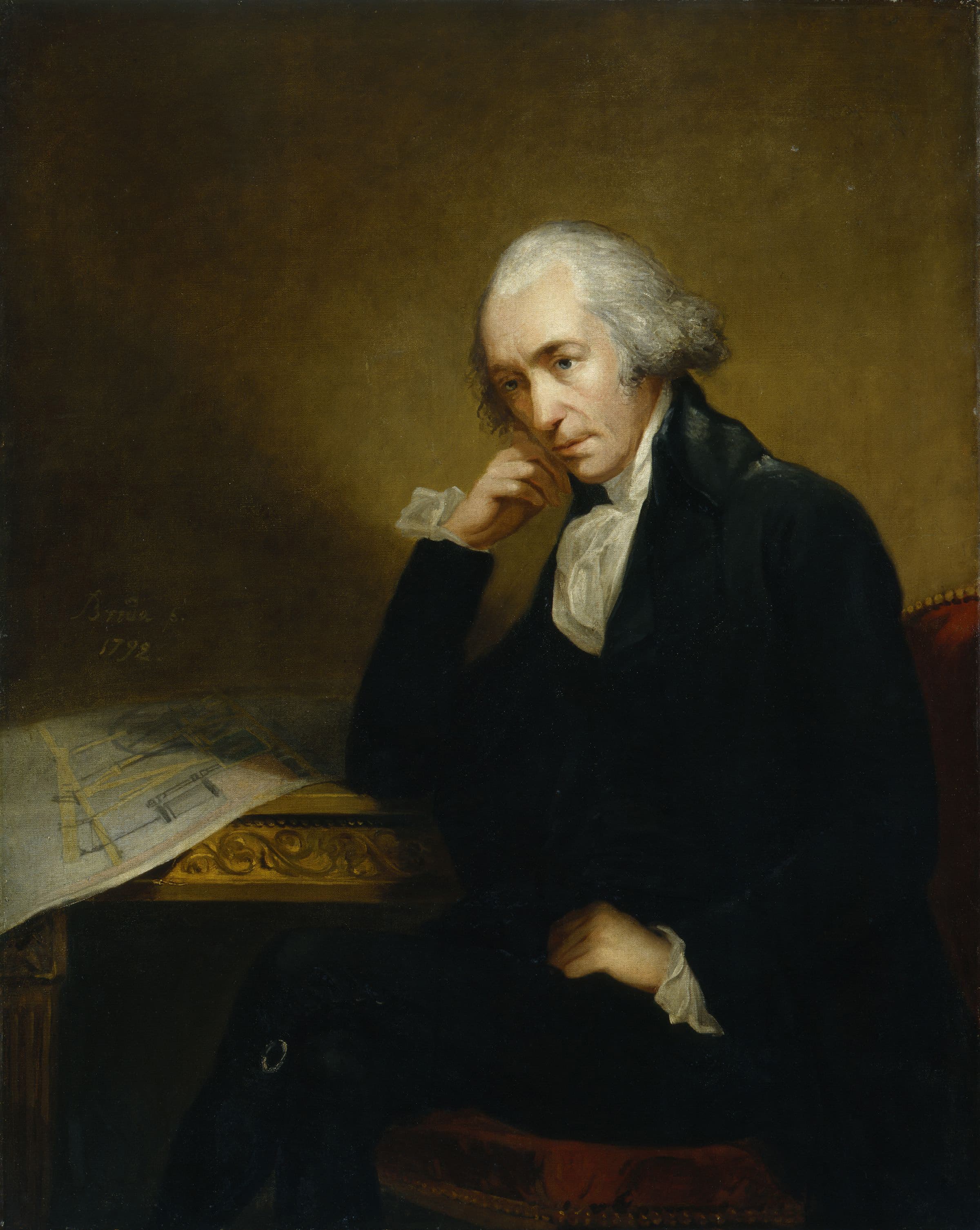
The great transformation of the industrial world turned on a simple realization about heat and waste.
On a Sunday afternoon in May 1765, a twenty-nine-year-old instrument maker named James Watt went for a walk across the quiet expanse of Glasgow Green. He was a man of delicate health, plagued since childhood by violent headaches and prone to bouts of deep discouragement. For months, he had been consumed by a small, frustratingly inefficient machine: a model of the Newcomen steam engine belonging to the University of Glasgow, which he had been tasked with repairing. The engine was a marvel of the early eighteenth century, used primarily to pump water from deep coal mines, but it was also a thermal disaster. It worked by filling a vertical cylinder with steam and then injecting cold water directly into that same cylinder to condense the steam, creating a vacuum that pulled the piston down. To Watt’s mounting frustration, three-quarters of the heat introduced in every single cycle was lost simply in reheating the metal cylinder, which had just been chilled by the cold injection water. As he walked the green that afternoon, an elegant, transformative idea suddenly took shape. If the steam could be drawn off and condensed in a separate, cold vessel while the cylinder itself was kept continuously hot—as hot as the entering steam—the catastrophic waste of energy would vanish. "The idea jumped into my mind," he would later recall. With that single flash of intuition, Watt did not merely repair a model; he laid the practical foundation for the age of industrial machine power.
This leap of intellect was not born in a vacuum, nor did it descend upon an uneducated tinkerer. Born in the Scottish port town of Greenock in 1736, Watt grew up in a household shaped by both intellectual ambition and the raw mechanics of commerce. His father was a shipwright, contractor, and ship owner who also served as the town’s chief baillie; his family’s comfort was built, in part, on the transatlantic trade in enslaved people and the goods they produced. Watt’s mother, Agnes Muirhead, was a well-educated woman of forceful character who initially taught him at home, while his grandfather had been a teacher of mathematics and navigation. Though the boy showed little appetite for the classical Greek and Latin taught at Greenock Grammar School, he possessed an extraordinary aptitude for geometry and a natural manual dexterity developed in his father’s maritime workshops. When his father’s fortune dissolved in unsuccessful speculations, eighteen-year-old Watt was cast onto his own resources. He traveled to London in 1755, enduring a grueling, year-long training under a mathematical instrument maker named John Morgan. The intense labor and frugal living broke his fragile health, forcing him to return north to Scotland, but he carried home an exquisite proficiency with brass, steel, and the delicate geometry of scientific tools.
Establishing himself as an independent craftsman in Glasgow proved difficult. The local trade guilds, protective of their monopolies, refused to recognize a young artisan who had not served the customary seven-year apprenticeship. Watt was saved from this legal impasse by the arrival of a collection of astronomical instruments bequeathed to the University of Glasgow from Jamaica. The delicate instruments required expert restoration, a task Watt performed with such skill that the university took him under its protection. In 1757, they granted him a small workshop within the college precincts and the title of mathematical-instrument maker to the university. It was a remarkable sanctuary. Free from the interference of the city guilds, Watt found himself working alongside some of the finest minds of the Scottish Enlightenment. He soon befriended Joseph Black, the chemist who discovered the concept of latent heat, and John Robison, a brilliant student who would later become a professor of natural philosophy. It was Robison who first directed Watt’s attention to steam as a potential source of motive power in 1759, though at the time, Watt had never actually seen an operating steam engine in person.
The path from the epiphany on Glasgow Green to a functioning commercial machine was a long, exhausting trial that nearly broke Watt’s spirit and his finances. To realize his design, he needed to keep the cylinder hot, which he achieved by encasing it in a outer "steam jacket," and he had to design an air-pump to continuously clear the separate condenser of water and air. Yet eighteenth-century metallurgy was crude. A Newcomen engine’s piston could be sealed against its poorly bored cylinder with a simple layer of standing water, but Watt’s hot, dry cylinder demanded an airtight seal lubricated by oil, requiring tolerances that contemporary ironmasters simply could not meet. Desperate for capital to secure a patent and build a full-scale prototype, Watt allied with John Roebuck, the founder of the Carron Iron Works. For years, Watt labored in a small cottage adjacent to Roebuck’s home at Kinneil House, but the cylinders cast for him were warped and leaky. As the years dragged on, Roebuck’s business slid toward bankruptcy. To support his family—which included his wife and cousin, Margaret Miller, whom he had married in 1764—Watt was forced to shelve his engine and work for eight years as a surveyor and civil engineer, mapping canals, designing harbor improvements for Greenock and Port-Glasgow, and inventing a simple micrometer to measure distances through a telescope.
The turning point came in the mid-1770s through a shift in geography and partnership. Following Roebuck’s financial collapse, his share of Watt's 1769 patent was acquired by Matthew Boulton, a wealthy, energetic Birmingham industrialist who owned the Soho Manufactory. Boulton was a man of immense commercial vision who possessed what Scotland lacked: access to the finest metalworkers in the world. In Birmingham, Watt found the solution to his manufacturing nightmare in John Wilkinson, an ironmaster who had recently developed a precision boring machine for hollow-casting cannons. Wilkinson’s machine could bore a massive iron cylinder with unprecedented accuracy, providing the airtight fit Watt's piston required. In 1775, Boulton and Watt secured a parliamentary extension of the engine patent until 1800, launching a partnership that would last a quarter of a century. The first commercial engines were erected in 1776, immediately proving their worth by pumping water from the deep, flooded copper and tin mines of Cornwall. Because Boulton and Watt did not yet operate their own foundry, Watt functioned as a consulting engineer, drawing up meticulous plans while the customers paid for the parts to be cast elsewhere and erected under the supervision of the firm's agents.
These early machines were colossal, requiring entire dedicated buildings to house cylinders that could measure fifty inches in diameter and stand twenty-four feet tall. Rather than selling the engines outright, Boulton and Watt charged their customers an annual premium equivalent to one-third of the cost of the coal saved by using their condensing engine instead of a traditional Newcomen machine. It was a wildly successful business model that transformed the economics of British mining and, eventually, manufacturing. Though Watt would spend his later years refining his inventions—and fighting protracted legal battles to defend his patents—his separate condenser remained the single most important leap in the history of the early Industrial Revolution. When he died in 1819 at the age of eighty-three, he was a wealthy, internationally celebrated man. He left behind a world that had begun to run not on the natural rhythms of wind, water, or muscle, but on the relentless, controlled expansion of steam—an era of artificial power so defined by his calculations that his own surname would eventually become the universal scientific unit of power itself.
Connected to
12 links to entries not yet ingested in the Library.