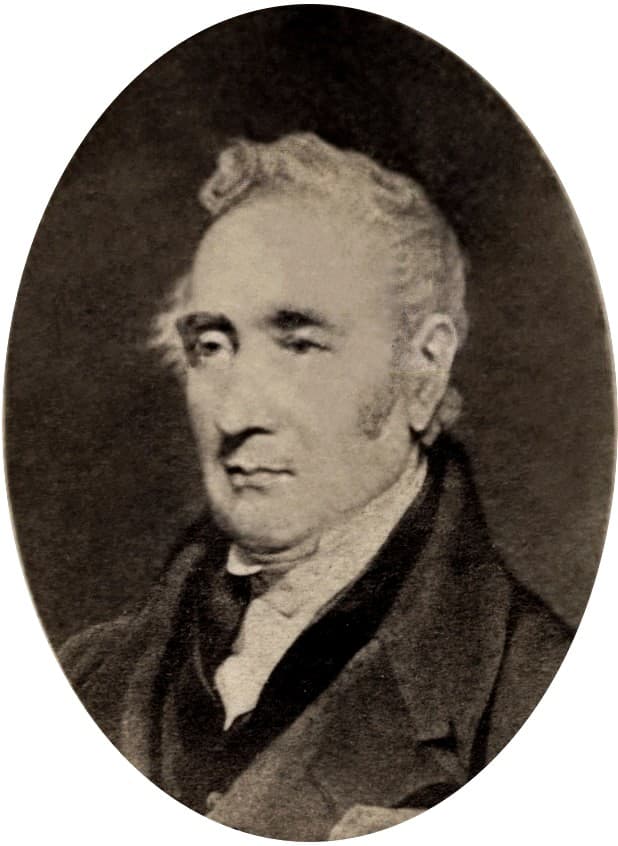
Until the age of eighteen, George Stephenson could neither read nor write.
In the autumn of 1815, a man carrying a primitive lamp descended into the dark, volatile depths of the Killingworth Colliery in Northumberland. The air in the pit was thick with firedamp—the invisible, highly flammable gas that had turned countless coal mines into subterranean tombs. The man, a self-taught colliery engine-wright named George Stephenson, walked directly toward a fissure in the rock where the gas was actively escaping. He held his lamp directly in front of the draft. It was an act of breathtaking physical courage, or perhaps of absolute confidence in his own mechanical intuition. To two witnesses standing at a safe distance, the experiment was a success: the flame inside the lamp remained contained, drawing in oxygen through minute, engineered perforations that prevented the ignition from spreading to the atmosphere outside.
A few weeks later and nearly three hundred miles to the south, the celebrated chemist Sir Humphry Davy presented his own safety lamp to the Royal Society in London. Davy’s lamp utilized a fine wire gauze to cool the gases and prevent explosion, a brilliant application of contemporary scientific theory. When news of Stephenson’s parallel, independent invention reached the capital, the metropolitan scientific establishment reacted with intense skepticism, even outrage. To the gentlemen of the Royal Society, it was inconceivable that an uneducated northern laborer, speaking in a thick, almost impenetrable Northumberland accent—scarcely the "Language of Parliament"—could have arrived at such a solution through mere trial and error. Davy’s supporters accused Stephenson of outright theft, arguing that he lacked the scientific vocabulary to have conceived of the design. Though a local committee of inquiry exonerated Stephenson, awarding him £1,000 to counter the £2,000 given to Davy, and a subsequent House of Commons committee in 1833 affirmed his equal claim to the invention, the bitter episode left a permanent mark. It instilled in Stephenson a lifelong, deep-seated distrust of London’s theoretical, academic experts, cementing his belief in the supremacy of practical, hands-on experimentation.
This divide between formal education and mechanical instinct was the defining reality of Stephenson's early life. Born in 1781 in the small mining village of Wylam, near Newcastle upon Tyne, he was the son of a colliery fireman who earned barely enough to feed his family. There was no money for schooling, and Stephenson spent his childhood as a cowherd, later driving the horse-powered gin at the colliery. By the age of seventeen, he was working as a plugman, tending to the massive steam-driven pumping engines that kept the mines dry. At eighteen, he was still entirely illiterate. Realizing that the secrets of the great steam pioneers Matthew Boulton and James Watt lay locked within written texts, he began paying a few pennies a week to attend a night school, rapidly mastering reading, writing, and basic arithmetic. His early manhood was a grind of relentless work and personal tragedy; his first wife, Frances Henderson, died of tuberculosis in 1806, shortly after the death of their infant daughter, leaving him to raise their young son, Robert. To support his family and fund his son's education, Stephenson took on extra work, mending shoes and cleaning watches and clocks by candlelight.
12 links to entries not yet ingested in the Library.
It was his promotion to engine-wright at Killingworth High Pit in 1812 that finally gave Stephenson the platform to apply his growing mastery of steam technology. Drawn to the early experiments in steam traction taking place in the region—most notably those of Cornish pioneer Richard Trevithick—Stephenson persuaded the colliery owners to fund the construction of a "travelling engine" to haul coal along the wooden and iron tramroads of the mine. In 1814, he completed his first locomotive, the Blücher, named after the Prussian general whose rapid march helped decide the Battle of Waterloo. While others had built steam engines for tracks before, the Blücher was a breakthrough: it was the first successful flanged-wheel adhesion locomotive, relying entirely on the contact between its metal wheels and the iron rails to pull its load.
Yet, the early locomotives were frustratingly ahead of their time, hampered by the material limits of the early nineteenth century. They were massive, heavy beasts that routinely crushed the brittle cast-iron rails of the era. Rather than abandoning the engine, Stephenson set out to reform the track itself. Working with ironmaster William Losh, he improved the design of cast-iron edge rails. He experimented with a "steam spring" system to cushion the engine’s weight and ultimately pioneered the distribution of the locomotive’s mass across multiple wheels. When commissioned to build the eight-mile Hetton colliery railway in 1820, Stephenson did away with animal power entirely, using a combination of gravity on downward slopes and steam locomotives on the flats and climbs.
The true scale of Stephenson’s vision, however, required a grander canvas than a local colliery. In 1821, a parliamentary act authorized the construction of the Stockton and Darlington Railway, a twenty-five-mile line designed to carry coal from the interior pits to the River Tees. The projectors had originally envisioned a traditional tramway, using horses to pull wagons along metal rails. But after Edward Pease, a prominent director of the project, met Stephenson, the plans were dramatically rewritten. Appointed as the railway’s engineer, Stephenson surveyed the route and convinced Pease that steam locomotives could perform the work far more efficiently than draft animals. To supply the necessary machinery, Stephenson, Pease, and other partners established Robert Stephenson and Company in Newcastle in 1823, appointing George's son, Robert, as managing director. Because Stephenson had painstakingly paid for Robert’s private education, the young man spoke the polished, Standard English preferred by parliamentary committees and London investors, acting as the elegant, diplomatic voice for his father’s rough-hewn genius.
On September 27, 1825, the Stockton and Darlington Railway opened to the public, marking a watershed moment in human history. Driven by Stephenson himself, the company’s first locomotive, Locomotion No. 1, hauled an eighty-ton payload of coal and flour. Behind the cargo wagons hung the Experiment, a custom-built carriage carrying local dignitaries. Traveling at speeds that reached fifteen miles per hour on downhill stretches, it was the first time in history that a steam locomotive had carried passengers on a public railway.
The success at Darlington paved the way for an even more ambitious project: the Liverpool and Manchester Railway. This was to be the world’s first fully public, inter-city railway designed to carry both passengers and freight exclusively by locomotive. It was a project fraught with immense engineering challenges, not least of which was crossing Chat Moss, a vast, treacherous peat bog that many of the era's leading engineers declared impassable. Stephenson defied them, constructing a floating roadbed of heather and branches that successfully carried the weight of the tracks and trains. When the line neared completion in 1829, the directors remained divided over whether to use stationary steam engines with cables or moving locomotives. To settle the matter, they announced the Rainhill Trials, offering a £500 prize for a locomotive that could meet their rigorous standards. Stephenson’s entry, The Rocket, built by his son's firm, easily outperformed its competitors. It combined a multi-tubular boiler with an efficient steam blast pipe, setting the template for locomotive design for the next century.
When the Liverpool and Manchester line officially opened in September 1830, the age of modern transport was born. It was during these years that Stephenson’s choice of a four-foot, eight-and-a-half-inch rail gauge—originally utilized in the colliery wagonways of his youth—was cemented. This "Stephenson gauge" would eventually cross oceans and continents, becoming the standard gauge for the vast majority of the world's railway networks.
In his final decades, Stephenson became the elder statesman of a global revolution. He acted as the chief engineer or consultant for major trunk lines across the English Midlands and traveled as far as Belgium and Spain to advise on new projects. Yet, as the "railway mania" of the mid-1840s took hold—a speculative frenzy that saw fortunes made and lost overnight on poorly conceived schemes—Stephenson grew deeply disillusioned and publicly disapproved of the financial chaos. He chose to spend his final years in quiet retirement at Tapton House in Chesterfield, turning his formidable intellect toward farming and horticulture until his death on August 12, 1848.
Ultimately, Stephenson’s legacy was not merely the physical engines he built, but the shrinkage of the world he helped initiate. By replacing the biological limits of the horse with the industrial power of coal and iron, he altered humanity’s relationship with time and space, laying down the physical and economic infrastructure that would define the modern global economy.