Person · 1765 CE – 1825 CE · Enlightenment and Revolutions
Eli Whitney
- Also known as
- Eli Vitni
- Eli Whitney Jr.
- Eлі Вітні
- Éli Whitney
- Ели Уитни
- Елі Уїтні
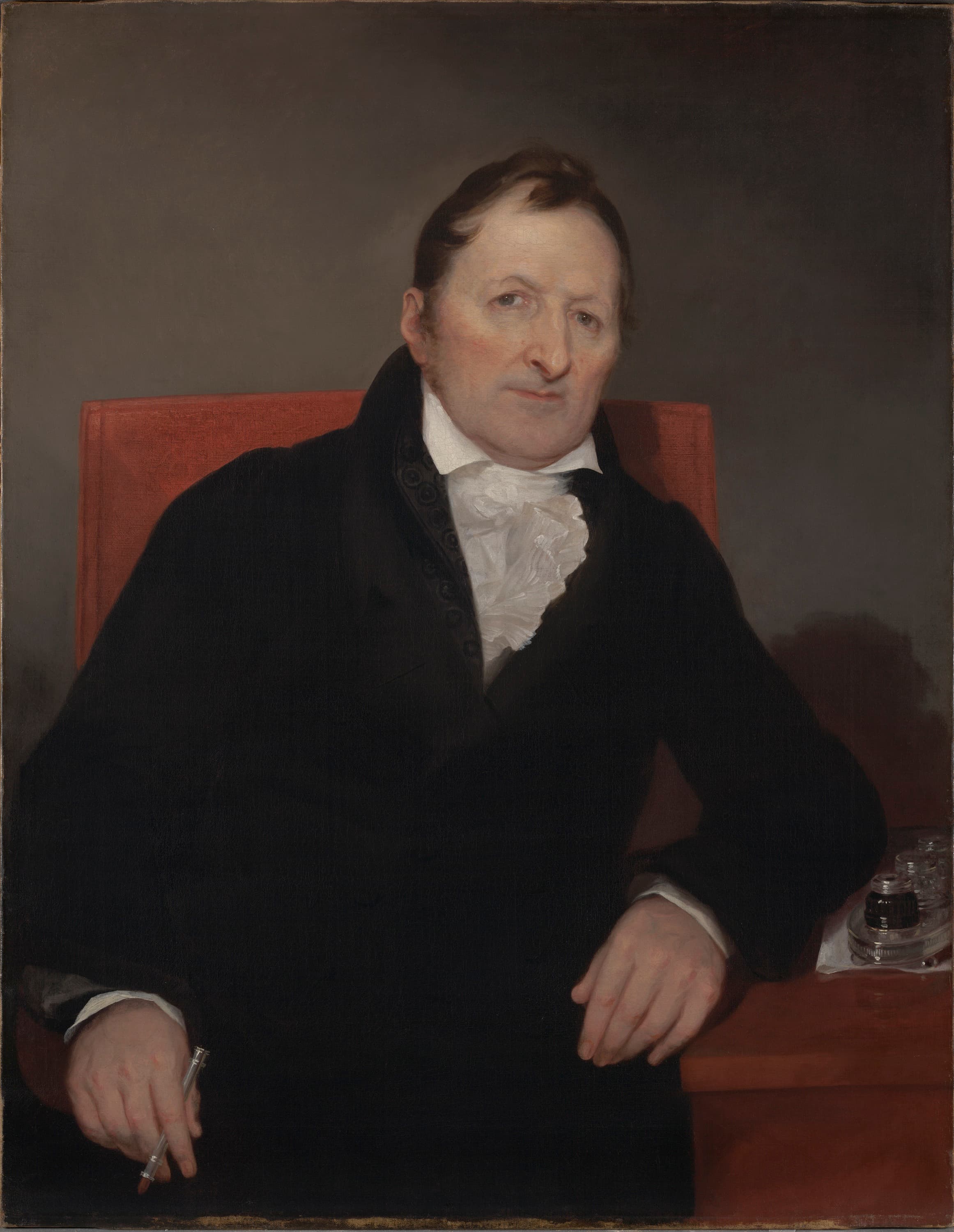
Few men have bound the American continent to its tragic, divided destiny quite like Eli Whitney.
In the autumn of 1792, a young Yale graduate named Eli Whitney boarded a ship bound for South Carolina, intending to find work as a private tutor to pay off his college debts. He was twenty-six, the son of a prosperous Massachusetts farmer, possessing little money but a highly disciplined mind and a rare mechanical aptitude. On the voyage, he met Catherine Littlefield Greene, the widow of the Revolutionary War hero General Nathanael Greene, who was returning to her Georgia plantation, Mulberry Grove. When the tutoring job fell through shortly after his arrival, Mrs. Greene invited the stranded New Englander to stay at her estate on the Savannah River while he figured out his next move. It was a casual gesture of Southern hospitality, but it placed Whitney at the precise geographical and economic pivot point of a young nation. At Mulberry Grove, Whitney found himself in conversation with local planters who lamented the stagnation of their region. The coastal tide-swamps grew lucrative long-staple cotton, but the vast, fertile interior of the South could support only short-staple upland cotton, a crop whose sticky green seeds adhered so stubbornly to the fiber that a laborer could spend an entire day cleaning just a single pound of lint. Without a mechanical solution, the South was bound to an unprofitable agricultural cycle, and the institution of slavery, centered on declining crops like tobacco and indigo, seemed to many contemporaries to be slowly dying of its own economic weight.
Intrigued by the problem, and encouraged by Mrs. Greene and her plantation manager, Phineas Miller—another transplanted Yale alumnus—Whitney set to work in a makeshift workshop. Within a few weeks, he produced a model of a machine he called a cotton "gin," short for engine. Its design was elegant in its simplicity: a wooden drum encircled by rows of slender wire hooks that pulled the raw cotton through a fine wire mesh. The gap in the mesh was too narrow for the seeds, which popped off and fell into a separate compartment, while a revolving brush swept the cleaned lint from the hooks. Watching his device work, Whitney allegedly recalled a cat attempting to pull a chicken through a fence, succeeding only in dragging the feathers through the slats. Whether or not the anecdote was apocryphal, the mechanical reality was staggering. By cranking the handle of Whitney’s wooden cylinder, a single operator could clean fifty to fifty-five pounds of cotton in a day. It was an invention that did not merely accelerate production; it reconstituted the economy of an entire hemisphere.
Yet the very simplicity that made the cotton gin so revolutionary proved to be Whitney’s financial undoing. He and Miller formed a partnership with a highly ambitious and ultimately disastrous business model. Instead of selling the machines, they planned to build and operate their own gins across the South, charging planters a toll of up to two-fifths of their cotton crop for the service. Planters, facing a sudden explosion of demand from the industrialized textile mills of New England and Great Britain, resented this attempt at an absolute monopoly. Because the machine could be easily replicated by any competent country blacksmith, piracy became rampant. Whitney’s first New Haven factory burned to the ground in March 1795, crippling his production capacity just as demand peaked. To make matters worse, other inventors modified his design; in 1796, Hogden Holmes secured a patent for a gin that replaced Whitney’s wire spikes with circular saws, a variation that proved highly effective. Whitney spent the next decade in an endless, exhausting series of patent infringement lawsuits that drained his resources and consumed his energy. Though his patent was finally validated in 1807, and states like South Carolina and North Carolina eventually paid him settlements of $50,000 and $30,000 respectively for the state rights to his technology, the litigation had devoured almost all his profits.
As Whitney’s fortune vanished into the ledgers of Southern courtrooms, the invention he had unleashed was reshaping the American landscape with terrifying speed. Before the gin, the United States exported fewer than 500,000 pounds of cotton in 1793. By 1810, that figure had climbed to 93 million pounds. Cotton became a miracle crop: it could be stored indefinitely without spoiling, packed tightly, and shipped across oceans. Between 1820 and 1860, it constituted more than half the value of all United States exports, earning the title "King Cotton." But this agricultural empire was built entirely on human bondage. The sudden, immense profitability of upland cotton transformed enslaved labor from a stagnant colonial legacy into the indispensable foundation of Southern wealth. The domestic slave trade intensified as hundreds of thousands of enslaved people were forcibly moved from the Upper South to the newly cleared cotton frontiers of Alabama, Mississippi, and Texas. The cotton gin, conceived as a labor-saving device in a Georgia workshop, had breathed vibrant, aggressive new life into slavery, hardening the political and moral divisions of the nation and setting it on an inexorable path toward the Civil War.
Disgusted by his treatment in the South and on the verge of bankruptcy, Whitney turned his back on cotton before the turn of the century. In 1798, with the United States facing a potential war with France, Congress authorized $800,000 for the acquisition of small arms and offered financial incentives for private manufacturers. Sensing a chance to rescue his finances, Whitney—who had never made a firearm in his life—secured a federal contract to manufacture 10,000 muskets within two years. To win the contract and secure cash advances, he began to champion a concept that would define the next phase of his life: the standardization of manufacturing through interchangeable parts. Whitney argued that instead of relying on highly skilled gunsmiths to hand-craft each weapon individually, machines could be designed to produce identical components that could be assembled into finished muskets by unskilled laborers.
In 1801, Whitney famously demonstrated this concept in Washington, assembling working muskets from piles of unsorted parts before an astonished audience of government officials, including Thomas Jefferson. It was a brilliant performance, but it was largely a theatrical illusion. Modern historians have revealed that the parts used in the demonstration had been carefully hand-fitted beforehand; Whitney was far from achieving true interchangeability. He used the time bought by this charade to construct a pioneering armory in New Haven, but the technical challenges of precision machining repeatedly defeated him. He missed his two-year deadline by nearly a decade, finally delivering the muskets in 1809 after repeatedly traveling to the South to collect cotton gin royalties to keep his arms business afloat.
Though Whitney did not successfully implement true interchangeability in his lifetime—a feat first accomplished by other New England gunsmiths like Simeon North and John H. Hall—he was its most influential evangelist. His constant promotion of the "armory system" popularized the concepts of the division of labor and mechanized uniformity that would eventually define mid-nineteenth-century American manufacturing. In his struggle to meet his government contracts, Whitney also made lasting contributions to industrial management. When federal authorities complained about his high prices compared to state-run armories, Whitney defended his figures by factoring in indirect "fixed costs" such as machinery depreciation and insurance—concepts of cost accounting and economic efficiency that were decades ahead of their time.
Whitney spent his final years as a respected elder statesman of American industry, utilizing his connections as a Yale alumnus to secure further government contracts and solidify his social standing. In 1817, he married Henrietta Edwards, a granddaughter of the famous theologian Jonathan Edwards, marrying his mechanical fame into the old theological aristocracy of New England. He died in New Haven in 1825, just as the industrial revolution he helped ignite was beginning to gather its full, unstoppable momentum. Ultimately, Whitney’s legacy rests on a profound historical irony. The northern armory system he helped popularize laid the technological foundations for the industrial superiority that enabled the Union to win the Civil War. Yet the conflict itself was fueled by the economic empire of "King Cotton"—a monolith built on the backs of millions of enslaved people, whose labor had been made infinitely more profitable by the wire-toothed cylinder Whitney had built as a young guest on a Georgia plantation.
Connected to
12 links to entries not yet ingested in the Library.