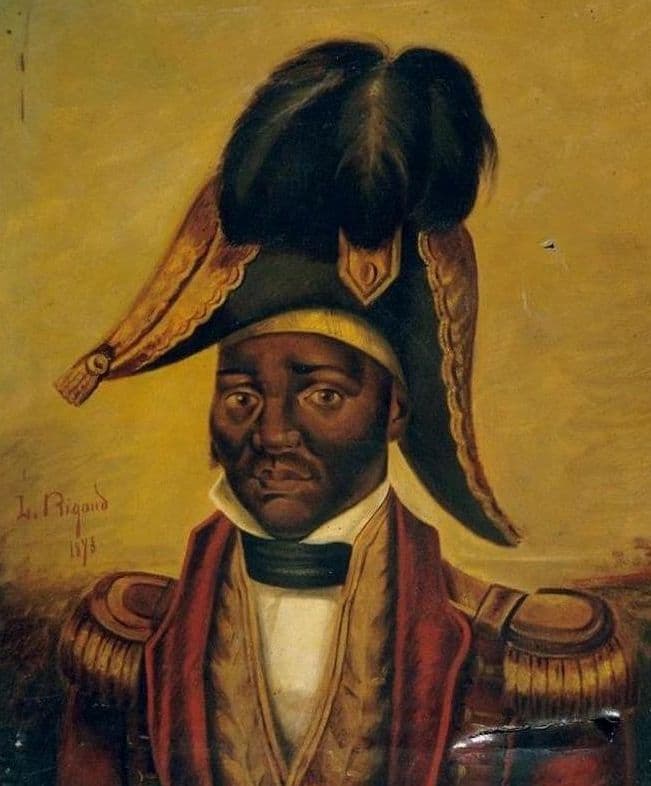
To abolish slavery permanently in the Americas, Jean-Jacques Dessalines first had to defeat three European empires.
To understand the birth of Haiti, one must look not to the polished drawing rooms of Paris or the nuanced political treatises of the early Enlightenment, but to a small, heavily fortified earthwork in the Cahos Mountains known as Crête-à-Pierrot. There, on March 11, 1802, a former sugarcane laborer named Jean-Jacques Dessalines stood before thirteen hundred rebel soldiers. Surrounding them were eighteen thousand seasoned French troops dispatched by Napoleon Bonaparte to reclaim the colony of Saint-Domingue and drag its population back into chattel slavery. Facing almost certain annihilation, Dessalines did not offer a speech of strategic retreat. Instead, he brandished a lit torch, held it inches from an open keg of gunpowder, and made his terms clear: if the French breached the walls, he would blow the fort, and everyone within it, to kingdom come.
They held the fort for twenty days. When food and ammunition finally vanished, Dessalines did not surrender; he led a bayonet charge straight through the French siege lines, escaping into the mountains with his army largely intact. It was the defining gesture of a man who understood that against an adversary committed to total subjugation, the only viable currency was absolute defiance. Dessalines was not a philosopher of liberty like his predecessor, Toussaint Louverture, nor was he a polished diplomat. He was the sword of the Haitian Revolution—a man whose back was patterned with the scars of the whip, and who resolved that the soil of his homeland would be salted with the blood of its colonizers before it ever hosted another slave market.
Born into slavery around 1758 on the Cormier plantation near Grande-Riviere-du-Nord, he was initially known as Jean-Jacques Duclos, taking the surname of his white owner. For some thirty years, he labored in the grueling sugarcane fields of the Plaine-du-Nord, eventually rising to the rank of commandeur, or foreman, a position that taught him both the brutal mechanics of plantation labor and the psychology of discipline. He was later purchased by a free man of color named Dessalines, from whom he acquired the name he would carry into history. When the great northern slave uprising of 1791 erupted, turning the sky orange with the smoke of burning sugar mills, Dessalines threw himself into the rebellion. He received early military instruction from a formidable woman known as Victoria Montou or Akbaraya Tòya, and quickly distinguished himself under the rebel leaders Jean François Papillon and Georges Biassou.
When the French Republic temporarily abolished slavery in 1794 to secure the loyalty of the black population against British and Spanish invaders, Dessalines followed Toussaint Louverture into the French service. He rose with terrifying speed. As Louverture’s principal lieutenant, Dessalines became famous for his merciless tactical efficiency. He suppressed internal rebellions with a "take no prisoners" policy, burning entire villages to the ground to enforce Louverture’s central authority. Yet this alliance was transactional, forged on the singular goal of preserving black freedom. When Napoleon Bonaparte’s brother-in-law, General Charles Leclerc, arrived in 1802 with a massive expeditionary force to disarm the population and restore the highly profitable plantation regime, the fragile peace shattered.
9 links to entries not yet ingested in the Library.
The war that followed was one of the most savage conflicts of the nineteenth century. For a brief, confusing window after the siege of Crête-à-Pierrot, Dessalines played a duplicitous game. He defected to the French side, cooperating with Leclerc and the mulatto generals Alexandre Pétion and André Rigaud. This maneuver remains one of the most controversial chapters of his life; Louverture’s family and several historians directly implicate Dessalines in the betrayal and arrest of Louverture, who was shipped to France to die in a freezing mountain cell. But if Dessalines sought to save himself, he soon realized that the French intended to re-enslave the entire population, just as they had recently done in Guadeloupe. In October 1802, Dessalines switched allegiances once more, uniting with Pétion’s free-colored forces to form a revolutionary alliance.
As yellow fever decimated the French ranks and the ruthless General Donatien de Rochambeau assumed command of the colonial forces, the conflict escalated into a war of extermination. Rochambeau’s sheer brutality served to weld the black and mulatto populations together under Dessalines’s supreme command. On November 18, 1803, at the Battle of Vertières, the indigenous army delivered a decisive defeat to Rochambeau’s forces. By December, the remnants of Napoleon’s grand expedition surrendered. On January 1, 1804, from the city of Gonaïves, Dessalines officially declared the island's independence. He discarded the colonial name of Saint-Domingue and rechristened the land "Ayiti," reclaiming the indigenous Taíno name for the mountainous island. Under his leadership, Haiti became the first country in the Americas to permanently abolish slavery, completing the only successful slave rebellion in human history.
Yet the birth of this new nation was baptized in blood. Driven by the lingering threat of a French reinvasion and the prospective reinstatement of slavery, Dessalines orchestrated the 1804 massacre of the remaining white French population. Between three and five thousand people were systematically killed, while thousands of others fled. Notably, Dessalines spared those he deemed non-threatening to the state’s survival: Polish Legionnaires who had defected from the French army, and German settlers who had played no part in the transatlantic slave trade. He granted them full citizenship and, in a radical legal subversion of colonial racial hierarchy, classified them as black.
By late 1804, Dessalines was crowned Emperor Jacques I under a new constitution that codified the permanent ban on slavery. But the challenges of governing a ruined country were as formidable as the French army. To revive a devastated economy, Dessalines enforced a system of compulsory plantation labor, maintaining an autocratic grip that alienated both the elite free-colored population—who had retained significant property and education during the colonial era—and the newly freed populace who resisted returning to the fields. Tension flared into conspiracy. On October 17, 1806, just two years into his reign, Dessalines was assassinated by members of his own administration and dismembered by a violent mob.
For decades, the memory of the first emperor was suppressed by the rulers who succeeded him. Yet the specter of Dessalines could not be easily erased from the soil he had freed. His wife, Marie-Claire Heureuse Félicité Bonheur—who had famously fed the hungry and is credited with inventing the pumpkin independence soup that remains a symbol of Haitian sovereignty—lived to be a centenarian, a quiet link to a heroic, terrifying past. By the turn of the twentieth century, as Haiti faced new imperial pressures, the memory of the Emperor underwent a dramatic rehabilitation. He was resurrected not as a tyrant, but as the uncompromising architect of black sovereignty. In 1903, on the centennial of the revolution, the nation adopted its national anthem, "La Dessalinienne." It stands as a tribute to a man who, when given the choice between the chains of the old world and the destructive fire of the new, chose to light the torch.