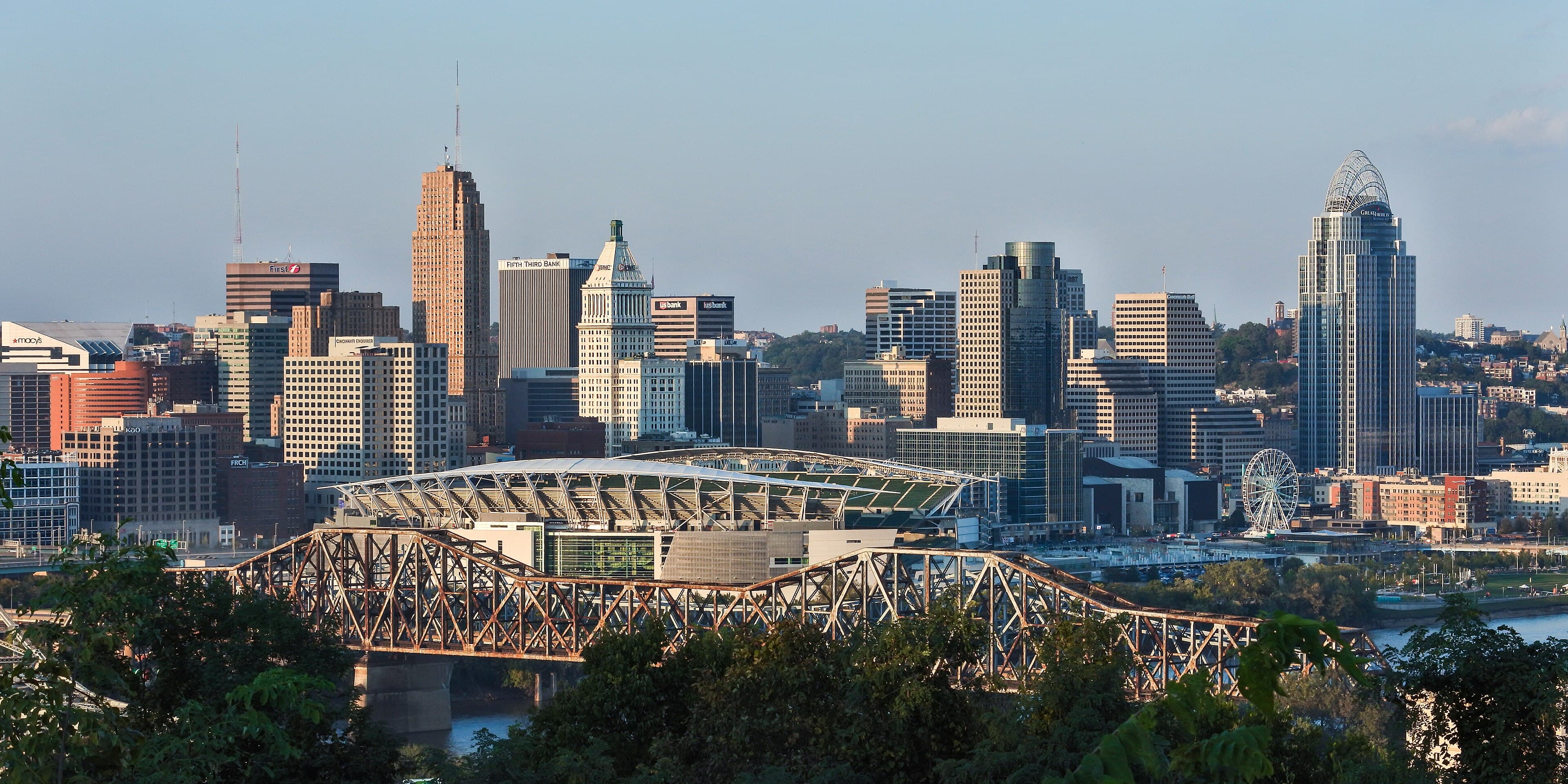
In the winter of 1788, Mathias Denman, Colonel Robert Patterson, and Israel Ludlow landed on the northern bank of the Ohio River, directly opposite the mouth of the Licking River.
On a chill December day in 1788, a small party of surveyors, land speculators, and frontiersmen guided their flatboats onto the northern bank of the Ohio River, just opposite the mouth of the Licking. The site was a dramatic double terrace of glacial gravel, cradled by a steep amphitheater of wooded hills that rose four hundred feet above the water. John Filson, the original surveyor of the tract, had christened the prospective settlement "Losantiville"—a hybrid construction of Latin and French designed to mean "the town opposite the mouth of the Licking." But Filson disappeared into the Ohio wilderness before the cabins were built, and when Arthur St. Clair, the governor of the Northwest Territory, arrived two years later, he found the name provincial. As president of the Society of the Cincinnati, an elite organization of Revolutionary War officers, St. Clair renamed the outpost after the Roman general Lucius Quinctius Cincinnatus, who had saved his republic and quietly returned to his plow. It was an ambitious title for a cluster of log cabins clustered around the wooden stockade of Fort Washington, yet the classical moniker carried an unintended prophecy: a city built on civic discipline, rapid labor, and an unyielding connection to the soil.
The transformation of this wilderness outpost into a metropolis was driven by the silty, muscular currents of the Ohio River. In 1811, the arrival of the first steamboats shattered the isolation of the western frontier, linking Cincinnati to downriver markets in St. Louis and New Orleans. The city became an inland empire of processing and shipping. By the 1830s, the surrounding hillsides were stripped of timber to feed the boilers of steamboats and the furnaces of iron foundries, while the valleys echoed with the squeal of the city’s primary industry. Capitalizing on the agricultural bounty of the Miami Valley, Cincinnati pioneered mechanized meatpacking, earning the international sobriquet "Porkopolis." From 1810 to 1830, the population tripled, and by the 1840s, the completion of the Miami and Erie Canal linked the Ohio River directly to Lake Erie, turning the city into the undisputed gateway of the American interior. This rapid rise to prominence prompted its citizens to proudly call their home the "Queen City."
Yet this prosperity was built along a precarious geopolitical fault line. Separated from the slave-holding state of Kentucky only by the width of the Ohio River, Cincinnati became a theater of intense racial and ideological conflict. To thousands of enslaved people fleeing the South, the city’s northern riverbank represented the first threshold of freedom. Abolitionists like Levi Coffin made the city the central terminal of the Underground Railroad, while Harriet Beecher Stowe drew upon the accounts of escaped slaves she met during her residence there to write . However, the city was also home to many settlers from the Upper South who brought their sympathies with them, and local merchants feared that anti-slavery agitation would sever their lucrative trade ties with Southern states. This volatility repeatedly erupted into violence. White mobs targeted Black neighborhoods and abolitionist printing presses in devastating riots in 1829, 1836, and 1842. During the 1829 riots, more than a thousand Black residents were forced to flee the city entirely, resettling in Canada—an exodus that catalyzed the first Negro Convention in Philadelphia.
+ 5 further connections to entries not yet ingested
As the mid-nineteenth century approached, the city’s social fabric was fundamentally reshaped by a massive wave of European immigration, dominated by German-speakers fleeing the European revolutions of 1848. These newcomers did not merely integrate into the city; they built a parallel society. Settling in the dense enclave north of the Miami Canal, a district they affectionately named "Over-the-Rhine," the Germans established their own breweries, schools, turnvereins, and cultural institutions. They brought with them a passion for classical music and monumental architecture, establishing the world-famous May Festivals and funding grand projects. By the late nineteenth century, this cultural flowering, alongside striking civic landmarks, earned Cincinnati the title "Paris of America." Chief among these monuments was the Tyler Davidson Fountain, cast in Munich and unveiled in 1871 in Fountain Square, and John A. Roebling’s soaring wire suspension bridge, which spanned the Ohio to Covington, Kentucky, serving as the immediate engineering precursor to his masterpiece in Brooklyn.
To accommodate its booming population, which passed 300,000 by the turn of the twentieth century, the city literally scaled its surrounding walls. Engineers constructed a network of inclined-plane railways to carry passengers up the steep hillsides of Mount Adams, Mount Auburn, and Price Hill. Atop these bluffs, wealthy citizens built elegant suburbs, leaving the smoky, flood-prone "bottoms" to factories, packinghouses, and tenements. To connect these new hilltop communities, the city government embarked on the extraordinary project of building its own interstate railway, the Cincinnati Southern, stretching all the way to Chattanooga, Tennessee. This municipally owned line remained a unique public asset for nearly a century and a half.
As the twentieth century progressed, Cincinnati navigated the challenges of industrial maturity and urban decline with a distinct conservative resilience. The city weathered the Great Depression better than most industrial hubs, shielded by a resurgence in low-cost river trade, though it was severely tested by the devastating Ohio River flood of 1937, which forced the construction of massive protective flood walls. Following World War II, a master plan for urban renewal modernized the downtown core, but it also accelerated a classic postwar demographic shift. White working-class families migrated to the sprawling suburbs, while Black families, arriving from the Jim Crow South in the Great Migration, moved into the older, increasingly neglected inner-city neighborhoods.
The decline of manufacturing in the late twentieth century left a trail of poverty, housing discrimination, and racial tension in its wake. This friction repeatedly ignited into civil unrest. In 1967 and 1968, the neighborhood of Avondale erupted in riots fueled by poor living conditions and police misconduct, prompting a federal investigation that pointed directly to systemic segregation and discriminatory policing. Decades later, in April 2001, the fatal shooting of Timothy Thomas, an unarmed Black teenager fleeing arrest for traffic warrants, sparked the first major American urban riot of the twenty-first century. The crisis forced a historic intervention: the city, its police union, and civil rights organizations signed a landmark collaborative agreement on community-oriented policing that became a national model for reform.
Today, Cincinnati exists as a complex tapestry of its historical eras. In the historic core of Over-the-Rhine, one of the largest preserved historic districts in the United States, decades of disinvestment have given way to rapid gentrification, bringing trendy restaurants and high-end apartments to the very streets where German immigrants once brewed lager and sought political refuge. On the riverfront, where flatboats and coal barges once jostled for space, modern sports stadiums stand alongside the National Underground Railroad Freedom Center. The city remains an economic powerhouse, home to global conglomerates like Procter & Gamble and Kroger, yet its deepest identity lies in its preservation of the past. Walking past the Romanesque stone arches of the monumental Music Hall or looking out over the Ohio River from the heights of Eden Park, one sees a landscape shaped by those who looked at a rugged river bend and envisioned a monument to civic virtue and industry.