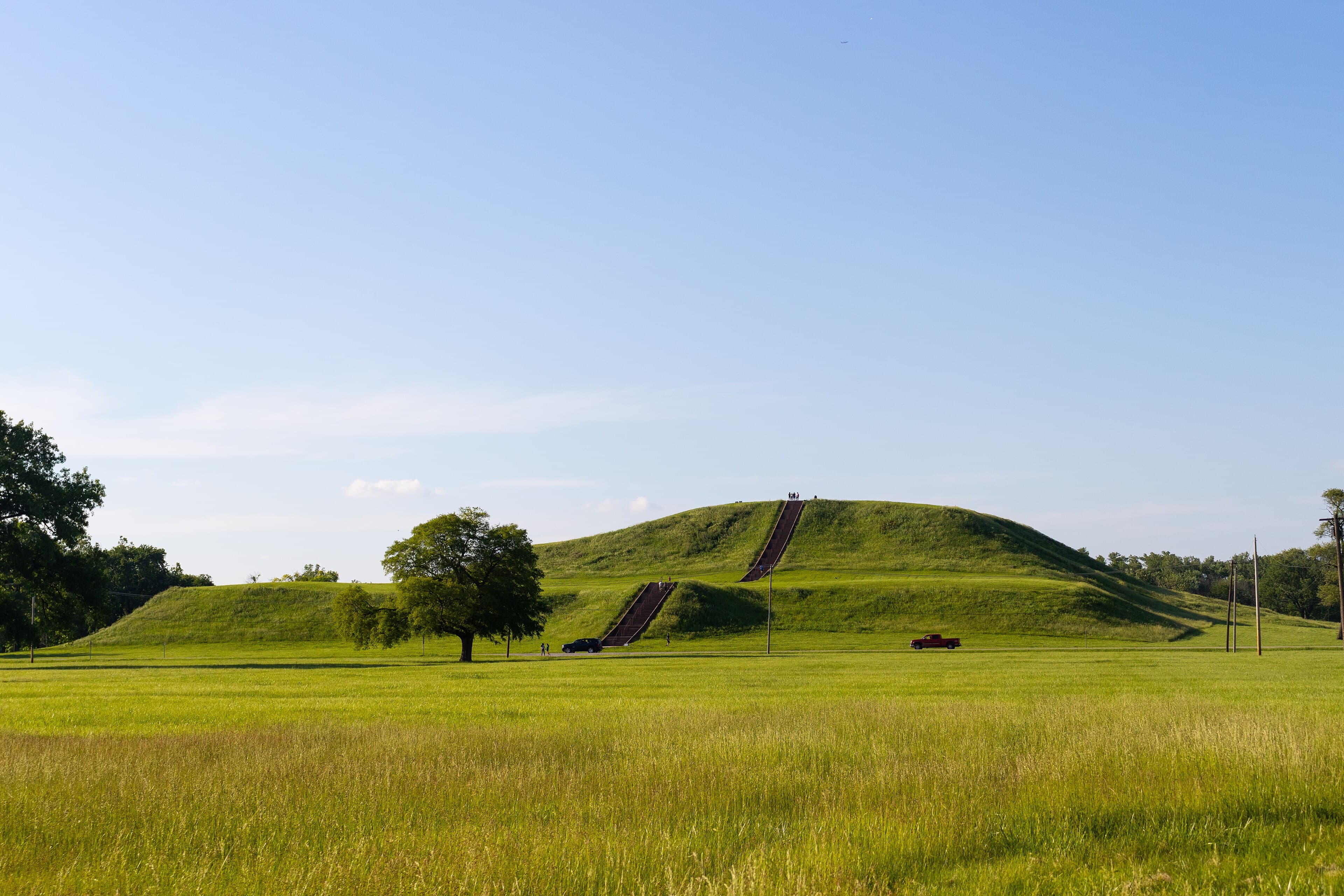
Long before European sails appeared on the Atlantic, a sprawling metropolis grew along the fertile banks of the Mississippi River, directly across from where St.
In the middle of the eleventh century, the broad floodplain of the Mississippi River, just south of its confluence with the Missouri and Illinois rivers, underwent a transformation so sudden and vast that archaeologists refer to it as a "Big Bang." For centuries, the region known as the American Bottom had been a quiet, shifting patchwork of small Late Woodland villages. Its inhabitants lived in clusters of perhaps fifty to one hundred people, farming native grasses and weeds, and moving their settlements every decade or so as the immediate soil and timber were exhausted. But around 1050 CE, this modest, dispersed world was abruptly swept away. In its place rose a sprawling, highly planned metropolis, an engineered landscape of colossal earthen monuments, gridded neighborhoods, and grand ceremonial plazas. It was a city of such scale that it would not be surpassed in population by any urban center in North America until the growth of Philadelphia in the late eighteenth century.
This city, whose original name is lost to time, is known today as Cahokia—a name bestowed centuries later by French explorers who encountered the historic Cahokia tribe of the Illiniwek people living nearby. The ancient city’s sudden birth was not a slow, organic accumulation of people, but a deliberate, monumental acts of creation. Over a remarkably short period, three distinct urban precincts—St. Louis, East St. Louis, and Cahokia proper—were laid out and constructed. Woodland-era settlements were leveled, and a rigid, cosmologically aligned grid was imposed upon the earth. The entire city was oriented to the north along a grand axis defined by the Grand Plaza, the Rattlesnake Causeway, and dozens of precisely placed, flat-topped earthen mounds. To construct this landscape, the city’s inhabitants excavated, carried, and deposited some 55 million cubic feet of earth using nothing but woven baskets and human muscle. This massive undertaking yielded more than one hundred and twenty mounds across six square miles, including the colossal central earthwork that dominated the skyline, a platform that served as the sacred and political anchor of the Mississippian world.
The catalyst for this sudden urban explosion was a massive influx of people. Between 1050 and 1100 CE, the population of Cahokia’s central core skyrocketed from a few thousand to at least ten to fifteen thousand residents, with wider regional estimates reaching as high as forty thousand. This growth was fueled by large-scale immigration. Families and clans traveled from across the mid-continent, bringing with them distinct traditions, technologies, and styles. Archaeologists trace their arrivals through the sudden appearance of non-local ceramics from the lower Ohio Drainage, the Lower Mississippi Valley, the south-central plains, and the Upper Midwest. This diverse population was bound together by a shared, newly minted Mississippian culture. Local pottery and architectural styles were rapidly homogenized, and a new agricultural regime took hold. Though maize had been present in the region for generations, its cultivation had been marginal; around 1050 CE, it became the undisputed engine of the Cahokian economy. Millions of bushels of corn were harvested in the surrounding uplands, such as the Richland Complex villages, where immigrant communities engaged in intensive farming and textile production to feed and clothe the urban core. To sustain this agricultural engine, Cahokia controlled the distribution of highly prized hoes made from Mill Creek chert, a specialized stone quarried in southwestern Illinois.
+ 9 further connections to entries not yet ingested
Cahokia’s reach was continental. At its peak, between 1050 and 1150 CE, the city sat at the center of a vast trade and tributary network that stretched from the Great Lakes to the Gulf of Mexico. Its artisans worked copper from the north and fashioned ornaments from lightning whelk shells and shark teeth brought from the southern seas. The city’s cultural and religious influence flowed outward along the river highways. Cahokian travelers paddled down to the Carson site in Mississippi to establish a permanent settlement, while others journeyed north to Trempealeau Bluffs in southern Wisconsin to construct a mounded religious outpost. At home, the city consolidated its political and spiritual power through spectacular, highly choreographed public rituals. In the outlying uplands, distinctive temple complexes featuring T- and L-shaped structures and ceremonial sweatlodges became centers of regional administration. Here, priests and leaders conducted rituals using tobacco, red cedar, agricultural offerings, and beautifully carved flint clay figurines depicting female deities. At the Emerald Acropolis, a massive upland mound site aligned to the 18.6-year lunar cycle, pilgrims gathered to venerate the moon, water, and fertility.
Yet, this grand experiment in ancient urbanism carried the seeds of its own fragility. To live in Cahokia was to participate in a grand, awe-inspiring, but deeply precarious social order. The cohesion of this multi-ethnic city was maintained not just through trade and shared belief, but through dramatic and violent displays of sovereign power. Excavations have revealed ridge-top mortuary mounds containing the burials of elite leaders alongside the remains of dozens of sacrificed young women, dramatic spectacles designed to integrate the population through shared, terrifying narratives of life, death, and cosmic order. Beneath the grandeur of the plazas, however, lay the grimmer realities of early dense urban life. With tens of thousands of people packed into a tight riverine environment, waste disposal became an existential problem. The city’s waterways, crucial for transport and drinking, grew increasingly polluted and unhealthy. The high mortality rates resulting from disease and poor sanitation meant that Cahokia could not sustain its population through birth rates alone; it was entirely dependent on its political, economic, and religious gravity to draw in a continuous stream of new immigrants.
By the late twelfth century, the delicate balance that sustained Cahokia began to fracture. The region was beset by severe droughts between 1100 and 1250 CE, which strained the agricultural systems that fed the city. Internal tensions, perhaps exacerbated by growing social inequalities and resource scarcity, began to manifest in physical violence and fear. Around 1160 to 1170 CE, a large, walled residential compound in the East St. Louis precinct was deliberately burned to the ground. This was no ordinary fire; multiple ritual structures filled with vast quantities of stone tools, exotic materials, and pots overflowing with shelled maize were consumed by the flames, an event suggesting deep civil unrest or ritualized destruction. Shortly thereafter, around 1175 CE, the residents of Cahokia constructed a massive defensive palisade around the city’s central core—a monumental wall that spoke of a new, defensive posture and a fear of external threat or internal revolt.
The decline, once it began, was irreversible. Throughout the late twelfth and thirteenth centuries, the great migration reversed its flow. People began leaving the city in waves, abandoning the plazas and mounds that their ancestors had built with such immense effort. By the mid-thirteenth century, the population had plummeted by half or more. The grand ceremonies grew infrequent, the trade networks contracted, and the fields of maize slowly reverted to wild grasses and forest. By 1350 CE, the great metropolis of the American Bottom was completely abandoned, its plazas silent, its wooden temples decaying into the earth. When European explorers finally arrived in the seventeenth century, they found only the silent, grass-covered earthen giants, the enigmatic footprints of a civilization that had gathered, flourished, and vanished long before the first foreign ships sighted the shores of the continent.