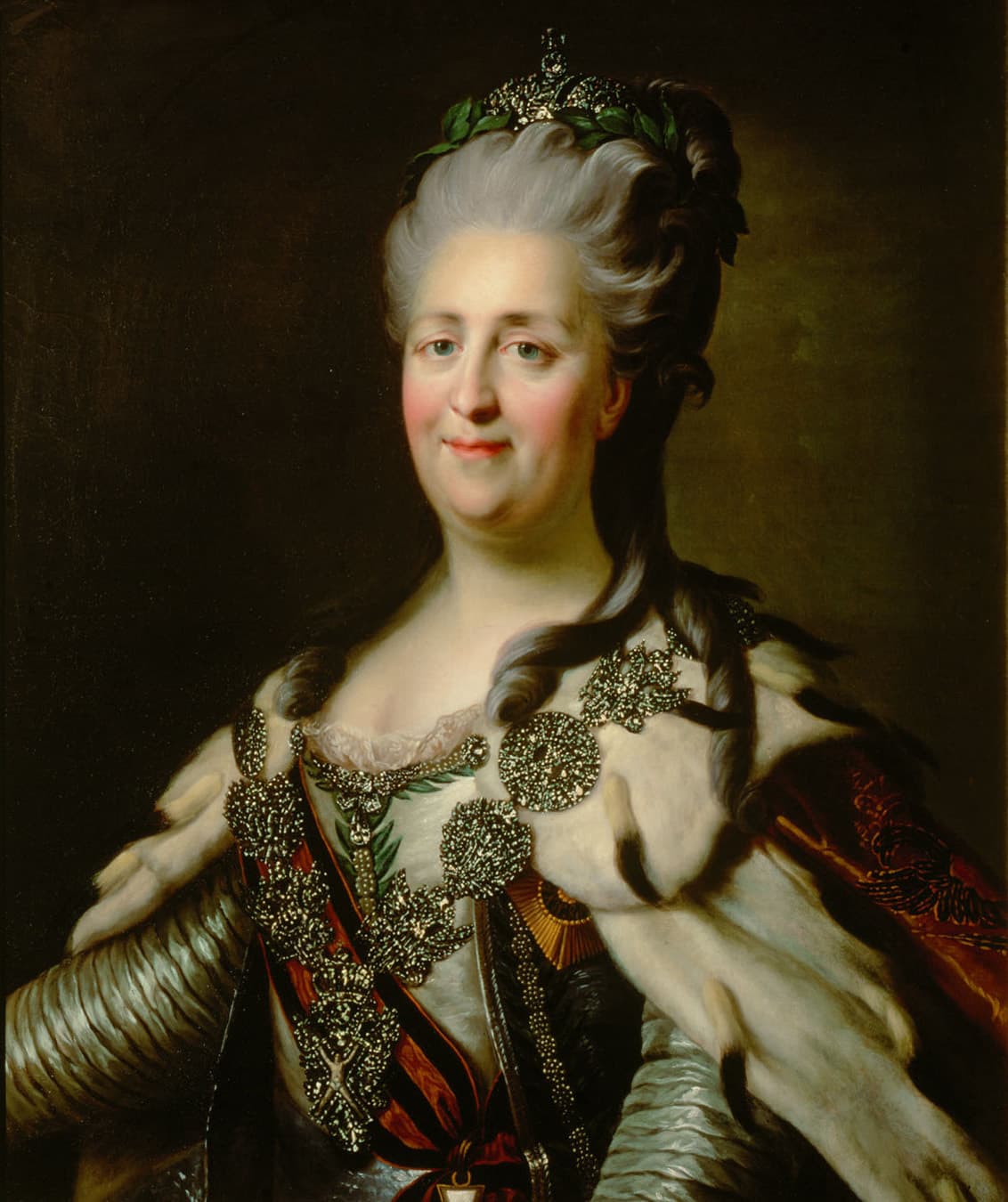
The German princess who would reshape the Eurasian landmass arrived in Russia as Sophia Augusta Frederica of Anhalt-Zerbst, but she secured her place in history as Empress Catherine II.
In 1744, a fifteen-year-old German princess named Sophia Augusta Frederica of Anhalt-Zerbst arrived in the frozen landscape of Russia, possessing little more than a pedigree from a minor, cash-strapped German house and a sharp, calculating mind. To survive the lethal waters of the imperial court in St. Petersburg, she understood early that she would have to shed her past entirely. When a sudden, violent case of pleuritis left her hovering near death, her mother, a woman whose abrasive nature and clumsy espionage on behalf of Prussia would eventually get her expelled from the country, franticly demanded a Lutheran pastor. Sophia, catching her breath between bloodlettings, refused. "I don't want any Lutheran," she declared to the court gathered around her bed. "I want my Orthodox father." It was a masterstroke of political theater performed by a teenager. Having survived both the illness and four phlebotomies in a single day, she was received into the Russian Orthodox Church, took the name Catherine, and married the heir to the throne, Peter of Holstein-Gottorp. Her father, a devout Lutheran prince who had stayed behind in Germany, watched from afar as his daughter systematically dismantled every tie to her homeland to position herself for a crown.
The marriage was a disaster of temperamental and intellectual incompatibility. Settled in the palace of Oranienbaum to govern Peter’s small German duchy of Holstein-Gottorp for administrative experience, the young couple retreated to opposite ends of the estate. While Peter, whom Catherine had found detestable and alcohol-dependent since their first meeting at age ten, obsessed over military drills and read Lutheran prayer books alongside sensationalist accounts of highwaymen broken on the wheel, Catherine turned to books of a different caliber. She devoured the French philosophes, beginning a lifelong intellectual romance with Voltaire, but it was the dark, unvarnished realism of Tacitus’s Annals that sparked what she described as a "revolution" in her teenage mind. From the Roman historian, she learned to look past the professed, high-minded ideals of rulers to find their hidden, self-serving motives. Armed with this realism, she navigated a court where her husband’s mental immaturity left their marriage unconsummated for years. Recognizing her precarious position, Catherine aligned herself with powerful political factions and engaged in a series of strategic love affairs, first with Sergei Saltykov—under pressure from the reigning Empress Elizabeth to produce an heir, which eventually resulted in the birth of the future Paul I in 1754—and later with the Polish nobleman Stanislaus Augustus Poniatowski and the dashing guard officer Grigory Orlov.
12 links to entries not yet ingested in the Library.
The death of Empress Elizabeth in early 1762 brought Catherine’s erratic, unpopular husband to the throne as Peter III, but his reign would last a mere six months. Unpopular with the military and the nobility alike, Peter was swiftly deposed in a coup d'état engineered by Catherine, her lover Grigory Orlov, and a faction of guardsmen. Having overthrown and likely assassinated her husband, Catherine ascended the throne as Empress of Russia, embarking on a thirty-four-year reign that would dramatically reshape the geopolitical map of Europe and the culture of her adopted empire. Under her rule, Russia entered a golden age of intellectual and physical expansion. Guided by the principles of the Enlightenment, she established the Smolny Institute of Noble Maidens, marking the first state-financed higher education institution for women in Europe, and fostered an environment where universities, theaters, and new cities flourished. Yet, Catherine was an "enlightened despot" who understood the pragmatism of power; she confirmed the Manifesto on Freedom of the Nobility, originally issued during her husband’s brief reign, which permanently freed Russian nobles from compulsory state or military service. This concession secured the loyalty of the aristocracy, who expressed their newfound wealth and freedom by erecting sprawling classical mansions that permanently transformed the Russian countryside.
This elegant, classical veneer, however, rested upon a brutal and deepening foundation of human bondage. While Catherine corresponded with the great minds of Europe, the Russian economy and military remained utterly dependent on the labor of millions of serfs. As the demands of both the state and private landowners intensified, the exploitation of serf labor reached unprecedented levels of cruelty, sparking violent domestic resistance. The most dangerous of these upheavals was Pugachev’s Rebellion, a massive uprising of Cossacks, nomadic peoples of the Volga, and desperate peasants that swept across the eastern frontiers, threatening the very stability of her reign. Though the rebellion was eventually crushed, it underscored the central paradox of Catherine’s rule: the modernization of Russia was funded by the systemic subjugation of its own people.
Beyond her borders, Catherine operated with a cold, expansionist ambition that would have made Tacitus proud. She was a master of leveraging personal relationships for imperial gain. In the west, she placed her former lover, Stanislaus Augustus Poniatowski, on the throne of Poland, only to systematically dismantle and partition the Polish-Lithuanian state alongside Prussia and Austria until Poland ceased to exist as an independent entity. To the south, her armies and fleets—led by brilliant commanders like Alexander Suvorov and Pyotr Rumyantsev, and admirals such as Samuel Greig and Fyodor Ushakov—secured devastating victories over the Ottoman Empire and the Bar Confederation. Through these conquests, she annexed the Crimean Khanate and, with the diplomatic support of Great Britain, aggressively colonized the fertile lands along the Black and Azov seas. This newly acquired territory, dubbed "New Russia," became the site of rapid urban development; on Catherine’s direct orders, entirely new cities were carved out of the southern steppe, including Yekaterinoslav, Kherson, Nikolayev, and the strategic naval base of Sevastopol. In her foreign policy, she relied heavily on her close ally and former lover Grigory Potemkin, whose administrative genius guided the integration of these southern conquests. Simultaneously, the empire’s gaze stretched across the Pacific, as Russian fur traders and explorers became the first Europeans to colonize Alaska, establishing the far-flung territory of Russian America.
By the time of her death in 1796, Catherine had transformed the Russian Empire from a peripheral, half-understood northern power into an indispensable titan of European affairs. She had successfully synthesized Western European culture with Russian imperial ambition, building a legacy that mirrored her own complex personality: intellectually brilliant, politically ruthless, and fundamentally contradictory. The German princess who had arrived in St. Petersburg with nothing but her wits had rewritten the borders of Europe, fostered a cultural renaissance, and bound the destiny of her empire to the Black Sea and the vast expanses of the American West, leaving behind an autocratic state that was as magnificent in its cultural achievements as it was severe in its internal inequality.