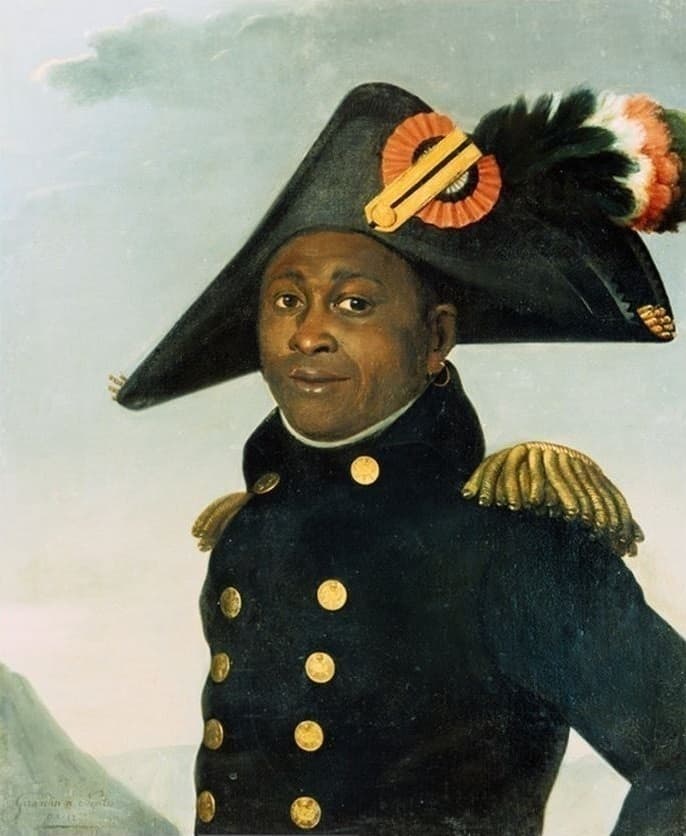
The man who would dismantle the wealthiest slave colony in the Americas began his military career at nearly fifty years old, carrying the contradictions of a world he was destined to rupture.
He was known in his youth as Fatras-Bâton—"sickly stick"—a thin, small boy born into the humid, sugar-choked air of the Bréda plantation on the northern coast of Saint-Domingue. He was the eldest son of Hyppolite, an Allada captive from West Africa, and Pauline, an Aja woman, both stripped of their original names by the French Code Noir and branded as property. Yet the boy possessed a quiet, steely pride and an extraordinary affinity for horses. This talent spared him the grueling, lethal labor of the cane fields, elevating him to the position of coachman and equestrian under the patronage of a sympathetic plantation overseer, François Antoine Bayon de Libertat. Behind the reins of his master’s carriage, Toussaint observed the world of the grands blancs—the wealthy white planters—and the complex, volatile hierarchy of the richest colony on earth.
By the time the tremors of the French Revolution began to reverberate across the Atlantic in 1789, Toussaint was no longer a slave, though history would long struggle to reconcile this fact. Sometime between 1772 and 1776, he had been manumitted, quietly transitioning into the ranks of the affranchis, the free people of color. He took the name Toussaint Bréda and set about building a life that mirrored the very system that had bound him. He rented a modest coffee plantation, worked by thirteen enslaved laborers—among whom, evidence suggests, was a fierce young man named Jean-Jacques Dessalines. Toussaint purchased the freedom of his second wife, Suzanne, his children, and various family members, navigating the narrow ledger of colonial survival. He was a devout Catholic, a bilingual speaker of Fon and Creole who had eventually mastered the standard French of the elite, and a man approaching fifty—an elder in a colony where the life expectancy of a field hand was brutally short. When the island’s enslaved majority finally rose in August 1791, lighting the night sky with the burning cane fields of the northern plain, Toussaint did not immediately rush to the barricades. He first secured the safety of his family and even escorted his former overseer, de Libertat, to safety. Only then did he ride into the fire.
He entered the rebellion not as a wild insurgent, but as a disciplined tactician, quickly rising to become a lieutenant to Georges Biassou, one of the early leaders of the revolt. It was during these chaotic early campaigns that he began to be called Louverture—"the opening"—perhaps in tribute to his uncanny ability to find gaps in enemy lines, or his talent for creating political opportunities where none seemed to exist. As Spain and Great Britain seized upon the French colonial chaos to launch invasions of Saint-Domingue, Louverture played a sophisticated geopolitical hand. He initially allied his highly disciplined black militia with the Spanish forces in neighboring Santo Domingo, fighting against French royalists. But when the radical Republican government in Paris, desperate to retain its prized colony and desperate for allies, formally abolished slavery across all French territories in 1794, Louverture executed a swift, stunning pivot. He abandoned the Spanish, pledged his allegiance to the French Republic, and turned his seasoned army against the British invaders and his former Spanish allies, driving them from the island.
12 links to entries not yet ingested in the Library.
With every victory, Louverture’s authority swelled, and the French commissioners sent to govern Saint-Domingue found themselves increasingly powerless against his quiet, imposing will. He systematically outmaneuvered his domestic rivals, both white and mulatto, consolidating control over the entire island. Yet, as governor-general, Louverture faced a devastating paradox: to protect the freedom of his people, he had to rebuild the colony’s shattered economy, which was entirely dependent on agriculture. His solution was as pragmatic as it was severe. He restored the plantation system, replacing chattel slavery with a system of paid, compulsory labor. Under his decrees, the newly freed citizens were legally bound to their plantations; they were paid a portion of the crops, but they were forbidden to leave without permission. To police this delicate, tense social order, Louverture maintained a large, meticulously trained standing army. He bypassed French trade monopolies by negotiating independent commercial agreements with Great Britain and the United States, securing vital goods and arms for his emerging state.
By 1801, Louverture’s ambition had outgrown the boundaries of colonial governance. Without consulting Paris, he drafted and promulgated a new constitution for Saint-Domingue. It was a remarkable document that abolished slavery forever, declared all men equal regardless of race, and named Toussaint Louverture Governor-General for Life, with the power to choose his successor. It was a de facto declaration of independence wrapped in the polite vocabulary of French colonial loyalty. Across the Atlantic, Napoleon Bonaparte, now First Consul of France, watched Louverture’s rise with growing fury. Bonaparte saw the "First of the Blacks" as an intolerable challenge to his vision of a restored French imperial empire in the Caribbean. In early 1802, Bonaparte dispatched a massive expeditionary force of tens of thousands of veteran European troops, commanded by his brother-in-law, General Charles Leclerc, with secret instructions to disarm the black population and restore slavery.
The war that followed was one of unmatched savagery. Louverture’s generals, including the relentless Dessalines, waged a scorched-earth campaign, burning coastal cities to the ground before retreating into the mountainous interior. Though the French troops won early victories, they quickly found themselves starved, harassed by guerrilla tactics, and decimated by yellow fever. Realizing the immense cost of the conflict, Louverture entered into negotiations with the French, agreeing to a ceasefire and a retirement to his private estates in May 1802. It was a temporary peace built on deception. In June, French Divisional General Jean-Baptiste Brunet invited Louverture to a parley to discuss colonial affairs. Suspecting nothing, or perhaps miscalculating his opponent's willingness to violate military honor, Louverture arrived with only a small escort. He was promptly surrounded, disarmed, and arrested.
"In overthrowing me, you have cut down in Saint-Domingue only the trunk of the tree of liberty," Louverture warned his captors as he was led onto a French warship. "It will spring up again from the roots, for they are many and they are deep." He was deported to France and hurried across the country under heavy guard to the Fort de Joux, a grim, freezing stone fortress high in the Jura Mountains near the Swiss border. Isolated from his family, deprived of his uniform, and locked in a cold, damp stone cell, his health rapidly declined. The man who had survived decades of tropical warfare and the brutal sun of the Caribbean could not withstand the alpine winter. He died of pneumonia and neglect on April 7, 1803, alone in the dark.
But Louverture's prophecy proved swift and absolute. When word reached Saint-Domingue that Bonaparte had indeed restored slavery in nearby Guadeloupe, the island erupted once more. Under the fierce command of Jean-Jacques Dessalines, the black army abandoned any remaining pretense of loyalty to France. They waged a war of total extermination against Leclerc’s dwindling, fever-ridden forces, culminating in the decisive Battle of Vertières on November 18, 1803. On January 1, 1804, Dessalines formally declared the independence of the nation, reclaiming its indigenous Taíno name: Haiti. It was the first independent black republic in the world, and the second independent nation in the Western Hemisphere. France would not recognize its lost gem until 1825, and then only by forcing the young nation to pay a crippling indemnity of 150 million gold francs. For decades, the United States, terrified of the example of a successful slave revolt, refused to recognize Haitian sovereignty. It was only in 1862, in the crucible of its own Civil War over the institution of slavery, that the United States under Abraham Lincoln finally officially recognized the nation Louverture had died to build—a belated nod to the legacy of the sickly stick who had broken an empire.