To understand the ancient Mediterranean is to understand the city that rose from the western edge of the Nile River Delta, near an Egyptian settlement named Rhacotis.
In April of 331 BCE, a young Macedonian king stood on a narrow strip of sand between the Mediterranean Sea and the vast, brackish expanse of Lake Mareotis. Behind him lay Egypt, a land of deep, inward-looking antiquity whose temples had stood for millennia; before him lay the open water, pointing toward Greece, Macedonia, and the unfinished business of his empire. Alexander the Great did not build his cities in the interior. He sought a gateway, a point of contact where the wealth of the Nile valley could be funneled directly into the wider Mediterranean. On this barren spit, near a small, ancient Egyptian fishing village called Rhacotis, he envisioned a massive causeway reaching out to the nearby limestone island of Pharos. The barrier would split the sea, creating two deep, sheltered natural harbors out of the shifting winds. Having drawn the rough boundaries of his namesake city, Alexander turned his back on the coast and marched inland to consult an oracle in the desert. He would never see the city built, nor would he ever return to it alive.
The task of transforming this windswept coast into a metropolis fell first to his viceroy, Cleomenes, and the architect Dinocrates of Rhodes. Dinocrates laid out the city on a rigorous, rational Hippodamian grid, a network of broad avenues designed to catch the sea breezes and divide the urban landscape into neat, functional blocks. When Alexander died in 323 BCE, his general Ptolemy Lagides seized control of Egypt. Recognizing the strategic and symbolic value of the new settlement, Ptolemy hijacked the founder’s embalmed corpse, brought it to Egypt, and eventually established his court at Alexandria, declaring himself Pharaoh as Ptolemy I Soter. In doing so, he abandoned the ancient, inland capital of Memphis. Within a generation, Alexandria inherited the trade of a ruined Tyre and grew with a speed that startled the ancient world, quickly eclipsing Carthage. Within a century, it was the largest city on Earth, a title it would hold until it was surpassed by Rome.
This was not a city that grew organically from the soil; it was an intellectual and commercial engine constructed by design. The Ptolemaic kings ruled as Greek monarchs over an Egyptian population, and the city’s very name reflected this administrative detachment: it was Alexandreia hē kat' Aígypton—"Alexandria by Egypt"—an enclave of Hellenism perched on the periphery of the country rather than a part of Egypt proper. Under the early Ptolemies, the city was organized to manage and segregate three major populations: the ruling Greeks, the native Egyptians who populated the old quarter of Rhacotis, and a rapidly growing Jewish community. It was here, in this highly literate, multicultural crucible, that the Hebrew Bible was translated into Greek as the Septuagint, bridging the intellectual worlds of Jerusalem and Athens. At the heart of the city’s prestige was its Great Library and Museum, a state-funded institute of research that drew the finest minds of the Mediterranean, turning Alexandria into the undisputed capital of Hellenistic science, mathematics, and philosophy.
+ 12 further connections to entries not yet ingested
Yet, Alexandria’s physical brilliance was as striking as its intellectual life. The great causeway, the Heptastadion, successfully joined the mainland to Pharos Island, where a colossal lighthouse—one of the Seven Wonders of the Ancient World—was erected to guide ships through the treacherous, low-lying reefs of the Egyptian coast. For nearly a millennium, the city remained the glittering crown of the eastern Mediterranean, a prize coveted and fought over by successive empires. In 47 BCE, Julius Caesar’s siege of the city brought fire to the harbor, damaging the legendary library. Under Roman rule, Alexandria became the imperial granary, shipping the agricultural wealth of the Nile to feed the Roman masses. The city's population swelled to over half a million, though its crowded streets were frequently combustible. In 38 CE, ethnic tensions between Greek citizens and the Jewish population erupted into the Alexandrian pogroms, characterized by the desecration of synagogues and widespread street violence that only subsided when the Roman emperor Caligula intervened to remove the governor, Flaccus.
The city's history is marked by such sudden, violent ruptures. In 115 CE, vast swathes of the city were reduced to ash during the Diaspora revolt, requiring a major imperial rebuilding effort under the emperor Hadrian. In 215 CE, the emperor Caracalla, enraged by local satires mocking his rule, ordered his troops to massacre all Alexandrian youths capable of bearing arms. Nature, too, conspired against the city’s grandeur. On 21 July 365 CE, a massive earthquake off the coast of Crete triggered a colossal tsunami that swept over the low-lying streets of Alexandria, drowning thousands and permanently submerging parts of the royal quarter. The disaster was so profound that it was commemorated for generations as a annual "day of horror."
As classical antiquity waned, Alexandria transformed from a pagan intellectual capital into a crucial battleground of early Christian theology. It hosted the Patriarchate of Alexandria, one of the primary seats of authority in the Eastern Roman Empire, a legacy still claimed by both the modern Coptic Orthodox and Greek Orthodox churches. Political control of the city remained a shifting tide. The Sassanid Persians captured it in 619, erecting a grand eastern palace known as Qasr Faris, only for the Byzantine emperor Heraclius to reclaim it a decade later. The final realignment of the ancient city occurred in 641, when the Arab general 'Amr ibn al-'As captured Alexandria after a grueling fourteen-month siege. Though the new Arab rulers eventually shifted the administrative capital of Egypt inland to Fustat, Alexandria remained a vital naval base and trading hub.
By the late Middle Ages, the city had re-emerged as the premier commercial gatekeeper of the Mediterranean. It became the southern terminus for the luxury trade of the East, a place where the products of India, Southeast Asia, and East Africa—pepper, cinnamon, cloves, pearls, ivory, and precious woods—arrived after a complex journey up the Red Sea and down the Nile. European travelers and merchants marvelled at its wealth. The Jewish traveler Benjamin of Tudela called it "a trading market for all nations," where Venetian, Genoese, Pisan, Catalan, and Provençal merchants established fortified compounds called funduqs. These enclaves, overseen by foreign consuls, operated as self-contained merchant colonies within the Muslim city.
By the fourteenth century, however, the physical monuments of Alexandria's ancient glory were fading into myth. When the global traveler Ibn Battuta visited the city in 1326, he found the legendary Pharos lighthouse partially in ruins; by his second visit in 1349, it had deteriorated so severely that it was no longer possible to enter. Power and wealth shifted, and the city’s fortunes ebbed until the early nineteenth century, when Muhammad Ali, the modernizer of Egypt, revived the port to export the country's lucrative cotton crops.
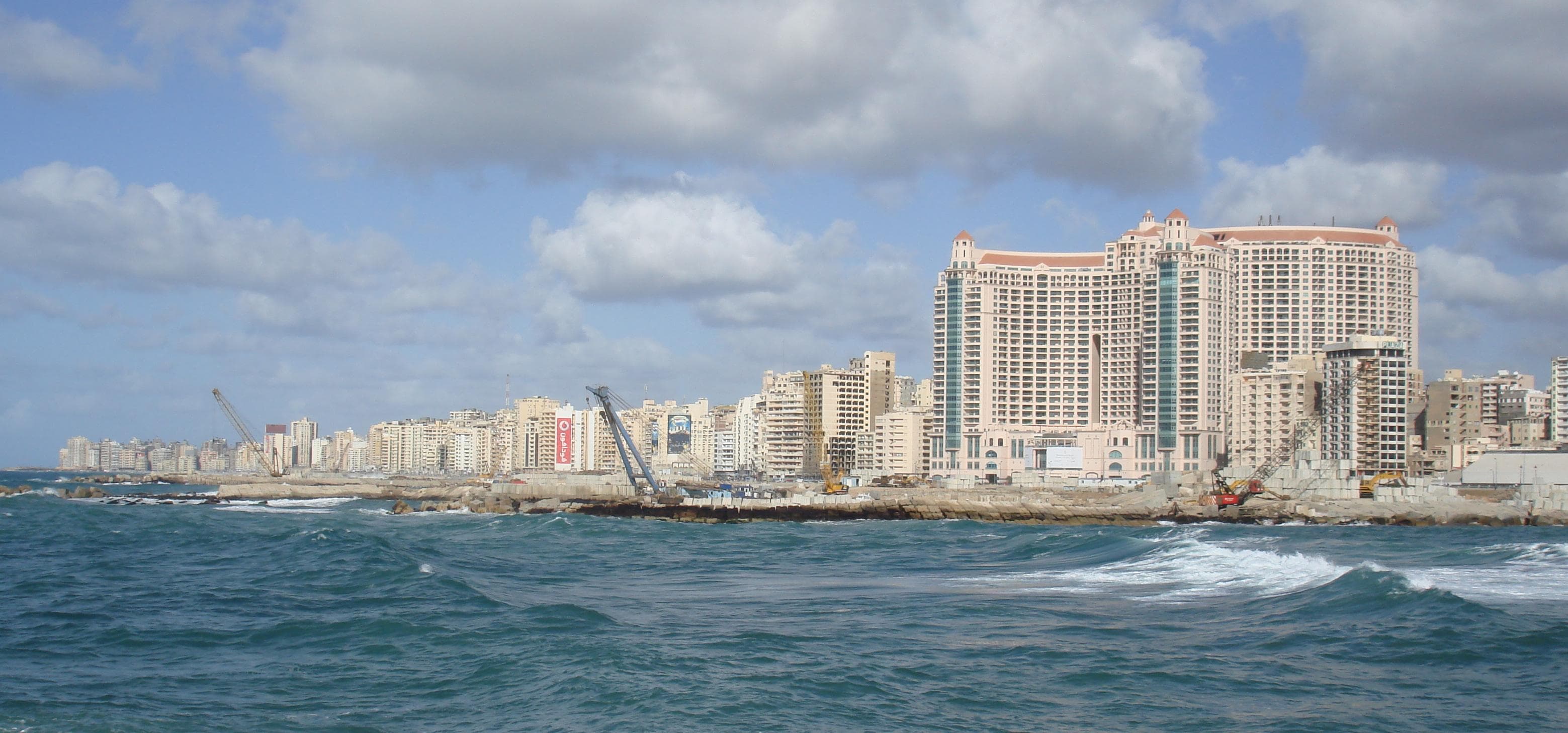
Today, the modern city of Alexandria stretches some forty kilometers along the Mediterranean coast, a sprawling industrial and financial hub of over six million people. It remains Egypt’s principal seaport, home to the Alexandria Shipyard, and a center of cultural life hosted at the modern Bibliotheca Alexandrina, a structure built to evoke the lost intellectual monument of the ancient world. Yet, beneath the concrete of the modern waterfront and the waves of the harbor—where the ancient cities of Canopus and Heracleion lie submerged—lies the memory of a place that was designed to be a bridge between worlds. Alexandria began as a Macedonian dream on a strip of Egyptian sand, and in its rise, destruction, and constant reinvention, it defined the cosmopolitan imagination of the Mediterranean for more than two thousand years.