In the autumn of 1780, a wealthy indigenous nobleman and muleteer named José Gabriel Condorcanqui Noguera took a step from which there was no turning back.
On the afternoon of November 9, 1780, in the central plaza of the small Andean town of Tinta, south of Cusco, a scaffold stood as a physical manifest of a world shifting on its axis. Antonio de Arriaga, the Spanish provincial governor—the corregidor whose administrative greed had squeezed the local indigenous population for years—stood beneath a wooden gallows. Beside him stood his captor, a wealthy, highly educated indigenous nobleman who had, until five days prior, gone by the name José Gabriel Condorcanqui. Now, wearing the black velvet, gold embroidery, and silver-buckled shoes of an elite colonial lord, yet increasingly embodying a older, dormant identity, he oversaw the proceedings not as a common rioter, but as a sovereign. To carry out the death sentence, he selected Antonio Oblitas, who was Arriaga’s own Afro-Peruvian slave, a choice designed to dramatically upend the hierarchy of the Viceroyalty of Peru. The first attempt to hang the governor failed when the rope snapped, sending Arriaga tumbling to the dust. In a desperate bid for sanctuary, the bruised official scrambled toward a nearby church, but the gathered crowd of thousands of indigenous onlookers blocked his path. He was dragged back to the platform, and the second attempt succeeded. This public execution of a direct representative of the Spanish Crown was the opening salvo of the Túpac Amaru rebellion, the largest, most destructive indigenous insurrection in the history of Spain’s American empire. It was an event that shook the imperial administration to its foundations, initiating a cycle of violence and ideological transformation that would permanently alter the social and political landscape of the Andes.
The man who orchestrated this execution was a figure of profound contradictions, straddling two vastly different worlds with a complex, fluid identity. Born around 1742 in the high-altitude village of Surimana, he was baptized José Gabriel Condorcanqui Noguera by a parish priest in Tungasuca. By blood and heritage, he was a direct descendant of Túpac Amaru I, the last Sapa Inca of the independent Vilcabamba state, who had been beheaded by the Spanish in Cusco in 1572. Yet José Gabriel’s early life was also thoroughly integrated into the institutions of the Spanish colonial state. Educated by the Jesuits at the San Francisco de Borja School in Cusco, an institution specifically founded to instruct the sons of indigenous chieftains (kurakas), he was literate in Spanish, fluent in Quechua, and capable of reading Latin. The Jesuits impressed upon him his social standing as a member of the royal Inca bloodline, preparing him to step into his hereditary role as the kuraka of Surimana, Pampamarca, and Tungasuca. He inherited not only political authority over these Quechua-speaking communities but also a substantial commercial estate from his father, which included a regional transport business built around a fleet of 350 cargo mules. As a merchant-muleteer, he traveled the long, treacherous mountain highways connecting Cusco, the mining center of Potosí, and the glittering ports of the Pacific coast. This business made him wealthy, but more importantly, it granted him a vast network of personal contacts and firsthand knowledge of the economic desperation gripping the southern Andes.
From the archives
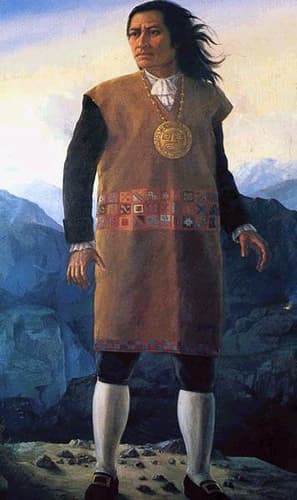
Túpac Amaru II — a 19th-century painted portrait based on contemporary descriptions.
Public domain · via Wikimedia Commons
Túpac Amaru II in Inca dress with an Andean Trinity behind him — religious-political iconography of the rebellion.
Public domain · via Wikimedia Commons
The geography of the 1780–1783 rebellion, from the Andean highlands south to Lake Titicaca.
CC BY-SA · via Wikimedia Commons
Connected to
12 links to entries not yet ingested in the Library.
This regional crisis was fueled by the Bourbon Reforms, a series of aggressive administrative and fiscal measures enacted by King Charles III to centralize imperial control and maximize revenue from the colonies. For the indigenous majority of Peru, these reforms manifested as an intolerable increase in the alcabala (sales tax), the establishment of internal customs houses, and a rigid collection of the tribute, a head tax levied on indigenous males. Worse still was the intensification of the mita, a system of forced labor that compelled thousands of native men to migrate to the notorious silver and mercury mines of Potosí and Huancavelica, where they labored under lethal conditions to enrich the metropolis. As a kuraka, José Gabriel stood in the crossfire of this extractive machine. It was his legal duty to collect these taxes and deliver his own people to the mining drafts, mediating between the rapacious Spanish provincial governors, the corregidores, and his suffering communities. For years, he attempted to operate within the parameters of the colonial legal system. He petitioned the royal courts in Tinta, Cusco, and the capital of Lima, begging for exemptions from the mita and arguing that the local population was being worked to death in the textile mills (obrajes) and mines. He spent years in exhausting litigation with the rival Betancur family over his claim to the Marquisate of Oropesa, a title that would have legally solidified his royal Inca lineage in the eyes of Spanish courts. His petitions were met with cold indifference, and his lawsuit was ultimately lost. By the late 1770s, facing personal debts brought on by the regional economic downturn and threatened with death by Governor Arriaga for falling behind on tax collections, José Gabriel concluded that the legal apparatus of the empire was a dead end. He began to look to a different source of authority.
He cast aside his Spanish name and styled himself Túpac Amaru II, invoking the ghost of his executed ancestor to reclaim the mantle of the Sapa Inca. This self-conception was deeply nourished by his reading of the Royal Commentaries of the Incas by El Inca Garcilaso de la Vega, a seventeenth-century mestizo writer whose romanticized, heroic history of the pre-conquest Andes painted the Inca Empire as a golden age of justice and harmony. Though the book was banned by the Spanish authorities for its subversive potential, Túpac Amaru II drew from it a vision of an alternative political order. Yet, his ideological platform was a complex, sometimes bewildering syncretism. He did not initially frame his movement as an anti-royalist war of independence. Instead, he claimed to be acting under the direct, secret orders of King Charles III of Spain, asserting that he was purging the kingdom of corrupt officials—like the universally hated visitador general (visitor general) José Antonio Areche—who were distorting the crown's benevolent intentions. His early proclamations called for a broad coalition of "Indians, mestizos, zambos, as well as native-born whites and blacks," united against the "European-born crown officials." In a stunning act of radical social reform, on November 16, 1780, he issued a decree abolishing slavery for Black people for the first time in the history of Spanish America. He envisioned a restructured Andean society: a Christian kingdom ruled by a restored Inca aristocracy, where different racial groups could live free of the crushing weight of the mita, the reparto de mercancías (the forced purchase of overpriced goods), and the brutal discipline of the textile workshops.
To the Spanish colonial authorities, however, this syncretic, aristocratic vision of reform was a delusion, masking a terrifying racial and social cataclysm. They did not see a loyal noble attempting to reform the empire; they saw a heretical usurper, an apostate who threatened to unleash an indigenous jacquerie that would wipe out the white minority and dismantle the entire social hierarchy of the viceroyalty. The sheer scale of the mobilization lent weight to Spanish fears. Following the execution of Arriaga, Túpac Amaru II rapidly assembled an army that swelled to over 6,000 fighters, as peasants abandoned their fields, mines, and workshops to join his banner. The rebellion swept through the provinces of Quispicanchis, Tinta, Cotabambas, Calca, and Chumbivilcas. On November 18, 1780, a Spanish loyalist force of 1,300 men dispatched from Cusco clashed with the rebel army at the town of Sangarará. The battle was an absolute victory for Túpac Amaru II. The rebel forces completely overwhelmed the loyalists, killing all 578 Spanish soldiers and seizing their weapons and supplies. Yet, the triumph at Sangarará exposed the deep ideological fractures within the movement. Once unleashed, the indigenous peasantry operated on their own revolutionary logic, one far more radical than Túpac Amaru II’s vision of inter-ethnic cooperation. For the poor peasants, artisans, and women who filled the ranks, the rebellion was an opportunity to "turn the world upside down" (pachakuti). They sought the total eradication of Spanish presence, the destruction of the colonial caste system, and the reclamation of communal lands under the traditional ayllu agricultural system. During and after the battle of Sangarará, the insurgent masses, operating outside of Túpac Amaru’s direct control, slaughtered Spaniards and looted estates with a fury that horrified the Creole (American-born Spanish) elite. This uncontrolled violence alienated the very Creoles whose support Túpac Amaru II had hoped to enlist, driving them firmly into the arms of the colonial administration.
As the rebellion grew, its leadership became a family affair, relying heavily on a network of trusted kin, chief among whom was Túpac Amaru II's wife, Micaela Bastidas Puyucahua. A woman of Afro-Peruvian and indigenous descent whom he had married in 1760, Bastidas was far more than a supportive spouse; she was a brilliant, iron-willed military strategist and co-commander of the insurrection. While Túpac Amaru II traveled through the provinces recruiting soldiers, Bastidas governed the rebel stronghold of Tungasuca, managing logistics, issuing passports, distributing resources, and commanding her own battalion of insurgent troops. She possessed a keen understanding of the tactical realities of the war. When the rebel army was at the height of its momentum after the victory at Sangarará, Bastidas pleaded with, and eventually scolded, her husband for his hesitation. She urged him to launch an immediate, surprise assault on Cusco while its defenses were weak and the city was paralyzed by panic. Túpac Amaru II, however, chose to delay, encircling the surrounding countryside in an attempt to gather more recruits and negotiate a peaceful surrender. This hesitation proved fatal. The delay gave the Spanish authorities in Lima and Cusco enough time to mobilize, bringing in heavy reinforcements, including thousands of loyalist indigenous militia led by rival kurakas like Mateo Pumacahua. When the rebel forces finally attacked Cusco in early 1781 with an army numbering between 40,000 and 60,000, they were repelled by the heavily fortified city defenses.
The retreat from Cusco marked the turning point of the campaign. The Spanish counter-offensive was swift and merciless, hunting the rebel forces through the high mountain passes. Surrounded between Tinta and Sangarará, the rebel lines disintegrated. In April 1781, Túpac Amaru II was betrayed by two of his own officers, Colonel Ventura Landaeta and Captain Francisco Cruz, who delivered him into the hands of the royalist forces. His capture, along with his wife, his sons, and his closest captains, was celebrated by the colonial administration as a deliverance. When the Spanish interrogators, led by the visitor general José Antonio Areche, attempted to extract the names of his accomplices in exchange for a lighter sentence, the captive Inca chief remained defiant. Looking Areche in the eye, he delivered a scathing indictment of the colonial system: "There are no accomplices here other than you and I. You as oppressor, I as liberator, deserve to die."
The sentence handed down by the Spanish authorities was designed not merely to end the life of a rebel, but to systematically obliterate the symbolic potency of his lineage and his movement. The execution, staged on May 18, 1781, in the crowded Plaza de Armas in Cusco—the historical heart of both the Inca Empire and Spanish colonial power—was transformed into a grand, gruesome public spectacle of state terror. The day began with a parade of the condemned, who were forced to walk under guard to the scaffolds erected in the center of the square. Túpac Amaru II was forced to watch the agonizing deaths of his family and close captains one by one. First came his eldest son, Hipólito, whose tongue was cut out by the executioners before he was sent to the gallows. Next, Micaela Bastidas was forced onto the platform. In front of her husband and her ten-year-old son, Fernando, she fought her executioners with ferocious physical resistance. After she was subdued, they cut out her tongue. Because her neck was too slender for the mechanical iron winch designed to strangle her, the executioners wrapped heavy ropes around her neck, pulling them from side to side to choke her, while simultaneously beating her with a club and kicking her repeatedly in the stomach and breasts until she died.
Then, Túpac Amaru II was brought forward. The executioners cut out his tongue and threw him to the stone-paved ground of the plaza. His hands and feet were bound with heavy leather thongs, which were then secured to the saddles of four draft horses. At a signal from the officers, the horses were driven in four opposite directions toward the corners of the square, straining to tear his limbs from his torso. Yet, despite the immense force, the horses failed to dismember him. Modern medical and physiological evaluations of the attempt suggest that Túpac Amaru II’s exceptional muscular build and physical resistance prevented the joints from tearing apart, though his shoulders, hips, and pelvis were violently dislocated. Frustrated by the delay and fearing the restless mood of the thousands of silent indigenous spectators who had packed into the plaza, the Spanish magistrate ordered the horses stopped. The executioners manually dragged him to the block, where they quartered his body and beheaded him, ending his life on the exact spot where his ancestor, Túpac Amaru I, had met the same fate more than two centuries earlier. The horror of the day was witnessed by his youngest son, Fernando, who was forced to stand beneath the gallows, passing beneath the dangling bodies of his family. While Fernando was spared the death penalty due to his age, he was sentenced to life imprisonment and exiled. The ship carrying him capsized during the voyage, but he survived, ending up in the damp dungeons of Cádiz in southern Spain, where he remained locked away from the world.
The physical destruction of Túpac Amaru II’s body was only the beginning of the Spanish campaign to erase his memory. The judicial sentence ordered his remains divided and distributed as warnings to the regions that had supported him: his head was sent to Tinta to be displayed on a pike at the city entrance; one of his arms was sent to Tungasuca and the other to Carabaya; his legs were dispatched to Livitica and Santa Rosa. His houses were demolished, the earth beneath them plowed with salt, and his personal property confiscated. All records of his genealogy were burned, and his relatives were declared legally infamous. Furthermore, the Spanish authorities recognized that the rebellion was deeply rooted in the preservation of Inca cultural memory. On the very day of his execution, May 18, 1781, the viceregal government issued a sweeping decree outlawing all outward expressions of Inca identity. The wearing of traditional Inca clothing, the ownership of paintings depicting the ancient kings, the playing of traditional musical instruments, and the use of the Quechua language in theatrical productions were strictly forbidden. Even self-identification as "Inca" was criminalized, as the administration embarked on an aggressive campaign of forced cultural assimilation, attempting to erase the memory of the Tahuantinsuyo and convert the population to Western European Spanish culture and government.
Yet, this calculated demonstration of imperial violence failed to immediately pacify the Andes. Instead of crushing the rebellion, the execution of Túpac Amaru II catalyzed a second, even more violent phase of the conflict. The leadership of the Peruvian movement fell to his surviving cousin, Diego Cristóbal Túpac Amaru, who kept the insurgency alive in the high plains surrounding Lake Titicaca. Simultaneously, the rebellion fused with an independent, highly radicalized indigenous uprising in Upper Peru (modern-day Bolivia) led by Julian Apaza, who took the name Túpac Katari in honor of Túpac Amaru II and Tomas Katari. Túpac Katari’s forces, consisting of tens of thousands of Aymara-speaking peasants, unleashed a war of total racial extermination against the Spanish elite. In 1781, Katari’s peasant army laid siege to the colonial city of La Paz for 109 days, turning the city into a starving, disease-ridden ruin before Spanish military reinforcements from Buenos Aires broke the blockade. Though Túpac Katari was eventually captured and executed in October 1781, and Diego Cristóbal was hunted down and killed shortly thereafter, the tremors of this massive continental convulsion continued to ripple across the Spanish Empire. In Colombia, the indigenous rebels of the Casanare plains invoked the name of the dead Sapa Inca, declaring him the "King of America." In Chile, the news of the Andean uprising inspired the Conspiracy of the Tres Antonios in January 1781, where conspirators sought to overthrow Spanish rule. The social fabric of the southern Andes remained deeply scarred, characterized by a profound, enduring distrust between the white Creole elite and the indigenous majority—a legacy of fear that would shape the contours of the South American wars of independence decades later.
Though the rebellion failed to achieve its immediate goals and was brutally suppressed, the ghost of Túpac Amaru II survived the Spanish bonfires. He was transformed from a historical figure into a powerful, shape-shifting myth, a symbol of resistance that would be resurrected by successive generations of political and social movements across the globe. During the twentieth century, his legacy was adopted by the Uruguayan urban guerrilla group known as the Tupamaros, and later by the Marxist-Leninist Túpac Amaru Revolutionary Movement (MRTA) in Peru, both of whom claimed his struggle as a precursor to modern socialist revolution. In 1968, the reformist military dictatorship of General Juan Velasco Alvarado in Peru officially elevated Túpac Amaru II to the status of a premier national hero, replacing the portrait of the conqueror Francisco Pizarro in the Government Palace with an image of the indigenous rebel. Even in contemporary global culture, his name resonates, famously inspiring the name of the American hip-hop icon Tupac Amaru Shakur. What began in 1780 as a desperate, localized rebellion against the abuses of colonial tax collectors has endured as a universal symbol of anti-colonial resistance and the struggle for human dignity. This long legacy raises fundamental questions about the nature of historical memory and the unfinished business of the conquest: how does an empire truly conquer a people whose kings refuse to stay dead, and how does a modern republic reconcile its European institutions with the deep, indigenous roots of its past?