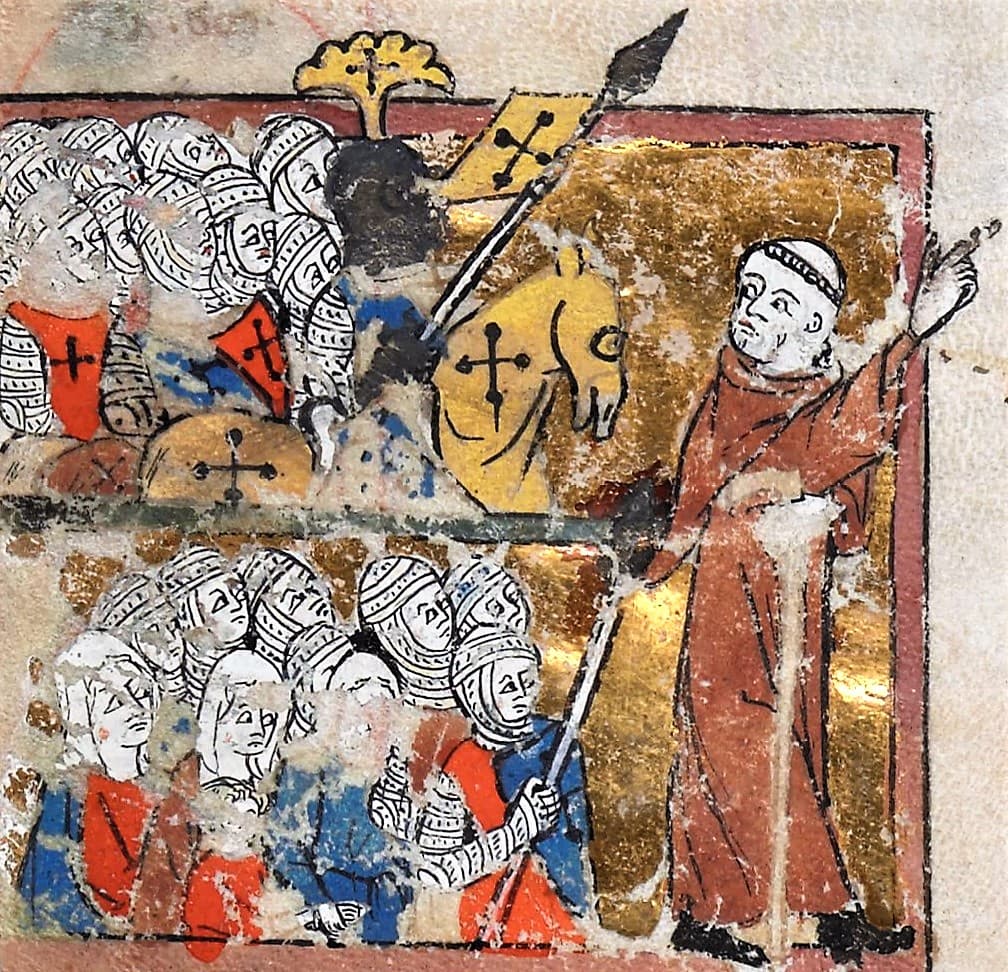
In 1095, an appeal for military aid from the Byzantine emperor Alexios I Komnenos, who was facing the pressure of Seljuk Turks, reached Pope Urban II.
In the late autumn of 1095, in a rain-swept field outside the French city of Clermont, Pope Urban II unleashed an idea that would redraw the map of the medieval world. Addressing a vast assembly of clergy, nobles, and commoners, Urban spoke of a distant crisis. He described the eastern reaches of Christendom, where the Byzantine Empire was buckling under the relentless advance of the Seljuk Turks, and spoke of Jerusalem, a city held by Muslim rulers for centuries but now reportedly closed or hostile to the pious flow of Western pilgrims. The Pope’s solution was a radical fusion of two of the Middle Ages’ most potent forces: the violent, land-hungry instinct of the European knightly class and the deep, anxious desire for Christian salvation. He urged the faithful to embark on an armed pilgrimage—a military expedition to reclaim the Holy Land—promising that those who undertook the journey would receive the remission of their sins. The response was immediate, visceral, and chaotic. Shouts of Deus vult—"God wills it"—echoed through the crowd, and across Europe, thousands of hands began sewing red fabric crosses onto their cloaks.
This call answered a profound, simmering crisis within Western Europe itself. For decades, the collapse of the Carolingian Empire had left behind a fractured landscape ruled by a highly militarized warrior caste. With no great external empires to fight, these knights spent their lives in bloody, localized feuds, terrorizing the peasantry and troubling the conscience of a reforming Church. The doctrine of holy war had been evolving since the fourth-century writings of Augustine of Hippo, who argued that violence could be justified if sanctioned by legitimate authority to defend or recover rightful territory. More recently, the Church had experimented with offering spiritual rewards for military service, blessing Norman conquests in Sicily and the ongoing campaigns of the Iberian Reconquista. By framing the expedition to Jerusalem as a penitential pilgrimage, Urban II offered Europe’s violent nobility a unique paradox: a path to absolution through the very act of warfare.
The enthusiasm, however, bypassed the nobility's careful preparations and struck the lower classes first. In the spring of 1096, long before the organized armies of the great lords were ready to march, a charismatic French priest known as Peter the Hermit mobilized a sprawling, disorganized mass of perhaps tens of thousands of impoverished peasants, petty knights, and families. This "People’s Crusade" swept eastward across Europe like an unruly tide. Lacking supplies, discipline, and military experience, their zeal quickly turned inward and violent. As they marched through the Rhineland, segments of the host indulged in horrific, wide-ranging anti-Jewish massacres, decimating ancient Jewish communities in cities like Speyer, Worms, and Mainz. When this ragged multitude finally crossed into Anatolia with the help of the wary Byzantine Emperor Alexios I Komnenos, their lack of military cohesion proved fatal. In October 1096, at the Battle of Civetot, the Seljuk sultan Kilij Arslan I easily lured the People’s Crusade into an ambush, annihilating the force and leaving a mountain of bones as a warning.
+ 12 further connections to entries not yet ingested
The true military weight of Europe arrived in Constantinople between November 1096 and April 1097. This was the "Princes’ Crusade," a formidable feudal host of roughly 100,000 people, including non-combatants, led by some of the most powerful lords of the Western world. There was Raymond IV of Toulouse, leading the southern French under the spiritual guidance of the papal legate Adhemar of Le Puy; Godfrey of Bouillon and his brother Baldwin of Boulogne, commanding the men of Lorraine; the brilliant but predatory Italo-Norman commander Bohemond of Taranto and his nephew Tancred; and a northern French contingent under Robert of Normandy and Stephen of Blois. Confronted by this massive, armed assembly outside his walls, Emperor Alexios I was deeply uneasy. He had asked Rome for mercenaries to help defend his borders, not an independent, foreign army of conquest. Before allowing them to cross into Asia, Alexios extracted oaths from the Western princes, demanding they return any recovered Byzantine territories to his empire.
The campaign in Anatolia began in June 1097 with the Siege of Nicaea. With the Seljuk sultan Kilij Arslan absent, fighting rivals elsewhere, the crusaders besieged the city while a Byzantine naval blockaded its lakeside flank, forcing Nicaea’s surrender directly to the Emperor—an outcome that deeply frustrated the Western knights hoping for plunder. Moving deeper into the arid interior, the crusaders faced the terrifying speed of Turkish horse archers at the Battle of Dorylaeum. Only the arrival of reinforcements saved the vanguard, cementing a tactical respect between the two forces. What followed was a brutal, searing march through the Anatolian sun, where water was scarce and horses died by the thousands. As the army dragged itself toward Syria, Baldwin of Boulogne broke away from the main host, marching east into Mesopotamia to establish the first Latin foothold: the County of Edessa.
By October 1097, the main crusader force stood before the colossal, ancient walls of Antioch. The siege of the city became an eight-month nightmare of starvation, disease, and desertion. Inside the camps, the crusaders ate their own horses, while outside, relief armies from neighboring Muslim cities threatened to trap them against the walls. The deadlock broke in June 1098 through treachery, when Bohemond bribed a guard to open a gate, allowing the crusaders to pour in and massacre the garrison. Days later, however, a massive Turkish relief army under Kerbogha of Mosul arrived, besieging the exhausted crusaders inside the very city they had just captured. Starving and desperate, the crusaders’ morale was revived by the reported discovery of the Holy Lance—the relic that had pierced Christ’s side—buried beneath Antioch’s cathedral. Galvanized by religious ecstasy and starvation-fueled desperation, the crusader army marched out of the gates and routed Kerbogha’s vast, divided coalition.
With Antioch secured, Bohemond claimed the city for himself, flagrantly violating his oath to Alexios. The remaining crusaders, pushed forward by the demands of the ordinary soldiers who threatened to march without their leaders, set their sights on the ultimate goal. In June 1099, a diminished force of perhaps 12,000 combatants finally reached the walls of Jerusalem, which had recently been recaptured from the Seljuks by the Shi'ite Fatimid Caliphate of Egypt. The dry summer heat, a lack of water, and the approach of a Fatimid relief army made a prolonged siege impossible. Dismantling their ships at the coast to construct massive wooden siege towers, the crusaders launched a desperate, all-out assault on July 15, 1099. Godfrey of Bouillon’s men were the first to breach the northern wall. Once inside, the pent-up fury and religious zeal of the three-year march erupted into a systematic, horrifying massacre of the city’s Muslim and Jewish inhabitants, filling the streets with blood.
The conquest of the Holy City was secured in August 1099 when the crusaders repulsed a Fatimid counterattack at the Battle of Ascalon. With their vows fulfilled, the vast majority of the surviving knights boarded ships to return to Europe, leaving behind a small, fragile core to govern the newly won lands. They organized their conquests into four distinct Crusader states: the Kingdom of Jerusalem, the County of Edessa, the Principality of Antioch, and the County of Tripoli. For nearly two centuries, these fragile feudal enclaves, deeply dependent on continuous waves of Western immigration and military orders, would survive as a contested frontier between the Christian and Islamic worlds, until the fall of the last major stronghold at Acre in 1291. The First Crusade did more than just capture a city; it forged a legacy of holy war, physical migration, and bitter sectarian division that would reverberate through the history of Europe and the Levant for generations to come.