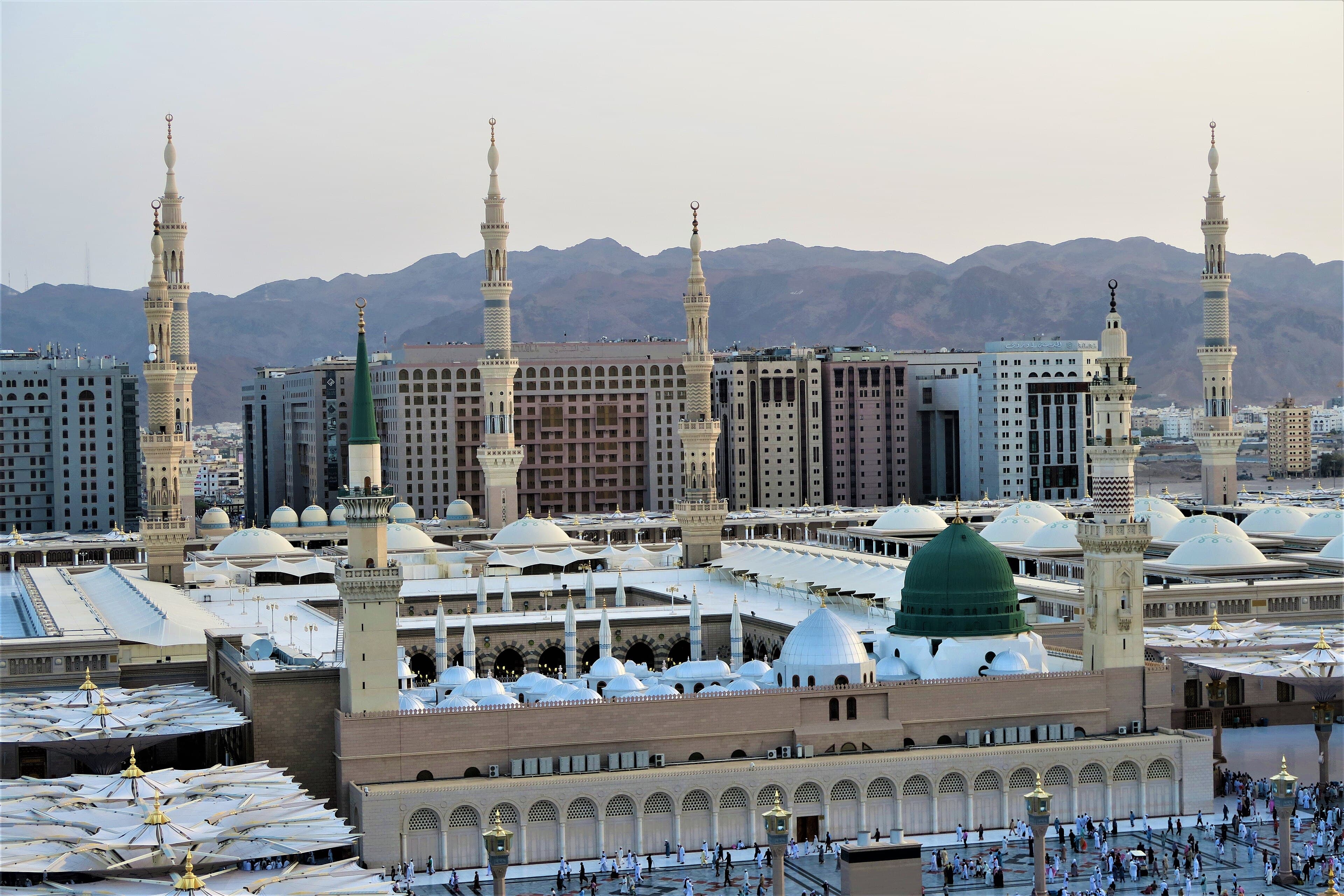
Before it was ever called the City of the Prophet, the oasis in the Hejaz highlands of western Saudi Arabia was known as Yathrib.
High in the basaltic plateaus of the western Hejaz, where the rugged peaks of the coastal mountains fall away toward the great central tableland of Arabia, lies a basin of singular green. To a traveler descending from the arid, sun-scourged valleys that surround it, this hollow appears as an unexpected triumph of water over stone. Beneath a surface scarred by ancient, dormant volcanoes and fields of dark, prehistoric lava, deep-lying underground channels converge to feed an abundant, brackish water table. For nearly three thousand years, this hydrological anomaly has sustained a sprawling oasis of date palms, wheat fields, and walled orchards. Long before it was ever known as the cradle of an empire or the sanctuary of a faith, the settlement was called Yathrib. It was not a place of merchants or grand stone monuments, but an island of farmers, stubbornly coaxing life from a volcanic soil rich in salt but blessed with water.
The antiquity of the oasis is quiet but vast. Archaeological memory places its first settled inhabitants around the ninth century BCE, and by the sixth century BCE, the name Yathrib had found its way into the cuneiform records of the Babylonian king Nabonidus. It was a fragmented, decentralized world. Unlike Mecca, its southern neighbor nestled in a barren valley where survival demanded the sharp instincts of the long-distance trade caravan, Yathrib was defined by the localized, defensive politics of the soil. By the fourth century CE, Jewish-Arabian tribes had established themselves as the dominant masters of the basin. The Banu Qurayza, the Banu Nadir, and the Banu Qaynuqa carved the land into fortified family estates and palm groves, managing the complex irrigation systems of the oasis. Under the distant shadow of the Persian Empire, these tribes held such sway that the Banu Qurayza reportedly acted as tax collectors for the Persian Shah.
This agrarian order was shattered toward the end of the fifth century by the arrival of two southern Arab tribes, the 'Aws and the Khazraj, migrating northward from Yemen. Initially arriving as clients to the established Jewish landholders, the newcomers steadily expanded, revolted, and eventually seized political dominance. Yet independence brought no peace. For more than a century, the 'Aws and the Khazraj engaged in a devastating, cyclical blood feud that fractured the oasis. The conflict drew in the Jewish tribes as reluctant allies: the Banu Nadir and Banu Qurayza sided with the 'Aws, while the Banu Qaynuqa aligned with the Khazraj. They fought four bitter wars, culminating in the inconclusive and bloody Battle of Bu'ath in the early seventh century. The fields were neglected, the palm groves threatened, and the society of the oasis reached a point of exhaustion. It was this desperate deadlock that set the stage for one of the most consequential migrations in human history.
In 622 CE, seeking an impartial mediator to resolve their ruinous feud, representatives from Yathrib met secretly near Mecca with a charismatic preacher named Muhammad. The Prophet and his small band of followers, the Muhajirun, were fleeing intense persecution in their home city. Yathrib offered them sanctuary; in return, Muhammad was accepted as the supreme arbiter of the oasis's warring factions. This migration, the Hijrah, did more than mark the beginning of the Islamic calendar; it fundamentally transformed the social fabric of the settlement. The ancient animosity between the 'Aws and the Khazraj was sublimated into a shared identity as the Ansar, or Helpers, who, together with the Meccan emigrants, formed the first ummah—a unified community of faith. To govern this delicate coalition of Muslims, pagan Arabs, and Jewish clans, Muhammad drafted what chroniclers call the Constitution of Medina, an early treaty establishing mutual defense and religious freedom, which modern scholars view as one of the oldest surviving administrative documents of the Islamic era.
With its new leader came a new name. The old designation of Yathrib, associated with pagan antiquity and tribal bloodshed, was discarded. Muhammad called the oasis Tabah or Taybah—the Kind, or the Good—but to history, it became simply Al-Madinah: "The City." Specifically, it was Madīnat an-Nabī, the City of the Prophet. From this agricultural refuge, Muhammad consolidated both his spiritual message and his political state. The nature of the Qur'anic revelations shifted dramatically in Medina; where the earlier Meccan verses had been poetic, cosmological, and intensely personal, the Medinan chapters were legal, social, and structural, laying down the blueprints for a functioning society.
The physical heart of this state was a modest structure built by Muhammad in 622 CE: Al-Masjid al-Nabawi, the Prophet’s Mosque. Originally constructed of sun-dried clay bricks with a roof of woven palm branches supported by palm trunks, it was a building that mirrored the agrarian simplicity of the oasis itself. Adjoining this low-slung house of prayer were the simple mud-brick huts of Muhammad’s wives. It was in one of these rooms, belonging to his wife Ayesha, that the Prophet died in 632 CE and was buried beneath the floorboards. His closest companions and the first two caliphs of the expanding Islamic state, Abu Sufyan's son Abu Bekr and Omar, were eventually laid to rest beside him.
For the first few decades of the Islamic expansion, Medina served as the administrative capital of a rapidly growing empire. From this quiet oasis, the first three Caliphs directed the conquests of Syria, Egypt, and Persia. Yet as the borders of the caliphate stretched from the borders of India to the shores of North Africa, Medina’s geographical isolation and its agrarian character made it increasingly impractical as an imperial capital. By 660 CE, political gravity had shifted elsewhere—first to Kufa, then to Damascus under the Umayyads, and later to Baghdad under the Abbasids. Medina was left behind, returning to its quiet existence as a provincial city of scholars, farmers, and guardians of the sacred graves.
This withdrawal from the center of global power did not diminish Medina's spiritual gravity. It became the second holiest city in Islam, a place of universal pilgrimage. In 711 CE, the Umayyad Caliph Walid dismantled the original, decaying mud-brick homes of the Prophet’s family to expand and reconstruct the mosque on a grand scale. Using Greek and Coptic artisans, the Umayyads built a vast, colonnaded sanctuary in the Byzantine style, effectively enclosing the sacred tombs within the walls of the mosque itself. The reconstruction initially sparked protest among the local populace, who lamented the destruction of the domestic spaces where the Prophet had lived, but it cemented the practice of Ziyarat—the pious visitation to the Prophet’s tomb—which millions of Muslims continue to undertake alongside their pilgrimage to Mecca.
Over the subsequent centuries, Medina became a mirror reflecting the rise and fall of Islamic empires. Control of the Hejaz shifted constantly: from the Umayyads and Abbasids to the Mamluks of Egypt, and eventually, in 1517, to the Ottoman Empire. Each dynasty sought to legitimize its rule by patronizing the holy sanctuaries. The Ottomans, in particular, poured wealth into the city. They rebuilt the massive stone walls that protected the city’s irregular, oval perimeter, maintained the ancient aqueduct that brought fresh water from the southern village of Quba, and crowned the Prophet’s tomb with its iconic green dome.
By the early twentieth century, as the Ottoman Empire waned, Medina found itself briefly connected to the modern world by the Hejaz Railway, which stretched over thirteen hundred kilometers from Damascus to the northern gate of the city. This brief moment of Ottoman-engineered modernity was short-lived. Following the upheavals of the First World War and the collapse of Hashemite rule, the city was integrated into the modern Kingdom of Saudi Arabia in 1925. Under Saudi administration, the city has undergone its most radical transformation since the eighth century. The ancient, narrow stone streets and Ottoman-era neighborhoods surrounding the Prophet’s Mosque have been cleared to accommodate millions of modern pilgrims. Vast marble plazas, towering hotels, and high-capacity infrastructure now dominate the landscape, while some historic structures and archaeological sites have been dismantled to make way for expansion.
Today, Medina stands as a metropolis of nearly one and a half million people, where modern high-rises overlook the same volcanic plains that once nourished the crops of the 'Aws and the Khazraj. It remains a city defined by a profound historical duality: an ancient agricultural basin that sought to isolate itself from the conflicts of the desert, which instead became the crucible of a global civilization.
+ 12 further connections to entries not yet ingested