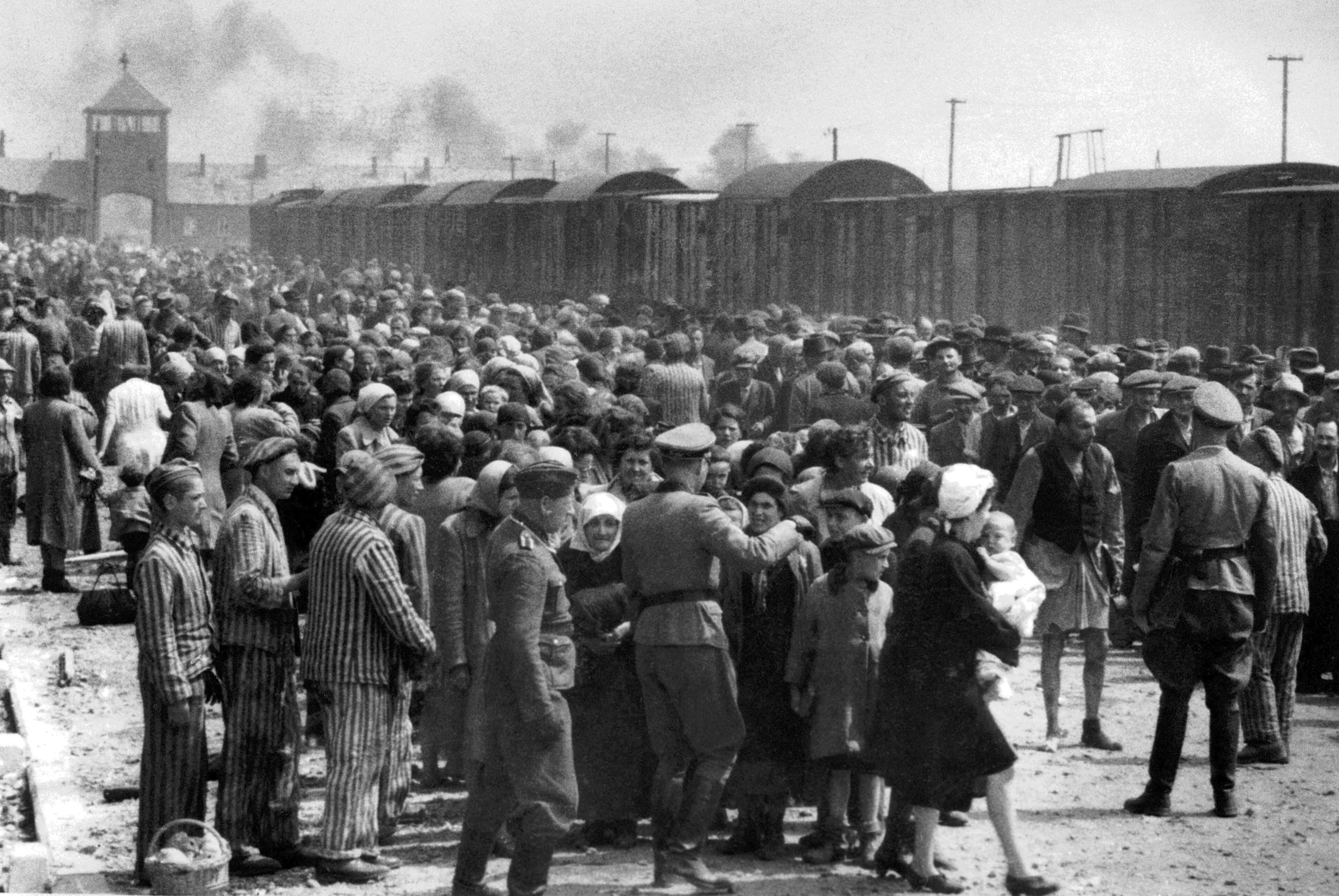
The destruction of European Jewry did not begin in the gas chambers, but in the deliberate dismantling of human dignity.
For centuries, the English word "holocaust"—derived from a Greek term for a sacrificial offering consumed entirely by fire—existed as a general noun for a great disaster or a massacre. But by the 1970s, the capitalization of the word became permanent, and its focus narrowed to a single, historically unprecedented catastrophe: the state-sponsored, systematic murder of European Jewry by Nazi Germany and its collaborators between 1933 and 1945. In Hebrew, the event is called the Shoah, meaning "catastrophic destruction." This systematic campaign of annihilation ultimately claimed the lives of approximately six million Jews, representing two-thirds of the Jewish population of Europe. It was a tragedy of such scale and administrative coldness that it permanently altered the Western historical consciousness, standing thereafter as the ultimate symbol of human evil.
The roots of this catastrophe were dry and deep, stretching back through millennia of European history. For over two thousand years, Jewish communities had lived across the continent, enduring generations of theological antisemitism that blamed them for the death of Jesus. Although the nineteenth century brought emancipation and full citizenship rights to many Jews in western and central Europe—leading to high degrees of cultural integration—the rise of modern nationalism and the rapid economic shocks of industrialization generated a new, political antisemitism. This modern variant posited a "Jewish question" and spun elaborate conspiracy theories of global Jewish control. Concurrently, nineteenth-century racial theorists began to categorize humanity into distinct biological races locked in a social-Darwinist struggle for survival. By the turn of the twentieth century, these racial theories had already bore lethal fruit in Germany’s colonial empire, where the Herero and Nama genocide and subsequent racial apartheid in South West Africa prefigured the dark potential of state-organized racial cleansing.
It was the trauma of World War I, however, that catalyzed these theories into a revolutionary political force. Germany’s defeat in 1918, which cost two million lives and stripped the nation of substantial territory, shattered the domestic order. The German military promoted the highly effective myth of the "stab in the back," falsely claiming that the army had not been defeated on the battlefield but had been betrayed from within by socialists and Jews. In this climate of humiliation, economic ruin, and violent anti-communist paranoia, the National Socialist German Workers' (Nazi) Party was born. Led by Adolf Hitler, the Nazis envisioned a world purged of Jews, whom they viewed as the very embodiment of modernity’s ills. Their ideology merged a biological definition of the German nation with an obsessive quest for (living space) in Eastern Europe to be cleared and colonized. To the German public, the Nazis presented themselves as the defenders of European civilization against a global Soviet threat, which Hitler claimed was orchestrated by an international Jewish conspiracy that simultaneously controlled the capitalist Western powers.
Connected to
12 links to entries not yet ingested in the Library.
When the Great Depression fractured the Weimar Republic, the Nazi Party capitalized on the desperation, securing 37 percent of the vote in mid-1932. In January 1933, through a backroom deal with conservative politicians who believed they could control him, Hitler was appointed chancellor. Within months, the democratic state was dismantled. All other political parties were banned, the media was subjugated, and tens of thousands of political opponents—predominantly communists—were arrested and placed in a newly established system of extrajudicial concentration camps. The regime quickly expanded its targets to social outsiders, including Roma and Sinti, homosexual men, and those deemed "workshy." Seeking to purge the national gene pool, the state forcibly sterilized 400,000 people and subjected others to forced abortions for hereditary illnesses. For the majority of Germans who did not actively oppose the regime, daily life remained secure, bolstered by state-led economic recovery, rearmament, and a series of bloodless foreign policy triumphs, including the annexations of Austria, the Sudetenland, Bohemia, and Moravia.
For Germany's 500,000 Jews, who made up less than one percent of the population, the Nazi ascension marked the beginning of a systematic campaign to force them out of the country. Between 1933 and 1939, the state and local authorities enacted approximately 1,500 anti-Jewish laws. Jews were banned from the civil service and professional life, and in 1935, the Nuremberg Laws stripped them of citizenship, defining "Jewishness" based on ancestry (three or four Jewish grandparents) and criminalizing marriage and sexual relations between Jews and non-Jewish Germans. Local, popular pressure and state decrees gradually forced Jewish children out of schools, barred Jews from public spaces, and expropriated Jewish businesses. This persecution culminated on the night of November 9–10, 1938, in a state-orchestrated nationwide pogrom known as Kristallnacht (the Night of Broken Glass). Over 7,500 Jewish shops were looted, more than 1,000 synagogues were damaged or destroyed, and at least 90 Jews were murdered. In the aftermath, 30,000 Jewish men were arrested and sent to concentration camps, and the German Jewish community was forced to pay a "fine" of over one billion Reichsmarks.
The primary objective of the Nazi regime during these pre-war years was not yet systematic mass murder, but rather the total, forced emigration of the Jewish population. Between 1933 and 1939, roughly 250,000 Jews managed to flee Germany. They sought refuge in South Africa, Mandatory Palestine, South America, the United States, Great Britain, and Western Europe, despite the fact that almost no nation lowered its immigration barriers to accommodate them. The regime extracted nearly one billion Reichsmarks in emigration taxes from those departing, leaving those who remained behind—largely the elderly, the poor, and women—impoverished and vulnerable.
The outbreak of World War II on September 1, 1939, when the German army invaded Poland, fundamentally transformed the nature and scale of Nazi anti-Jewish policy. The invasion brought millions of Eastern European Jews under German control, far too many to be removed by emigration. In Poland, the occupying authorities began to segregate Jewish populations into cramped, impoverished, and sealed urban areas known as ghettos. The invasion of the Soviet Union in June 1941 marked the critical transition from forced segregation and territorial expulsion to active, systematic extermination. Behind the advancing German army marched the Einsatzgruppen—special mobile killing units—tasked with eliminating perceived enemies. Initially targeting Jewish Red Army prisoners of war and adult male civilians, these units, supported by local collaborators, quickly escalated to the systematic slaughter of entire Jewish communities, including women and children. Between 1.5 and 2 million Jews were murdered in these mass shootings across Eastern Europe.
By early 1942, following the Wannsee Conference where Nazi bureaucrats coordinated the logistics of the "Final Solution of the Jewish Question," the machinery of murder was industrialized. Rather than bringing the killers to the victims, the state built a network of dedicated extermination camps equipped with poison gas chambers, constructed primarily in occupied Poland—most famously Auschwitz-Birkenau, Treblinka, Belzec, Sobibor, Chełmno, and Majdanek. Millions of Jews from across occupied Europe were packed into cattle cars and deported to these camps. Those who survived the grueling journeys were subjected to immediate "selections"; the majority were sent directly to the gas chambers, while others were spared temporarily for forced labor, where they were worked to death, starved, or subjected to fatal medical experiments. The intensity of the slaughter peaked during Operation Reinhard, between March 1942 and November 1943. While the vast majority of the victims died during the frenzy of 1942, the assembly-line killings continued until the final collapse of the Nazi regime in the spring of 1945.
When the Allied armies finally liberated the camps in 1945, they exposed to the world a landscape of unparalleled horror. The physical assets and property of the millions murdered had been systematically plundered and redistributed to German citizens and non-Jewish neighbors, leaving survivors with nothing to return to. In the decades that followed, the devastated survivors scattered across the globe, many building new lives in Israel and the United States. Though a series of post-war trials brought some of the perpetrators to justice, the vast majority of those complicit in the machinery of death escaped prosecution. Germany has since paid billions of dollars in reparations, though such gestures remain symbolic against the scale of what was lost. The Holocaust remains etched into global memory not merely as a historical event, but as a warning of how modern bureaucratic efficiency, scientific rationalism, and ancient prejudices can be fused by a state to perpetrate the absolute destruction of a people.