The unresolved tensions of one global cataclysm paved the way for another, far more devastating conflict that eventually pulled nearly every nation on Earth into its orbit.
On September 18, 1931, a section of railway track owned by Japan’s South Manchuria Railway was damaged in a minor explosion near Mukden. The blast was so slight that a passenger train passed safely over the site moments later, yet its reverberations shook the international order. Fabricated by officers of the Imperial Japanese Army as a pretext for invasion, the Mukden incident led to the swift occupation of Manchuria and the creation of the puppet state of Manchukuo. When the League of Nations formally condemned the aggression, Japan simply withdrew from the organization. It was a moment of profound revelation. The post-World War I dream of collective security, anchored by a League designed to prevent global slaughter through arbitration, was exposed as an illusion. The long fuse of the twentieth century’s second global conflagration had been lit, demonstrating that the international architecture built in Paris after 1918 was incapable of restraining revisionist powers.
What followed over the next decade was a cascading collapse of peace across multiple continents, driven by unresolved grievances from the First World War and the rise of aggressive ideologies. In Germany, the deep scars of the Treaty of Versailles—which had stripped the nation of thirteen percent of its territory, dismantled its military capacity, and imposed staggering financial reparations—fueled a revanchist nationalism. Adolf Hitler capitalised on this resentment, dismantling the democratic Weimar Republic to establish a totalitarian regime in 1933. Soon after, he repudiated the Versailles treaty, accelerated rearmament, and introduced conscription. In Italy, Benito Mussolini’s fascist regime, frustrated by what nationalists viewed as inadequate territorial rewards for their role in the First World War, sought to build a "New Roman Empire" through brutal expansion. When Italy invaded the independent African state of Ethiopia in October 1935, the League of Nations once again failed to act decisively, imposing toothless sanctions that did nothing to halt the conquest. The Western democracies, paralyzed by pacifist public sentiment and economic distress, adopted a policy of appeasement. France and the United Kingdom watched as Hitler remilitarized the Rhineland in 1936, and stood by as Germany and Italy tested their modern war machines in the Spanish Civil War by backing the Nationalist rebels under General Francisco Franco.
By the late 1930s, these revisionist states had consolidated their ambitions into formal alliances. Germany and Italy established the Rome–Berlin Axis in October 1936, and Germany soon joined Japan in the Anti-Comintern Pact, creating a global web of militaristic regimes. Japan, locked in a civil-war-addled China since its full-scale invasion in 1937, was rapidly expanding its footprint in Asia. In Europe, Hitler’s annexations of Austria and the Czechoslovakian Sudetenland in 1938 proved to be mere preludes. The crisis reached its flashpoint on September 1, 1939, when Nazi Germany invaded Poland. Having secured a stunning, cynical non-aggression pact with the Soviet Union under the Molotov–Ribbentrop Pact just days prior, Hitler believed he could dismantle Poland without facing a wider war. He was wrong. On September 3, the United Kingdom and France declared war on Germany. Two weeks later, Soviet forces invaded Poland from the east, and the country was partitioned between the two totalitarian powers. The Second World War had begun.
+ 12 further connections to entries not yet ingested
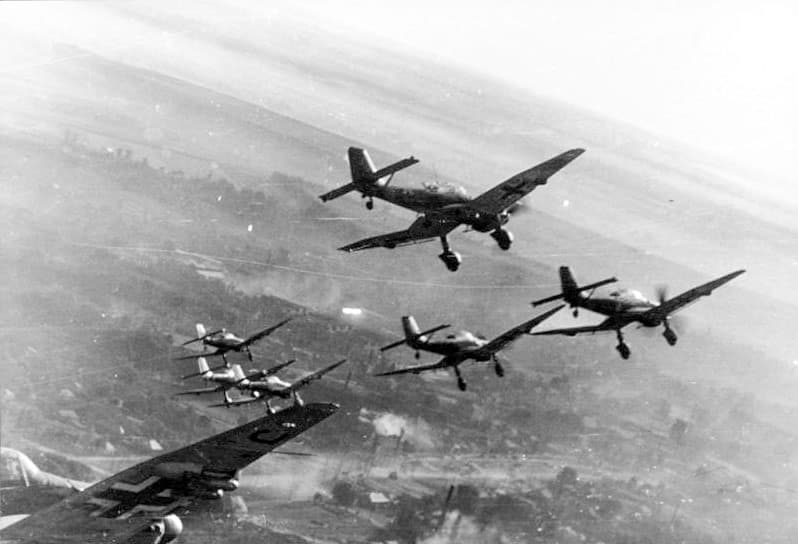
The initial phase of the war was characterized by stunning, rapid conquests. In 1940, while the Soviet Union annexed the Baltic states and carved away territories from Finland and Romania, Germany launched a series of blistering campaigns. Norway, Denmark, Belgium, Luxembourg, and the Netherlands fell in rapid succession. By June 1940, France had collapsed, leaving the British Empire and Commonwealth to stand virtually alone against the Axis powers. Under the relentless assault of the German Luftwaffe during the Battle of Britain and the devastating civilian bombings of the Blitz, the British resisted, while fighting also erupted in the Mediterranean, East Africa, the Balkans, and the Middle East. But the conflict’s character shifted irrevocably in June 1941 when Hitler broke his pact with Joseph Stalin and launched a massive invasion of the Soviet Union. This opened the Eastern Front, a vast, merciless theater of war that would consume millions of lives and see some of the largest land battles in human history.
The European war became truly global in December 1941. Seeking to secure resources and eliminate Western interference in its Asian conquests, Japan launched a surprise attack on American and British territories in Asia and the Pacific, including the United States naval base at Pearl Harbor in Hawaii. This sudden strike brought the immense economic and military weight of the United States into the war on the side of the Allies. Initially, Japanese forces swept through Southeast Asia and the coastal regions of China, but their momentum was halted in June 1942 at the naval Battle of Midway. By 1943, the tide of the entire global conflict began to turn. In the frozen ruins of Stalingrad, a massive German army was surrounded and destroyed by Soviet forces, marking a psychological and physical turning point from which the German military would never fully recover. Simultaneously, Axis forces were decisively defeated in North Africa, paving the way for an Allied invasion of Italy in July 1943, which brought about the collapse of Mussolini’s fascist regime.
By 1944, the Axis was retreating on all fronts. In June, the Western Allies executed the largest amphibious invasion in history at Normandy, opening a long-awaited second front in Western Europe, while the Soviet army pushed relentlessly from the east into Central Europe. In the Pacific, the United States Navy crippled Japan’s fleet, captured key Western Pacific islands, and squeezed the Japanese home islands through strategic bombing, while Allied forces secured victories in Burma. The European conflict ended in May 1945 as Allied forces advanced into the heart of Germany, culminating in the capture of Berlin by Soviet troops and the unconditional surrender of Germany on May 8. Yet, the war in Asia persisted. It was brought to a sudden, terrifying conclusion in August 1945. The United States dropped two newly developed atomic bombs on the Japanese cities of Hiroshima and Nagasaki, while the Soviet Union launched a massive invasion of Japanese-occupied Manchuria. Faced with total annihilation, Japan announced its unconditional surrender on August 15, formally signing the surrender documents aboard the USS Missouri on September 2, 1945.
The human cost of these six years of warfare defies easy comprehension. Between 60 and 75 million people perished, making World War II the deadliest conflict in human history. Unlike previous wars, the majority of the casualties were civilians, killed not only by the crossfire of armies, but by deliberate, systematic state policies of massacre, starvation, disease, and genocide. Chief among these horrors was the Holocaust, the industrial genocide perpetrated by Nazi Germany that murdered six million Jews alongside millions of others deemed undesirable by the regime. Entire cities were reduced to rubble by strategic bombing campaigns, and the deployment of nuclear weapons on Hiroshima and Nagasaki introduced humanity to the terrifying reality of potential self-extinction.
The aftermath of this global cataclysm completely reshaped the geopolitical landscape. The great powers of Western Europe, devastated and bankrupt, saw their global influence shatter, triggering a wave of decolonization across Africa and Asia in the decades that followed. Germany, Austria, Japan, and Korea were placed under military occupation, and their leaders were tried for war crimes in unprecedented international tribunals. In place of the old European-centered balance of power, two rival superpowers emerged: the United States and the Soviet Union, whose ideological divide would immediately set the stage for the Cold War. To prevent such a catastrophe from ever happening again, the international community replaced the failed League of Nations with the United Nations. Within this new organization, the victorious powers—the United States, the Soviet Union, Great Britain, France, and China—secured permanent seats on the Security Council, establishing a power structure that would govern international relations into the twenty-first century. Out of the ashes of absolute destruction, the modern world was born.