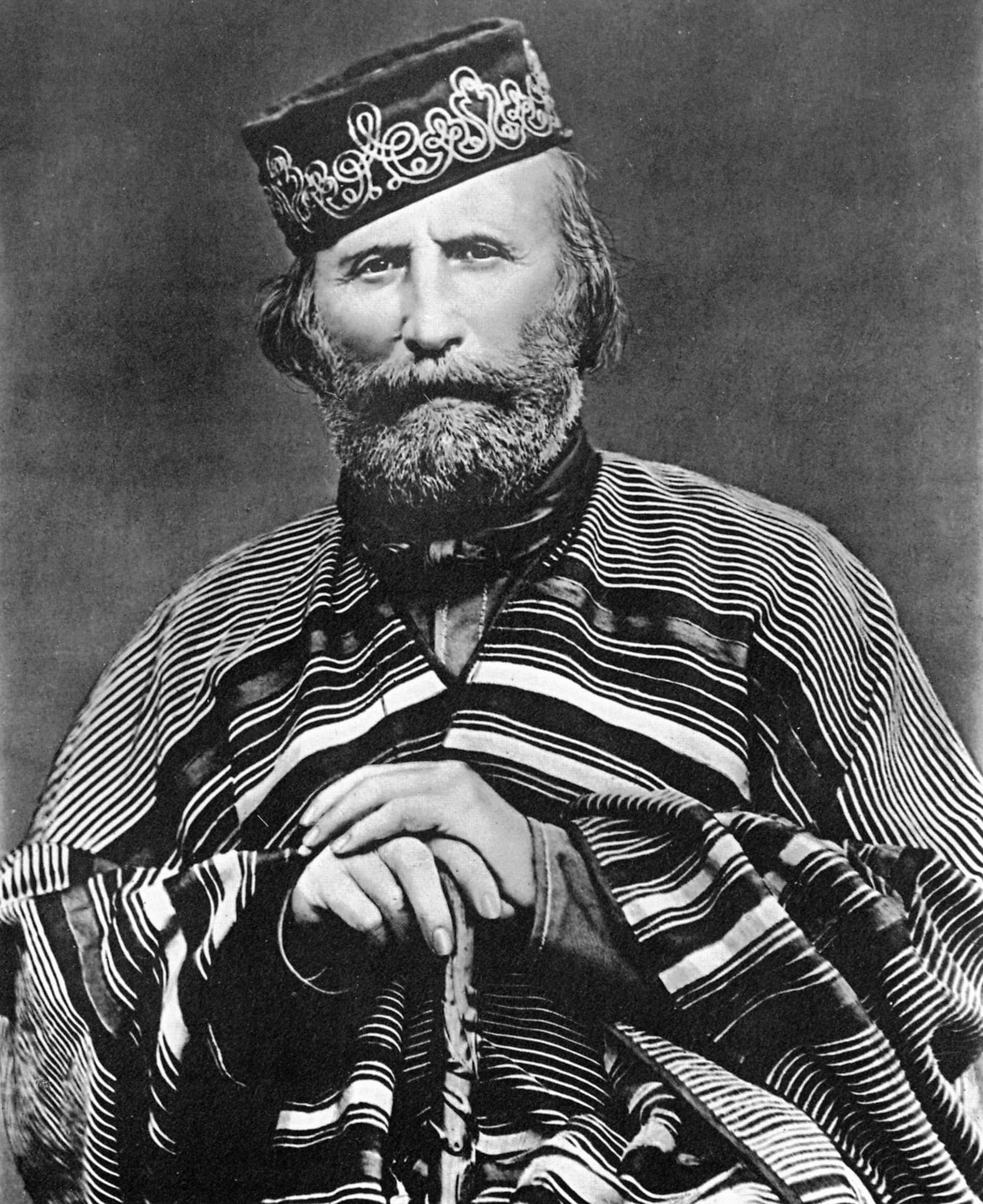
The legend of the Hero of the Two Worlds was forged not on the battlefields of Europe, but in the guerrilla skirmishes of South America.
In August 1842, off the steep, wind-scoured cliffs of the Argentinian coast, an aging Irish-born admiral named William Brown cornered a small, desperate flotilla. The commander of the trapped fleet was a young, sunburned Italian exile who had spent his youth sailing the Mediterranean and his recent years fighting other people's revolutions in the South American wilderness. Outgunned and completely out of ammunition, the Italian chose to burn his own ships to the waterline rather than surrender them, escaping into the marshes under a hail of gunfire. When Brown’s officers urged a final, relentless pursuit to finish him off, the old admiral shook his head. "Let him escape," Brown remarked, in words that would ripple across two hemispheres. "That gringo is a brave man."
The brave gringo was Giuseppe Garibaldi, and he was already constructing the myth that would eventually reshape the map of Europe. Born in Nice in 1807—during a brief window when the city had been annexed by the French Republic—Garibaldi was a child of the borderlands, claimed by both France and the Kingdom of Sardinia. To escape the stifling trajectory of a clerical education, he fled his home as a youth and took to the sea, joining his father in the coastal trade. But the quiet life of a merchant sailor was shattered in 1833 in the Russian port of Taganrog over a shipment of oranges. There, Garibaldi met Giovanni Battista Cuneo, a member of "Young Italy"—the clandestine movement founded by the romantic republican Giuseppe Mazzini, who dreamed of a unified, democratic Italian peninsula. Garibaldi was instantly converted. Within months, he had joined the revolutionary Carbonari, initiated a mutiny aboard a Sardinian frigate in Genoa to coincide with a Mazzinian invasion of Piedmont, and found himself condemned to death by default when the plot collapsed.
Fleeing across the Atlantic, Garibaldi spent fourteen years in exile, transforming himself into a master of guerrilla warfare. In the vast, marshy stretches of southern Brazil, he took up the cause of the rebel "Ragamuffins" trying to carve out the Riograndense Republic. It was a brutal conflict of small boats, sudden cavalry charges, and severe physical trials; during one capture, Garibaldi was subjected to torture that dislocated his limbs. Yet the wilderness also gave him his most enduring partner. In 1839, he met Ana Maria de Jesus Ribeiro da Silva—Anita—a fiercely independent Brazilian woman who became his wife, his fellow soldier, and his constant companion. She rode beside him through the pine forests and coastal lagoons, once fighting her way off a smoking warship during a naval engagement. Moving to Montevideo, Uruguay, Garibaldi raised the "Italian Legion" to defend the city against the Argentine dictator Juan Manuel de Rosas. Lacking standard uniforms, his legionaries clad themselves in heavy red wool shirts obtained from a local factory that had intended to export them to the slaughterhouses of Buenos Aires. Coupled with a gaucho poncho, a wide-brimmed hat, and a black flag bearing a smoking volcano, the Redshirt was born: a visual brand that would soon capture the imagination of the Western world.
12 links to entries not yet ingested in the Library.
By 1848, the scent of revolution was drifting across the Mediterranean, and Garibaldi returned to a peninsula in flames. His relationship with Mazzini was already showing its first fractures; while Mazzini was an unyielding republican theorist, Garibaldi was a pragmatist who understood that the dream of a unified Italy required bayonets, even if those bayonets belonged to a king. He offered his sword to Charles Albert of Sardinia, who received the condemned rebel with cold suspicion. Rebuffed, Garibaldi took his volunteers to Rome, where a short-lived Roman Republic had been declared after the Pope fled. Here, Garibaldi performed military miracles, defeating a superior French army at the Porta San Pancrazio on April 30, 1849, remaining in his saddle all day despite a painful wound in his side. But the weight of French, Austrian, and Neapolitan arms was too great. When the Roman Assembly debated surrender, Garibaldi entered the chamber covered in dust and blood, declaring, "Wherever we will go, that will be Rome."
What followed was a retreat of Homeric proportions. Pursued by four foreign armies through the rugged spine of the Apennines, Garibaldi’s force of four thousand volunteers dwindled to a handful. Most of his captured legionaries were summarily shot. In the pine forests near Ravenna, Anita, pregnant and burning with malaria, died in his arms. Devastated, hunted, and unable to reach the besieged republican holdout of Venice, Garibaldi was smuggled across the peninsula by sympathetic peasants and fishermen to Tuscany, escaping once more into exile. In New York, the great general of the Roman Republic worked quietly as a candle-maker and trading skipper, saving enough money to return to Italy in 1854 and purchase half of the barren, wind-swept island of Caprera off the coast of Sardinia. It was here, among the rocks and wild rosemary, that he built a simple whitewashed house that would remain his emotional anchor for the rest of his life.
The climax of Garibaldi's life came in 1860, a year of political theater and raw military audacity that stunned Europe. Nominally allied with the Piedmontese prime minister Camillo Benso di Cavour and King Victor Emmanuel II, Garibaldi grew furious when Cavour ceded his native Nice to France to secure French support against Austria. Determined to force the pace of unification, Garibaldi, alongside conspirators like Francesco Crispi, planned an invasion of the Kingdom of the Two Sicilies. On May 5, 1860, he sailed from Genoa with two small steamers and a mere 1,070 volunteers—the legendary "Expedition of the Thousand." Landing at Marsala under the protective, silent gaze of two British warships, Garibaldi proclaimed himself dictator of Sicily in the name of Victor Emmanuel II.
The campaign was a succession of impossibilities. At Calatafimi, his outnumbered, poorly equipped Redshirts routed Neapolitan regulars with bayonet charges up steep terraces. By late May, they had taken Palermo; by July, they had forced the capitulation of twenty thousand royal troops at Milazzo and Messina. Crossing the Strait of Messina in defiance of Cavour's attempts to restrain him, Garibaldi marched north through Calabria in what became a triumphal procession. On September 7, he entered Naples not at the head of an army, but in a train carriage, cheered by ecstatic crowds while the Bourbon King Francesco II fled to the fortress of Gaeta. On the Volturno River, Garibaldi's now swollen army of volunteers shattered the final, forty-thousand-strong remnant of the Bourbon forces.
Yet the ultimate test of Garibaldi's patriotism was not victory, but surrender. As he prepared to march on Rome to complete the unification, Cavour and Victor Emmanuel, terrified that an attack on the Pope would provoke a French invasion, sent Piedmontese troops south to intercept him. Rather than plunge his newly born nation into a civil war, Garibaldi chose self-effacement. On November 7, 1860, he rode into Naples side-by-side with Victor Emmanuel II, handing over a conquered kingdom of nine million subjects to the Piedmontese monarch. Refusing all titles, land, and wealth, the "Hero of the Two Worlds" boarded a ship back to Caprera with nothing but a bag of seed corn and a small supply of dried cod.
The final two decades of Garibaldi's life were defined by a restless, often bitter impatience with the kingdom he had helped create. Twice, in 1862 and 1867, he grew frustrated with the diplomatic delays regarding Rome and raised volunteer armies to seize the city. Both times, the Italian government, fearing international ruin, stopped him by force. At Aspromonte in 1862, he was shot in the foot and taken prisoner by the very Italian troops he had once led to victory. Yet whenever a legitimate war of liberation broke out, his sword was ready. During the Third Italian War of Independence in 1866, his Alpine volunteers won a string of victories against the Austrians, but just as he was poised to take Trent, he was ordered by the regular army to retreat. His reply was a single, famous telegram: Obbedisco—"I obey."
Giuseppe Garibaldi died on his beloved island of Caprera in June 1882, surrounded by the sea that had defined his youth. He left behind a world that had made him a secular saint of the nineteenth century, admired by figures as diverse as Victor Hugo, Charles Dickens, and Abraham Lincoln, who had once offered him a command in the American Civil War. Unlike the calculating Cavour or the monarchical Victor Emmanuel II, Garibaldi belonged to the romantic, popular imagination. He was a revolutionary who fought not for dynasty or territory, but for the self-determination of peoples, leaving behind the blueprint of the citizen-soldier and a name that would inspire liberation movements across the globe for a century to come.