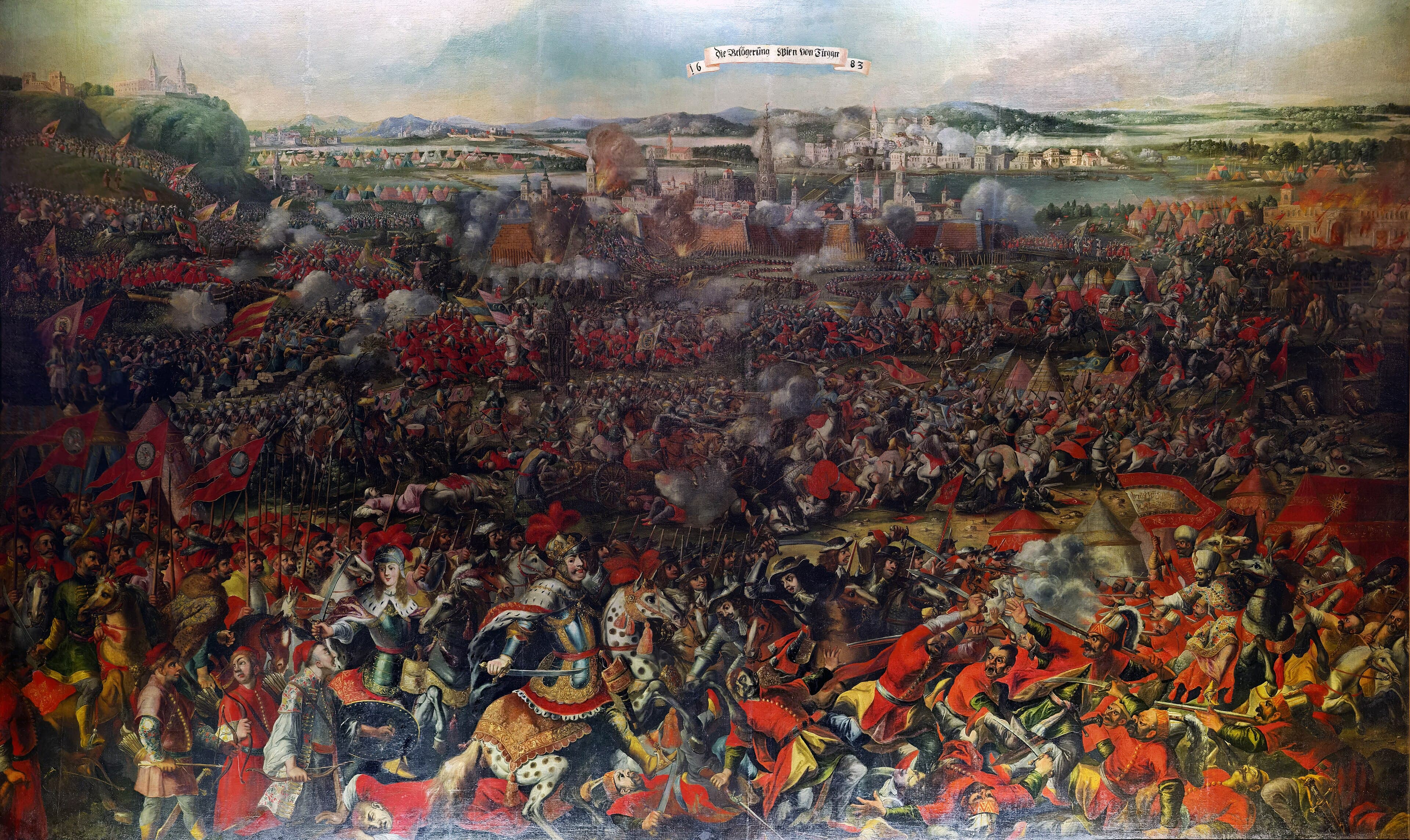
For two months in the summer of 1683, the Ottoman Empire held the city of Vienna in a choking siege, the culmination of a century and a half of geopolitical friction and a long-held strategic dream to control the Danube and the lucrative overland trade routes into Germany.
In the late summer of 1683, the fields surrounding Vienna were reduced to a scorched, subterranean nightmare. For nearly two months, the capital of the Holy Roman Empire had been choked by a ring of ninety thousand Ottoman soldiers, their tents stretching across the horizon like a canvas metropolis. Under the direction of the Grand Vizier, Merzifonlu Kara Mustafa Pasha, the besiegers had eschewed a simple blockade in favor of a ferocious, burrowing assault. Trenches snaked toward the city walls like black veins, while five thousand expert Ottoman sappers labored in the dark beneath the earth, planting vast chambers of gunpowder under the bastions. Inside the city, Count Ernst Rüdiger von Starhemberg, the governor of the garrison, was running out of time, space, and men. He ordered that any soldier found asleep on watch be shot immediately. The air was thick with the stench of decay and the relentless concussions of artillery. By early September, Ottoman mines had blown open gaps forty feet wide in the city’s outer defenses, and the defenders were preparing to fight block-by-block through the rubble of their own streets.
The siege was the climax of a geopolitical rivalry that had simmered along the Danube for a century and a half, ever since the failed Ottoman siege of 1529. For the Ottoman Empire, Vienna was the "Golden Apple," the supreme strategic prize that commanded the overland trade routes to Germany and the Eastern Mediterranean. Kara Mustafa Pasha had spent years quietly laying the groundwork for this campaign. Under his administration, roads and bridges stretching through the Balkans and into the Holy Roman Empire were meticulously repaired, while armaments and grain were stockpiled in forward logistics hubs. The political terrain was equally prepared. Deep within Habsburg-occupied Hungary, a populace exhausted by Emperor Leopold I’s aggressive Counter-Reformation policies had risen in open rebellion. The Protestants and anti-Habsburg insurgents, led by the charismatic Imre Thököly, turned to the Ottomans for assistance. Recognizing Thököly as the King of "Upper Hungary," the Sublime Porte promised him the "Kingdom of Vienna" itself if the city fell, turning a sectarian civil war into a vanguard for an imperial invasion.
When the Ottoman war machine finally mobilized in the spring of 1683, it shattered a twenty-year peace established by the Treaty of Vasvár. The scale of the movement was staggering. Over 150,000 men, including a massive contingent of Crimean Tatars, marched northward, joined by Hungarian and Transylvanian allies. As the vanguard approached in July, the imperial court panicked. Emperor Leopold fled Vienna for the safety of Passau with sixty thousand citizens, leaving Starhemberg with a mere fifteen thousand soldiers and a hastily assembled group of eight thousand civilian volunteers. They were protected by a medieval wall and a century-old outer palisade that was, in many places, entirely rotten. To buy time, the Viennese demolished the houses directly outside the walls to deny the enemy cover, and furiously hammered heavy tree trunks into the earth to reinforce the decaying palisades. This desperate woodwork, combined with the weeks the Ottomans spent methodically digging trenches to shield their troops from the defenders’ 370 cannons, slowed the Grand Vizier’s progress. Some argued that Kara Mustafa delayed his final, devastating infantry assault because he wanted to preserve the city’s immense wealth intact for his own treasury, rather than see it destroyed in a chaotic, general sack by his soldiers.
+ 12 further connections to entries not yet ingested
Whatever the Grand Vizier’s motives, the delay proved fatal. The fifteen-month window between the initial Ottoman mobilization in 1682 and the siege had given Europe’s divided Christian powers time to forge an unlikely defensive coalition. Pope Innocent XI helped underwrite the alliance, while the Duke of Lorraine, Charles V, kept the imperial army intact on the north bank of the Danube, even defeating Thököly’s insurgent forces at Bisamberg in August. Most crucially, the treaty signed in Warsaw earlier that year bore fruit. King John III Sobieski of Poland, a commander of immense prestige who had spent decades fighting the Ottomans, pledged to march to Leopold’s aid. Sobieski left Kraków on August 15, leaving his own kingdom largely undefended and ignoring the delay of his Lithuanian allies under Kazimierz Jan Sapieha, who was distracted by campaigns in the Hungarian Highlands.
On September 6, the Polish army crossed the Danube at Tulln, uniting with the Imperial forces and additional contingents from Saxony, Bavaria, and Baden. This relief force, now seventy to eighty thousand strong, was placed under the supreme command of Sobieski. Yet, even as they marched toward the besieged capital, the alliance was strained by bitter logistical squabbles. The Polish king flatly refused to pay for his army’s provisions while on German soil, arguing that his crown was already spending its own blood to rescue the Emperor's capital; the Habsburgs, desperate and depleted, scrambled to raise the cash to appease both the Poles and their German allies.
On September 11, the relief army reached the heights of the Kahlenberg, the densely wooded mountain overlooking the Viennese basin from the north. Below them lay a striking panorama of the war: the grand, sprawling camp of the Ottomans, the smoking ruins of the Viennese suburbs, and the battered city walls, where Ottoman sappers had just captured the vital Burg ravelin. Kara Mustafa, confident in his numbers and unwilling to abandon the siege works that were on the cusp of breaking the city, made the critical error of failing to prepare a strong defensive line to his rear, leaving his flank exposed to the rugged terrain of the Kahlenberg.
The battle began at dawn on September 12, 1683. The Christian forces descended from the hills in a multi-pronged assault. The imperial troops on the left flank, led by the Duke of Lorraine, and the German contingents in the center engaged in fierce, grinding combat through the vineyards and ravines of the mountain’s lower slopes, slowly pushing back the Ottoman infantry. Kara Mustafa launched counterattacks, but his forces were divided between holding the trenches against Starhemberg’s starving garrison and facing the fresh, disciplined army descending from the heights.
By late afternoon, the decisive moment arrived. King John III Sobieski, observing the battlefield from the high ground, saw the Ottoman right flank begin to buckle and waver. Emerging from the forest canopy onto the flatter terrain below, Sobieski personally led a massive cavalry charge. Comprising some eighteen thousand horsemen, including three thousand of Poland’s famed "Winged Hussars"—heavy cavalrymen clad in steel plate with great wooden wings arched over their shoulders—it was the largest recorded cavalry charge in human history. The shockwave of this massed iron and horseflesh struck the Ottoman lines with cataclysmic force. The Ottoman ranks, exhausted by hours of fighting and demoralized by the sudden onslaught from the hills, collapsed into a rout. The Grand Vizier’s camp was overrun within hours, and Kara Mustafa was forced to flee into the night, abandoning his banners, his treasury, and the immense spoils of his campaign.
The relief of Vienna was a rupture that reshaped the map of Europe. It ended the era of Ottoman expansion into the Christian West; never again would the armies of the Sultan threaten the gates of Central Europe. In the long war that followed, lasting until the Treaty of Karlowitz in 1699, the Habsburgs consolidated their grip on the continent, driving the Ottomans out of Hungary and establishing themselves as the dominant power of Central Europe. For Poland, the victory was a moment of supreme martial glory, though one that yielded little long-term territorial gain, leaving the kingdom vulnerable in the decades to follow. For Vienna, the victory was memorialized not just in treaties, but in the cultural fabric of the city—in the church bells cast from melted-down Ottoman cannons, and in the enduring mythologies of a frontier shield that had successfully held the line.