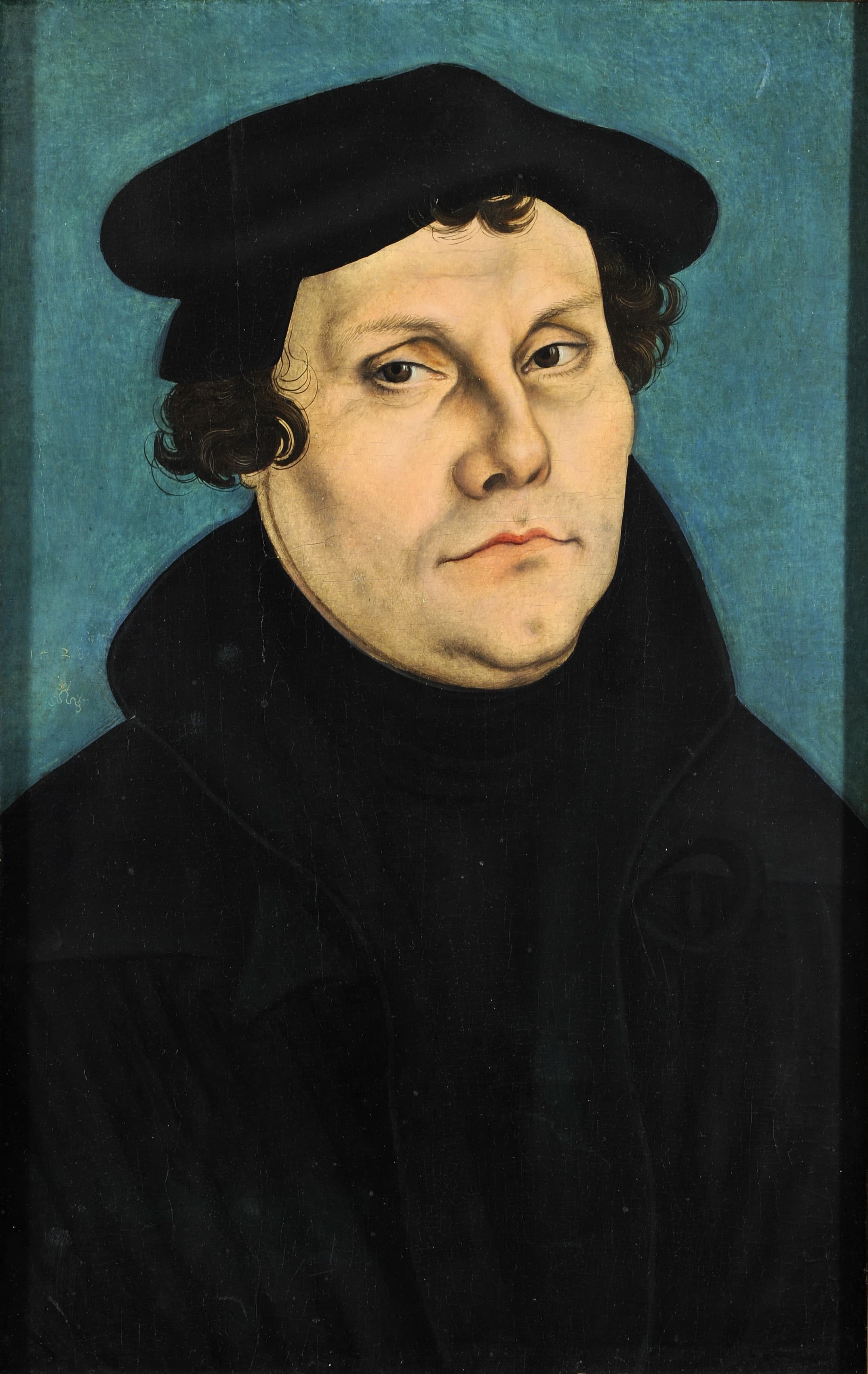
The fracturing of Western Christendom began not with an army, but with a scholar’s doubt.
In the summer of 1505, a young master of arts named Martin Luther was riding back to the University of Erfurt after a visit with his parents. As he crossed the open Saxon countryside, a violent summer thunderstorm broke overhead. A bolt of lightning struck close beside him, throwing him to the ground in the blinding flash and concussive roar. Terrified of sudden death and the imminent, unappeasable judgment of God, the twenty-one-year-old student shrieked a vow into the rain: "Help! Saint Anna, I will become a monk!" He survived the storm, and to the bitter disappointment of his father, Hans—a prosperous leaseholder of copper mines who had spent his hard-earned wealth to educate his eldest son for a lucrative career in the law—Luther kept his word. Within two weeks, he sold his books, said a melancholy farewell to his friends at a final supper, and was walked to the gates of the Black Cloister of the Augustinian Hermits in Erfurt. He was seeking an elusive peace of mind, entering a system designed to manufacture holiness through systematic self-denial. Instead, he had set his foot upon a path that would dismantle the medieval Church.
The world Luther entered was one saturated by a profound, ambient anxiety. The late fifteenth and early sixteenth centuries in central Europe were decades overshadowed by plague, the terrifying advance of the Ottoman Turks, and an intense, popular dread of the afterlife. In the parish church of Mansfeld where Luther had grown up, a stained-glass window depicted Jesus not as a savior, but as a stern judge seated upon a rainbow with a sword in his hand. Under the influence of this fearful revivalism, salvation was viewed as a transaction, a grueling ascent assisted by the intercession of the Virgin Mary and Saint Anna, and won through pilgrimages, the veneration of relics, and the rigorous discipline of the cloister. Luther threw himself into this monastic life with a desperate, agonizing intensity. He fasted, prayed for hours, undertook pilgrimages, and wore out his confessors with hours of relentless self-examination. Yet the more he strove for perfection, the more he felt the weight of his own inadequacy. He later recalled that he lost all touch with Christ as a savior, viewing Him instead as the "jailer and hangman of my poor soul." His superior, Johann von Staupitz, recognizing that this brilliant, tortured young monk was consuming himself in excessive introspection, ordered him to channel his energies into an academic career.
Ordained as a priest in 1507, Luther was sent to the young University of Wittenberg, where he completed his Doctor of Theology in 1512 and succeeded Staupitz as the chair of theology, a position he would hold for the remainder of his life. It was here, while preparing lectures on the Psalms and the epistles of Saint Paul to the Romans and the Galatians, that the intellectual breakthrough occurred. Armed with Erasmus’s newly published Greek translation of the New Testament, Luther began to re-examine the Latin Church’s traditional vocabulary of penance and righteousness. He realized that the "righteousness of God" spoken of by Paul was not a standard of terrifying perfection by which humanity is judged and condemned, but rather a free gift. Justification—the reckoning of a sinner as righteous before God—was not something earned through human effort, merit, or the performance of sacraments. It was a grace received through faith alone. To Luther, this discovery was an existential liberation; it was, he wrote, "as though I had been born again," an entry into paradise itself. Righteousness was not infused into the believer by their own good works; it was the righteousness of Christ Himself, imputed to the believer from the outside.
12 links to entries not yet ingested in the Library.
This private theological realization caught fire when it collided with the financial machinery of the Renaissance papacy. In 1516, the Dominican friar Johann Tetzel arrived in Germany to preach a special plenary indulgence. The proceeds of this sale were destined for a double purpose: half was to fund the grand rebuilding of St. Peter’s Basilica in Rome, and the other half was to help Albert of Brandenburg, the Archbishop of Mainz, repay the massive debts he had incurred to purchase his high ecclesiastical offices from Pope Leo X. Tetzel, an exceptionally effective salesman, preyed upon the spiritual anxieties of ordinary people, offering immediate remission of temporal punishments for sins—both for the living and for loved ones suffering in purgatory—in exchange for coins in his chest. To Luther, this was a grotesque distortion of the Gospel, a cynical trade that promised false security and bypassed the necessity of true repentance. In response, on the eve of All Saints' Day, 1517, Luther drafted ninety-five academic theses challenging the theological validity of indulgences and papal authority, intending them for a localized university debate.
Instead, the Ninety-five Theses acted as a spark in a dry forest. Translated from Latin into German and rapidly distributed by the newly invented printing press, the document gave voice to a deep-seated German resentment of Roman financial exploitation and clerical corruption. What began as an academic dispute quickly escalated into an international crisis. Pope Leo X demanded that Luther recant his writings, but the professor refused, deepening his criticisms of the Roman hierarchy by asserting that the Bible, rather than the pope or church councils, was the sole source of divinely revealed knowledge. Luther rejected the traditional Catholic division between the clergy and the laity, advocating instead the "priesthood of all believers," which stripped the ordained priesthood of its role as an indispensable intermediary between humanity and God. In January 1521, Leo X excommunicated him. A few months later, the young Holy Roman Emperor, Charles V, summoned Luther to the Diet of Worms. Ordered once more to recant his books, Luther refused to yield his conscience to any authority other than Scripture and plain reason. He was declared an outlaw, his writings banned, and his life forfeit.
Though condemned by both the church and the empire, Luther was protected by powerful German princes, notably Frederick III of Saxony, who hid him in the remote Wartburg Castle. In this isolation, Luther undertook one of his most enduring works: translating the New Testament from the original Greek into the vernacular German. His translation did not merely make the scriptures accessible to the common person; written in a vigorous, poetic idiom, it helped shape and standardize the modern German language itself. Luther’s reforms soon transformed the physical and social landscape of northern Europe. He abolished the Latin Mass in favor of vernacular services, wrote hymns that brought congregational singing into the heart of worship, and dismantled the monastic system. His own marriage to Katharina von Bora, a former nun who had escaped her convent, established a lasting model for Protestant clerical marriage.
Yet the movement Luther unleashed quickly fractured, escaping his control and revealing the darker, more volatile currents of his character. In his later years, as he faced failing health and the fragmentation of the reforming movement into competing sects, Luther’s rhetoric grew increasingly bitter and apocalyptic. He turned his pen not only against Rome, but also against fellow reformers who disagreed with his theology, and, most notoriously, against the Jewish population. In his 1543 treatise On the Jews and Their Lies, written after his disappointment that Jews did not convert to his reformed version of Christianity, Luther expressed virulent antisemitic views, calling for the burning of synagogues, the confiscation of Jewish books, and the expulsion of Jewish populations from German territories. Though he did not advocate murder, the violent rhetoric of these late writings left a dark, heavy legacy in German history, one that would be resurrected centuries later with catastrophic consequences.
When Martin Luther died in February 1546 in Eisleben, the very town of his birth, his excommunication was still in effect, and central Europe stood on the brink of devastating religious wars. He was a man of immense contradictions—capable of writing tender hymns of faith and translating the scriptures with exquisite poetic sensitivity, yet equally capable of unleashed fury, vulgarity, and devastating prejudice. By demanding that the individual conscience stand accountable to God alone rather than to the ancient hierarchy of Rome, he shattered the fragile unity of Western Christendom. He left behind a world permanently divided, where the modern concept of individual conscience and the authority of the state would grow in the fertile, fractured soil of the Reformation.