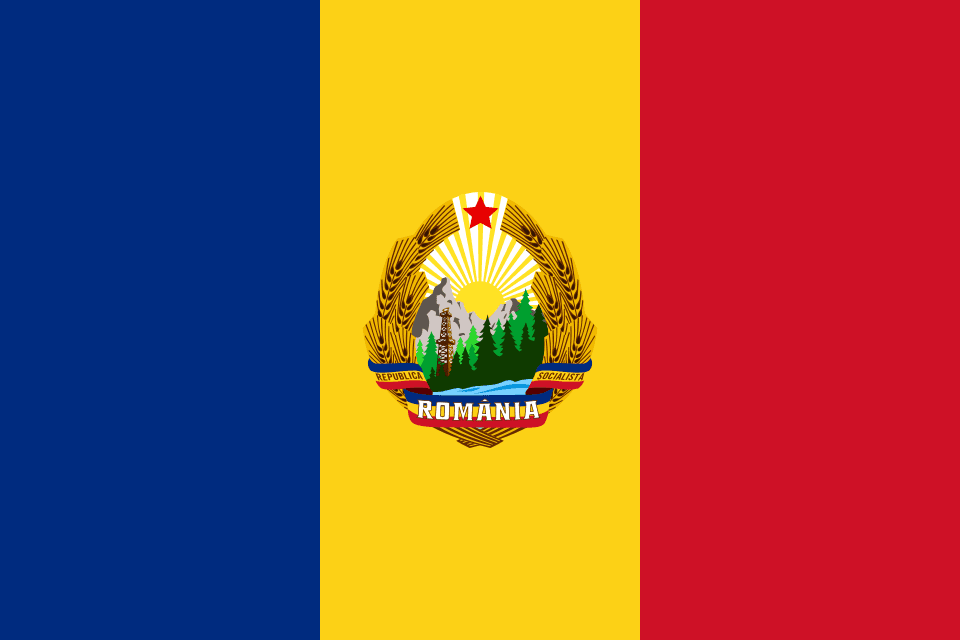
The transformation of Romania from an Axis power into a communist state began not with a popular revolution, but with the quiet, suffocating pressure of Soviet occupation at the close of World War II.
On the final day of December 1947, the Romanian parliament abolished the monarchy and proclaimed a new state. Just hours earlier, King Michael I had been summoned from his palace in Sinaia to the capital of Bucharest by the Prime Minister, Dr. Petru Groza, and the communist leader Gheorghe Gheorghiu-Dej. They presented the young king with a pre-typed instrument of abdication. With pro-communist troops surrounding the palace, his telephone lines severed, and no room for negotiation, Michael signed. The departure of the monarch cleared the final obstacle to the establishment of the Romanian People’s Republic, a state that would redefine the nation’s political, economic, and social fabric until 1965.
This transition was the culmination of a swift, calculated realignment of power that began in the chaotic final years of World War II. In August 1944, King Michael, backed by the country’s major political parties, had overthrown the pro-Axis dictator Ion Antonescu, pulling Romania out of its alliance with Nazi Germany and bringing its forces onto the Allied side. Romanian soldiers fought under Soviet command through Northern Transylvania, Hungary, Czechoslovakia, and Austria. Yet, this late-stage shift could not erase the memory of Romania’s long, active participation in the Axis invasion of the Soviet Union. Treating Romania as a conquered territory rather than a co-belligerent, Soviet forces occupied the country. The Yalta Conference and the subsequent Paris Peace Treaties solidified this reality, granting the Soviet Union a predominant interest in Romania’s postwar destiny.
Under the watchful eye of the Allied Control Commission, the Romanian Communist Party—previously a marginal force—moved steadily toward dominance. In March 1945, political pressure and mass demonstrations led to the installation of a government headed by Petru Groza of the Ploughmen’s Front, a party closely allied with the communists. Though nominally a broad coalition, this administration placed communists in control of key ministries. When King Michael attempted a "royal strike" by refusing to sign any legislation in an effort to force Groza’s resignation, the prime minister simply bypassed the royal signature, enacting laws unilaterally. Tensions spilled into the streets on November 8, 1945, during a pro-monarchy demonstration at the Royal Palace, resulting in street battles and dozens of casualties before Soviet troops restored order.
To build a popular base, the early Groza government enacted land reforms that won favor among southern and eastern peasants, and introduced women’s suffrage, securing the support of educated women. However, the democratic process was rapidly hollowed out. During the parliamentary elections of November 19, 1946, the Communist-led Bloc of Democratic Parties claimed 84 percent of the vote in an election marked by intimidation, violence, and systematic fraud. With the machinery of state in hand, the communists systematically dismantled the opposition. High-ranking members of the wartime pro-Axis government, including Antonescu, were executed as war criminals. The centrist National Peasants’ Party was destroyed in 1947 after its leaders were accused of espionage following secret meetings with United States officials; its leadership was jailed, and other political groups were forced to merge with the communists.
+ 6 further connections to entries not yet ingested
With the king’s forced abdication, the Romanian People’s Republic was formalized under the constitution of April 13, 1948. Modeled closely on the 1936 Soviet Constitution, the document guaranteed a wide array of civil liberties on paper but banned any association of a "fascist or anti-democratic nature." This elastic clause provided a legal veneer for the total suppression of political dissent. In February 1948, the communists merged with the Social Democrats to form the Romanian Workers’ Party, though independent-minded socialists were quickly purged, leaving the remaining non-communist leadership either imprisoned or in exile.
This total political control allowed the regime to reshape Romanian society. In 1948, the government nationalized all banks and large businesses. Religion was heavily targeted; while the constitution maintained a pretense of religious freedom, the state actively promoted Marxist-Leninist atheism and nationalized church properties, including schools, to diminish the social influence of the clergy. Rather than attempting to eradicate religion entirely, the regime sought to co-opt it, forcing the dissolution of the Romanian Greek-Catholic Uniate Church and declaring its merger with the Romanian Orthodox Church.
The early years of the People’s Republic were characterized by severe economic strain and intense internal power struggles. Under the "SovRoms"—tax-exempt, joint Soviet-Romanian joint-stock companies—the Soviet Union took direct control of Romania’s primary sources of income. These agreements, combined with heavy postwar reparations, allowed the Soviets to drain the country’s resources, shipping Romanian goods to the Soviet Union at nominal prices.
Inside the Romanian Workers’ Party, three Stalinist factions vied for control, distinguished not by ideology but by their wartime experiences. The "Muscovites," led by Ana Pauker and Vasile Luca, had spent the war years in exile in Moscow, while the "Prison Communists," led by Gheorghe Gheorghiu-Dej, had spent the war years in domestic prisons. Backed by Joseph Stalin, Gheorghiu-Dej eventually triumphed. Pauker was purged from the party alongside 192,000 other members, and rival Lucrețiu Pătrășcanu was executed after a show trial.
This political consolidation took place against a backdrop of intense domestic repression. During the Stalinist era of the 1950s, tens or even hundreds of thousands of Romanians were arrested, sent to labor camps, or died in custody for political and economic reasons. Between 1945 and 1964, the state carried out 137 official judicial executions, though this figure represents only a fraction of the total lives lost to the prison system and forced labor projects of the era.
Following Stalin’s death in 1953, the character of the Romanian People’s Republic began to shift. Gheorghiu-Dej, a resolute Stalinist, grew deeply uncomfortable with the reformist, de-Stalinizing path taken by Nikita Khrushchev in the Soviet Union. He also strongly resisted plans by the Council for Mutual Economic Assistance (Comecon) to keep Romania as an agricultural "breadbasket" for the Eastern Bloc, opting instead to pursue an aggressive economic program centered on heavy industry and energy production. In a bid to secure domestic stability and signal a change of direction, the government closed its largest labor camps, abandoned the costly Danube–Black Sea Canal project, ended food rationing, and raised workers’ wages.
To safeguard his regime from Soviet interference, Gheorghiu-Dej steered Romania toward a more independent, nationalist course. He declared that Romania would cooperate with any state, regardless of its political-economic system, provided it respected international equality and non-interference in domestic affairs. This policy brought Bucharest closer to Beijing, which similarly opposed Soviet hegemony. Even as Romania maintained its membership in the Warsaw Pact, which it had joined in 1955, it began asserting its sovereignty. By 1958, the regime successfully negotiated the complete withdrawal of Soviet military forces from Romanian soil.
This nationalist-communist model laid the groundwork for significant domestic changes. Between the 1950s and the 1970s, the state achieved high rates of economic growth and oversaw major improvements in literacy, urbanization, life expectancy, and infant mortality, alongside a formal expansion of women’s rights. Yet this developmental success came at a steep human cost, built upon the foundations of the earlier terror.
When Gheorghiu-Dej died in 1965, he left behind a highly centralized state that had successfully carved out a degree of autonomy from Moscow while maintaining a rigid domestic order. His successor, Nicolae Ceaușescu, assumed leadership of the party in 1965, ushering in a new constitutional era that changed the state’s name to the Socialist Republic of Romania. The era of the People’s Republic had ended, but the institutions, the heavy industrial apparatus, and the security state forged during those seventeen years remained the bedrock of the regime. The legacy of this period—marked by the violent elimination of the prewar order, economic subservience to the Soviets, and the eventual rise of a fiercely independent national stalinism—would shape the country's path until the collapse of the socialist system in December 1989.